Houthis Threaten the Port City of Aden
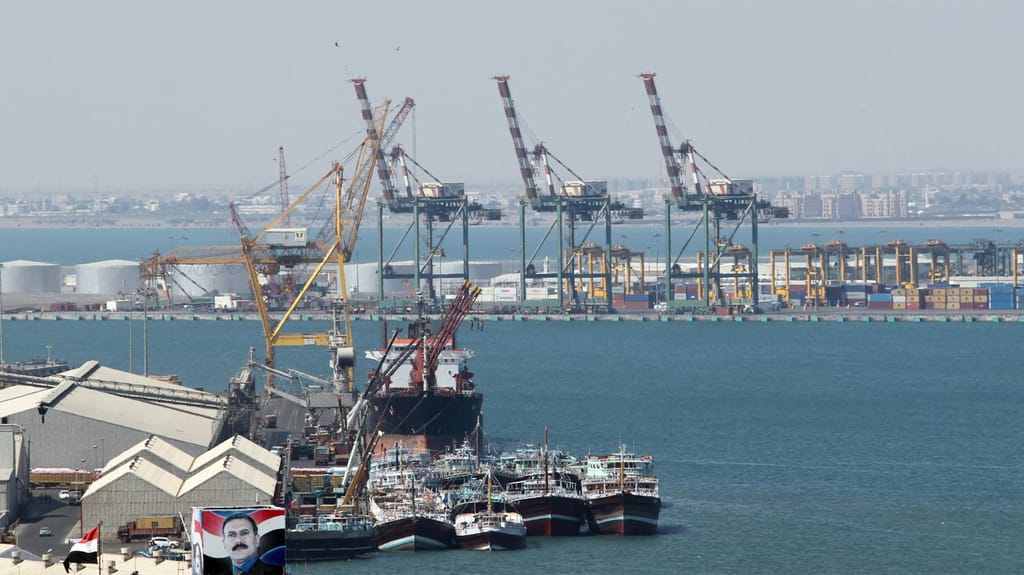
Confused fighting is continuing between the Houthis and forces of the Internationally Recognized Government (IRG) in Yemen. It is being made all the more confusing because of the fierce information war being fought between the two sides using false accounts and misleading reports on social media.
IRG forces appear to be holding their own in the Marib area, an important hold both because of its oil fields and because it abuts the Saudi border; while the Marib remains in IRG hands, the southern Saudi border is protected from major incursions.
But elsewhere, developments on the battlefield taken together suggest that the Houthis are making an attempt to cut off Aden, the provisional seat of the IRG government, from the rest of the country and from IRG-held territory in the east of the country.
The Houthis have consolidated the recapture of the Ras Menhali peninsula and Perim Island overlooking the Bab el Mandeb entrance to the Red Sea. They have continued their advance along the coastline and the hills to the north of the coastline, eastwards towards Aden. In the flat, open strip bordering the sea and along the N2 highway towards Aden, Houthi forces have paid heavily in casualties for their advances, being exposed to Saudi and IRG air attacks. Saudi air attacks have increased significantly since Lt Gen Fayyadh Al Ruwaili, chief of staff of the Saudi Armed Forces, also took on direct responsibility last week for prosecuting the war as Chief of the Joint Forces Command.
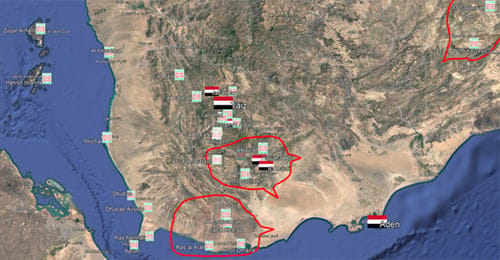
A confused battlefield but three areas where Houthi advances threaten Aden: locations noted as being in Houthi or Government hands on November 20 (Google Earth/CJRC)
Further north, the Houthis have continued to seize territory in the mountainous area south of Taiz, attempting to complete the cutting of routes from Aden into Taiz. Given the nature of the terrain, some entry and exit into Taiz probably remain possible, but the main truck routes into Taiz are probably severed, although the IRG defense of Taiz city itself remains robust.
To the northeast of Aden, the Houthis have made advances towards the city from the direction of the Al Bayda Governorate, which, if they continue, would threaten the IRG’s communications links both with the Marib and with the Hadramaut and Al Mahra Governorates in the east, which have been largely isolated from the fighting.
In summary, the Houthis have been making advances but have been doing so at some cost. With strained logistics, the Houthis will eventually run out of resources to maintain their advance. Meanwhile, the IRG, although the situation is perilous and the coalition is still suffering from disunity within its ranks, has not given up. Indeed, in some areas the IRG are holding their positions and making some advances.

that matters most
Get the latest maritime news delivered to your inbox daily.
The immediate danger, however, is that the Houthis will manage to close on Aden and place it under siege. Whilst it would be difficult for the Houthis to capture a densely built-up area against resistance, a threat to Aden could upset the political balance within the coalition of forces which make up the IRG, and it could also prove catastrophic for the IRG defenders of Taiz if they were to be completely isolated. But a Houthi capture of the port of Aden and a substantial chunk of the southern Yemeni coastline would also have major regional implications, and would no doubt soon result in the closure of the Bab el Mandeb in coordination and mutual support of IRGC efforts in the Strait of Hormuz.
Besides the fact that the IRG defense has not yet collapsed, the other source of hope is that the prominent Yemeni analyst Mohammed al Basha, has been called in to brief the White House, and hence there should be some awareness, in the right places, of the implications and wider potential regional ramifications of the current situation in Yemen.