


The IRGC's Hormuz Toll System is Unlikely to be Exposed
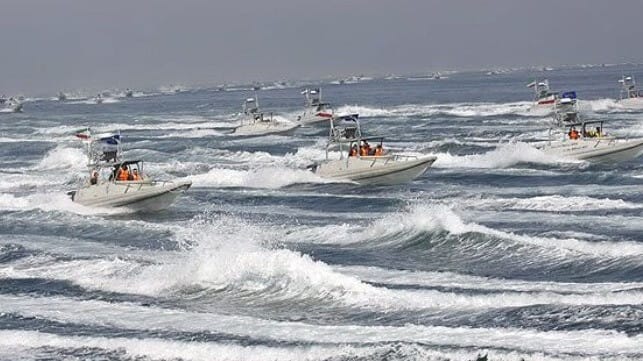
Tasnim and Fars, both IRGC-linked semi-official news agencies in Iran, have claimed that Strait of Hormuz transit fees are being deposited into the ‘national treasury’.
These claims are being carried by a number of media outlets, notwithstanding the lack of any evidence presented as to who has paid what fees, and without clues as to which institution might be the ‘national treasury’. Any successful underworld enterprise normally demands money from a criminal transaction before the goods or services are handed over, so it would seem strange that in this case the money is supposedly being banked long after the released tanker has sailed far away to safety with its valuable cargo aboard.
Nonetheless, the IRGC has years of experience in handling covert payments, and has a sophisticated network in place using front companies in third countries for both paying for services that it needs and also for goods, often weapons-related. This IRGC expertise is rooted in the heavy historical use by the Iranian bazaar and business community of the traditional hawalah payment system. The IRGC modern system is now used for civilian purposes, so as to evade sanctions, but also for the support of proxy organizations abroad within its Axis of Resistance structure. The same system is also used by corrupt but protected businessmen in Iran with strong or family connections to members of Iran’s religious elite, such as Hossein Shamkani and Babak Zanjani. Thus the IRGC has for a long time had the necessary infrastructure in place to handle and receive covert payments.
There will be ship-owners and others who will certainly be willing to pay the $1 per barrel toll fee which the Iranians have quoted. Such a fee is a very small percentage of the arbitrage which a "pirate" tanker-owner might be able to profit from, if he or his broker is selling the cargo when it has a scarcity value. So the likelihood is that such fees are being paid by such "pirate" ship-owners either wanting to take advantage of inflated prices, or who wish to get the capital tied up in ownership of a ship working again.
Nobody paying a transit fee will however be prepared to admit that he has done so, or how he has gone about doing so. To pay such a fee to any Iranian, let alone an entity connected with the IRGC, is a breach of US OFAC Sanctions, rendering those who might have paid a transit toll liable to huge US Treasury fines. Moreover, Admiral Cooper and the sailors of CENTCOM have stated that any ship which has paid transit tolls is liable to stoppage and seizure in the blockade, and its master might well face imprisonment. From the huge numbers of front organizations used by the IRGC that have been sanctioned by OFAC, a front company only has a limited time free from surveillance before the US Treasury becomes aware of its true identity, and who it has been dealing with.
For the master or a ship-owner contemplating paying a transit fee, the potential for being defrauded is very high. As indicated above with reference to criminal networks, the payment system proposed will be unorthodox and unverifiable: you are handing over money on trust to people who are intrinsically deceptive. Another difficulty is that any ship making a transit of the Strait of Hormuz has to contact three separate agencies on Channel 16, an open channel, to gain clearance to proceed: the IRGC Navy (colloquially referred to as the Sepah), the regular Navy and the Iranian Coastguard. As the master of the VLCC tanker Sanmar Herald (IMO 9330563) discovered on April 18, gaining clearance from one agency, possibly having made a payment, does not necessarily mean clearance has been given by all, in particular as these three Iranian agencies may be in competition or conflict with each other.

that matters most
Get the latest maritime news delivered to your inbox daily.
Similarly, even governments seeking to gain clearance for one of their flagged vessels to leave through the Strait face difficulties determining if the entity they are negotiating with has sufficient authority with the forces on the ground, principally the IRGC Navy, for any laissez faire issued to be honored at the tactical level. The Indian and Pakistani governments have both had some successes in gaining diplomatic clearances for particular vessels, but also suffered some failures.
Many others, such as the Thai government, have sought to use the good offices of Oman as a channel through which to deal with Iran, again with limited success. But even the Omanis, with their detailed understanding of how the Iranian governmental system works, cannot necessarily coordinate an Iranian response across all stations of what is now a very fragmented Iranian governmental system. However, Oman is likely to try to assist, being strong advocates on humanitarian grounds of respecting the current rules for free and innocent passage through the Strait, rules which are enshrined in international law to which Iran is a signatory.
The opinions expressed herein are the author's and not necessarily those of The Maritime Executive.
