

Keeping Crimea and Kherson Supplied Stretches Russian Resources
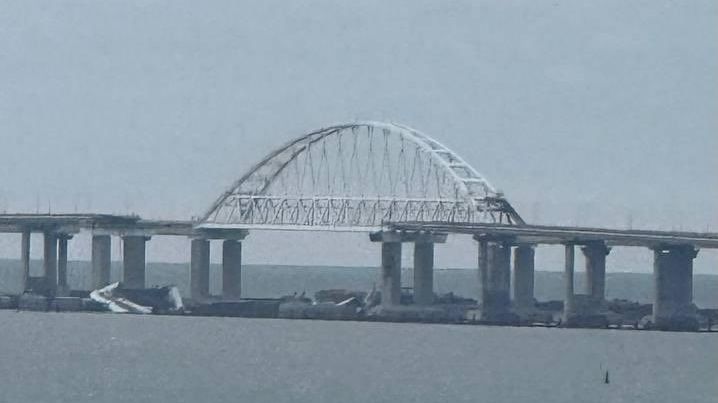
Russian logisticians must have been planning for some time how to do without a supply route over the Kerch Bridge. Even so, the long-term destruction of roadways and damage to the railway component of the bridge on November 17 adds to the difficulties of maintaining deliveries – not only of military supplies to troops holding the front line in occupied southern Ukraine, but also to the largely Russian civilian population of Crimea.
Even when the Ukrainians finally drop the last remaining railway span of the bridge into the Kerch Strait, sometime soon, the Russians will still probably manage to cling on in Crimea. But this is a struggle which comes at a cost, drawing away the resources needed to keep the supply lines open which otherwise might have been employed capturing more Ukrainian territory or attacking Ukrainian power stations, hospitals and educational facilities.
As an alternative to using the bridge, the Russian authorities have three main transport channels.
There may still be two ferries plying between Kerch and the port of Kavkaz. Both the Lavrentiy (IMO 8647866) and the Panagia (IMO 8647751), the last of a formerly five-strong fleet, have been attacked previously and require towing and tethering by tugs. Civilian traffic had been banned on these two ferries previously, so there is now no exit for civilian vehicles over the Strait.
Passengers for the time being can still use the train over the bridge. Several trains, including trains from Moscow, have been seen crossing the bridge at slow speeds since the bridge was attacked. The Russians have now opened a free foot-passenger ferry service from Krym to Port Kavkaz, for those nervous about using the bridge, but have found it necessary to ban passengers from carrying petrol cans on board as hand luggage. Previously banned, fuel rail cars are also probably now being hauled across the bridge, given that road tankers can no longer cross.
The second communication channel uses road and rail routes hugging the Sea of Azov, through Mariupol and Melitopol. This has now become a dangerous corridor, with Route 280 now littered with dozens of burned-out vehicles, given that the road and rail lines are within the range of drones launched from behind the Ukrainian front line 50 miles to the north. Choke points and bridges as well as military logistic traffic are regularly attacked on this route, causing delays and diversions. Both road and rail routes have to use one of three vulnerable bridges into Crimea across the marshes and lakes of the Perekop Isthmus and the Henichesk Strait.
These routes are sporadically open but dangerous, not suitable for civilian traffic, and need to be defended by anti-drone and missile units. There is a cost to keeping this corridor open, drawing in surveillance and air defense resources to protect a broad swathe of territory and critical points, resources which otherwise are desperately needed on the front line. This is a similar problem to that being experienced by the Russian Navy, which is having to devote more and more of its diminishing fleet of fighting ships to protecting itself plus merchant and dark-fleet shipping on the high seas.
Finally, although the Kerch Strait itself is closed for the moment to shipping traffic, coastal vessels can still risk passage across the Sea of Azov from Rostov to Mariupol and Berdiansk. However, the northeastern coast of the Crimea, famed for its sandy holiday beaches, is bereft of cargo-handling ports. The only suitable facilities are in the worst position possible, on the eastern tip of the Kerch peninsula just to the north of the bridge.
The attack on the Kerch Bridge and the squeeze of Russian logistic chains can now clearly be seen as part of a Ukrainian long-term strategic approach to ending the war. The aim is to destroy the logistic underpinning of the Russian presence in the southern half of occupied Ukraine, which will leave Russian forward forces in Zaporizhzhia, Kherson and the Crimea exposed and under-resourced. Contrary to suggestions that the Ukrainians (and their European allies) do not have a plan for ending the war, it appears that the Ukrainians do indeed have a plan, except they haven’t briefed the Russians (or their friends) on what this plan is.
If anyone knows how the Russians think, it is the Ukrainians, many of whom started life in the Soviet Union and its military machine. The attack on the Kerch Bridge was not a knockout blow, but part of increasing pressure which the Ukrainians are applying across a number of fronts.
Some respected experts, such as Mark Galeotti, writing in the Sunday Times, suggest that the Kerch Bridge attack, and that on RFS Merkury in Benghazi harbor, are designed to provoke a dramatic Russian escalation of the conflict. But it looks more as if the Ukrainian plan is to gradually increase pressure, without providing an excuse for the Russians to go nuclear or to take other dramatic action, so that it will slowly dawn upon them that they cannot win – and therefore need to start negotiating seriously. This would entail the Russians abandoning their current red-line negotiating position, which amounts to a demand that the Ukrainians should surrender nationhood and give up sovereignty.

that matters most
Get the latest maritime news delivered to your inbox daily.
In many respects, the Russian position is similar to that of the IRGC-dominated regime in Iran. Both Russia and Iran are facing increasing external pressure but remain obdurate in their negotiating positions, while their adversaries look settled, maintaining pressure at little risk and gradually establishing dominance. Both Russia and Iran are ruled by leaders who are isolated from and impervious to domestic criticism, whether it be over the astonishing and appalling Russian death toll or, in Iran’s case, domestic unrest and the disintegration of a functioning economy able to keep its population warm and fed.
Politically, it’s a question of how long the regimes in Russia and Iran can hold out against rising popular discontent, juxtaposed against how long their opponents can stick to their strategy of gradually increasing pressure.
The opinions expressed herein are the author's and not necessarily those of The Maritime Executive.