

Ukraine Economy Headed for Recession Because of Russian Blockade
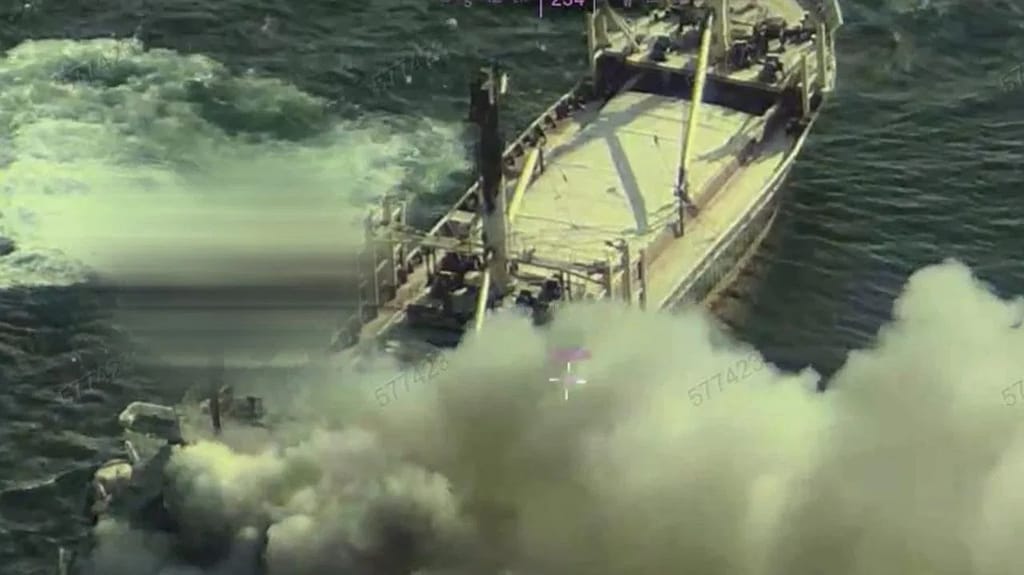
Inability by war-ravaged Ukraine to export commodities due to the continuous blockade of its Black Sea ports is set to have devastating impacts on the economy in the coming year, an independent think tank in the country has warned.
The Center for Transport Strategies (CFTS) reckons that following the emergence of the Black Sea as the deadliest shipping route in the world due to Russia’s increased attacks on commercial shipping, the Ukrainian economy could sink into recession in 2027 if the blockade of ports in the Odesa region persists.
In recent months, the Black Sea has become the most dangerous shipping route for commercial shipping. Data by maritime security company Ambrey show that in the period between July and September, a total of 387 vessels were attacked, with Russia being responsible for 90 percent of the attacks. Since the beginning of the year, more than 570 vessels have been targeted, with at least 40 seafarers being killed.
Owing to the increased attacks, commercial vessels are now keeping away from the Black Sea waters, the impact of which has been a significant plunge in traffic. In September, the ports of Greater Odesa handled fewer than 10 vessels, a massive drop from about 400 ships in July. The drop in vessel numbers is having a devastating impact on Ukraine, with the exports of critical commodities like grain, oil and other cargo badly affected across its ports of Odesa, Chornomorsk and Pivdennyi.
CFTS is now raising the red flag that if the blockade persists, Ukraine’s economy will plunge into a recession with negative 2.9 percent growth in 2027. If the ports are open, the economy will manage to maintain the sluggish growth witnessed in recent years with an expansion of 1.3 percent.
In its analysis, CFTS contends that if the blockade continues, the Ukrainian economy is set to lose over $10 billion in export foreign exchange earnings, a development that is bound to exert more pressure on the country’s local currency, the hryvnia. Worse still, the blockade could reduce the gross domestic product (GDP) by 4.1 percent, or $9.8 billion, the effect of which would set the economy back two years.
While Ukraine President Volodymyr Zelenskiy has been categorical that the country will need some €115 billion ($125 billion) in external financial support in 2027, CFTS is warning that the impact of the port blockade on the economy will rise to 6.2 percent of GDP.
Considering that the ports of Odesa, Chornomorsk and Pivdennyi are critical in commodity exports, the analysis shows that due to the blockade, Ukraine will be unable to export some 53 million tonnes of cargo worth $13 billion. This is about a quarter of Ukraine’s total exports. The ripple effect will see the government lose $3 billion in tax revenues, with 400,000 jobs being at risk.

that matters most
Get the latest maritime news delivered to your inbox daily.
“The negative impact will be felt most acutely by agricultural producers and the metals and mining sector, which will face constraints on selling their products and, consequently, a shortage of working capital and a lack of resources to expand production in 2027,” said CFTS.
For agricultural commodities, the analysis shows that Ukraine will lose $6.9 billion owing to an inability to export 29 million tonnes of grain. Another $4.5 billion will be lost because the country cannot export 23 million tonnes of iron ore, as well as $1.4 billion for not being able to export 2 million tonnes of other cargo.