

Spain Approves Salvage Plan to Tow Capsized Tanker
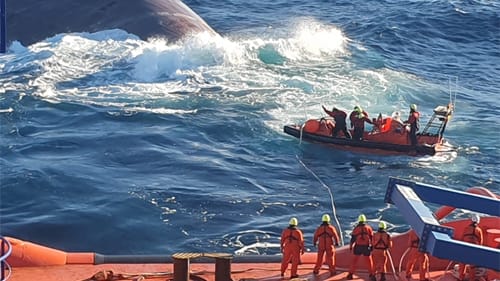
Spanish officials confirmed that they have approved a plan by the salvage companies to tow the capsized product tanker Med Emre to the port of Cartagena. The vessel has remained stable and is being held with a tow line attached to the pollution control vessel Clara Campoamor approximately 19 nautical miles northwest of Ibiza.
Divers were sent to the vessel on Friday to inspect its condition and, critically, the condition of the tanks, which hold about 7,000 metric tons of diesel fuel. Earlier reports had indicated there was a sheen stretching 2.6 miles from the vessel. Later reports said it had dissipated, while others said there was a minimal oil leak stretching about 1 mile and likely dissipating. Government officials emphasized it was very slight and about the best outcome they could hope for based on the current situation.
Government officials in the Balearic Islands, however, raised concerns about the potential environmental impact. They immediately voiced opposition to any suggestion of towing the capsized vessel closer to the islands.
Spanish officials reported that SMIT Salvage and Ardentia Salvage were retained by the vessel’s owners. Working with Salvamento Marítimo, a plan to tow the vessel to Cartagena was completed. It is expected to take several days, possibly reaching the port on Monday. Officials emphasized that it was the only port in the region with sufficient depth to handle the operation. With the vessel capsized, they said they would need a clearance of 27 to 29 meters (88 to 95 feet).
They said it was not feasible to extract the fuel from the vessel while it was out in the open waters. They said it would be a long-duration operation and would require sheltered waters. The officials expressed concern over possibly worsening weather conditions and the need to quickly secure the vessel. They will explore “hot tapping” into the tanks to remove the fuel. They also said a containment collar would not be effective in the ocean, but would be deployed once the hulk reaches the port.
Built in 2019, Med Emre was 120 meters (394 feet) in length. It had a crew of 17 and was sailing under the flag of Malta. It had no issues in its last Port State inspection.
Additional details also emerged about the events leading up to the capsizing of the vessel early on Thursday, November 26. The captain spoke of the rapid ingress of water into the ballast tanks, with officials saying it took less than an hour for the vessel to lose stability and capsize. The waves were reported to be up to four meters (13 feet) in the area.
The captain and three other crewmembers were recovered by a cable-laying vessel that was in the vicinity and responded to the emergency calls. One of the crewmembers was discovered to be suffering from a broken leg. They were taken to Cartagena, where the captain has already met with investigators. The other crewmembers were recovered by the rescue teams, with most of them taken to Ibiza.

that matters most
Get the latest maritime news delivered to your inbox daily.
The chief engineer of the Med Emre, a 46-year-old Turk, succumbed to his injuries and died after reaching a hospital. Reports said two others were discharged while four of the crewmembers remain hospitalized. They were reported to be suffering from hypothermia, dehydration, ingestion of saltwater, and exposure to petroleum products.
For now, the officials said the priority is on securing the vessel so that the salvage operations can commence. After pumping the fuel, they will attempt to right the vessel.