


U.S. Navy Sees a Big Bill Coming Due for Extended Overseas Deployments
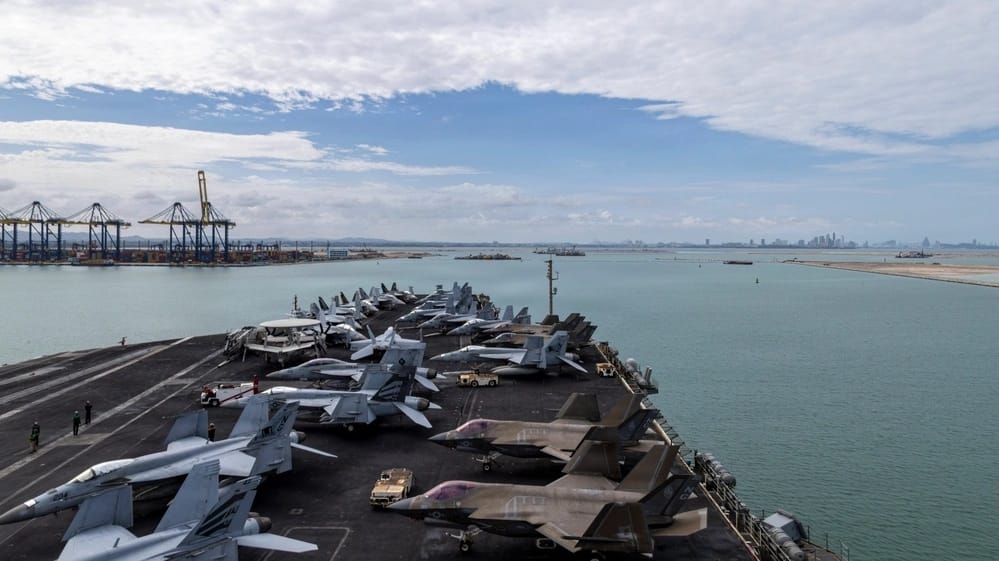
The U.S. Navy's carrier force has been carrying an unusually heavy load in the Mideast for years, and has been setting records with extended carrier deployments. Extensions come with well-known consequences: deferred maintenance causes unexpected issues, which cause delays during the next yard period, which can then cascade into delays for the yard itself and for other carriers in the fleet. The Navy is very good at performing on an extended deployment when asked, the service's second-in-command told a blue-ribbon panel on navy reform on Thursday - but its willingness to jump when ordered by a combatant commander comes at a cost, and that cost only becomes clearer down the line.
"We're seeing artificially high combat surge ready rates because those ships are over there [in the Mideast], and they haven't been introduced back into maintenance," Vice Chief of Naval Operations Adm. James Kilby told the National Commission on the Future of the Navy in an unclassified hearing. "The problem will come when eventually they do come home. The industrial base will not be able to swallow that pill."
To get a worn-down and late-returning carrier into the yard and back out again, Kilby said, the Navy has to triage the workload. Some maintenance has to be deferred, and necessary modernization work gets skipped in the interest of conserving time and shipyard capacity. "That's the piece that I think we need to be better at articulating and demonstrating: what the cost of this extension will be two years from now, so that [decisionmakers] see that and sign that bill," he said.
Kilby also emphasized the impact of long operational deployments on Military Sealift Command, both on maintenance and on mariners. MSC's ships are civilian-crewed, and the command has long struggled with finding and keeping enough people to man its full fleet of naval auxiliaries - the oilers and dry stores ships that keep carriers running. Congress has recently provided MSC with legislative changes to provide mariners with more competitive pay and timely relief - a significant step forward - but the long deployments to the Mideast are offsetting that progress, Kilby said.
"Relief of mariners on time is key to building their trust and having them want to work for [MSC], and now we're pulling that rubber band in the other direction now with the conflict we're in," he said. "More than just the material part, there's a human part that I think we've got to be thoughtful about."
The Navy hopes that its future unmanned capabilities will be able to alleviate some of the burden on the carrier force, along with the destroyers, naval auxiliaries and thousands of crewmembers who provide support while under way. Kilby suggested that a lighter-weight task force built around unmanned surface vessels and unmanned aviation could fulfill a regional combatant commander's requirements for lower-end missions, leaving the carriers more time to regenerate readiness. A task force of smaller assets could perform monitoring, presence and even combat missions, without the need to mobilize an entire carrier strike group or amphibious ready group.
"But that's a long time coming, because [combatant commanders] don't see that offer on the menu right now," he said. "We've got to action that and produce that thing for them to ask for."
The equipment will be arriving fast: the Navy recently ordered 30 Medium Unmanned Surface Vessels (MUSVs) from three different contractors, and on a rapid delivery timeline. But Commission member Arthur "Trip" Barber questioned whether the Navy was yet doing enough to operationalize that unmanned capability. The service does not yet have a type commander or base infrastructure assigned for these small warships, Barber noted.
"We've seen a great degree of emphasis on the platforms - but the people, the payloads, the piers, we have not seen that degree of emphasis," Barber said. "How are you going to make sure that you have the other elements needed to make them a useful capability?"

that matters most
Get the latest maritime news delivered to your inbox daily.
Adm. Kilby highlighted Fleet Forces Command's new warfighting development center for robotic and autonomous systems (RASWDC), just outside Norfolk, which will be tasked with integrating MUSV capabilities into fleet operations.
"The Secretary of War is developing capability very fast from an unmanned perspective, and the Navy needs to do a better job of integrating with that capability so that we know what we're receiving," Kilby said. "I'm not satisfied with where we are, but I do believe we have the elements to provide the governance and structure that you need moving forward."
