

U-Ming Names First LNG Carrier as Diversification and Expansion Continue
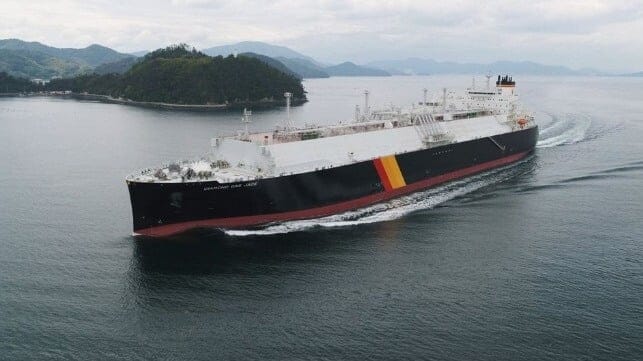
Taiwanese shipping company Un-Ming reports that it is continuing its business growth and diversification strategy with the naming of its first LNG carrier. According to the company, the commissioning of its first LNG carrier symbolizes its entry into the energy transport sector, building on its current operations of Very Large Crude Carriers.
The naming ceremony for the new vessel, Diamond Gas Jade, took place on May 19 at Samsung Heavy Industries’ Geoje Shipyard in South Korea. The yard is known as one of the leaders in building gas carriers and has applied the latest technologies to the new vessel.
It will have a capacity of 174,000 cbm of LNG. The ship measures 290 meters (951 feet). It uses the latest energy-saving technologies and has a dual-fuel ME-GA propulsion system. The vessel will have a speed of 19.5 knots.
U-Ming reports that when the ship is delivered in August, it will launch a new joint venture to expand operations into LNG transport. It will be involved in international trade.
The ship is the latest in a growth and diversification strategy for the carrier, which traces its origins to 1968, when it started as Yumin Transportation Company to operate truck transportation. It was reorganized in 1984 to specialize in maritime transport.
U-Ming Shipping currently operates a fleet of 71 vessels, with 13 more under construction, bringing the total fleet size to 84 vessels and a total deadweight tonnage of 9.96 million tons. Its operations are mostly focused on bulkers, including Capesize, Panamax, Post Panamax, and Ultramax, as well as cement carriers. It has expanded with Very Large Ore Carriers and four VLCCs for crude transport. Most recently, it has expanded into offshore wind support with personnel carriers and service maintenance vessels.

that matters most
Get the latest maritime news delivered to your inbox daily.
It has been moving into alternative energy sectors. It has been operating LNG-fueled ships for the past four years, and last year it began adding wind rotors to some of its large bulkers.
Its board has approved the construction of four 210,000-ton Capesize and four 64,000-ton Ultramax bulk carriers, moving towards the "dual growth" strategic goal of exceeding 100 vessels and a total deadweight tonnage of over 10 million tons.