


Two Tankers Attacked: What Next in the Bab el Mandeb?
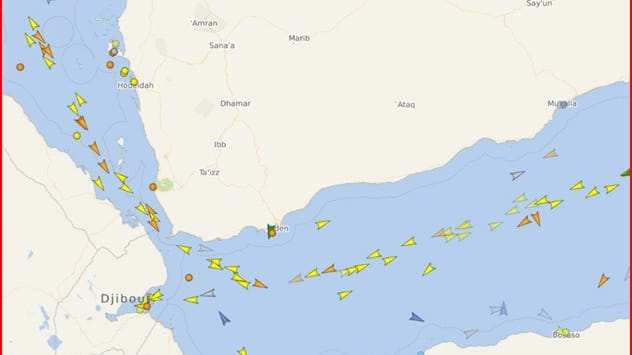
The Houthis are claiming attacks on two tankers in the Red Sea, furthering their threat to impose by force a blockade on Saudi ships or ships using Saudi ports. The Houthi threat is global in character, and not restricted to the Red Sea or Gulf of Aden.
The two Saudi-flagged tankers targeted by the Houthis are the VLCC Layla (IMO 9336098), and the 250-meter products tanker Encelia (IMO 9240172). The crew of the Layla, which had loaded at Yanbu, reported it was fighting a fire on board, and its present position is not known. Post the reported strike, the Encelia is at anchor off Jizan, and a strike on the vessel and its current condition have not been confirmed.
Notwithstanding the reported attacks, traffic still seems to be flowing at normal levels through the Bab el Mandeb, as seen at midday on July 23. The National carried a report that two Sinopec-chartered VLCC tankers carrying 4 million barrels of Saudi crude loaded at Yanbu to China, were still proceeding on passage through the Bab El Mandeb. Both are displaying their destinations on AIS as CHINA CREW & OWNER. The Singapore-flagged Xin Long Yang (IMO 9761463) is now through to the Gulf of Aden. The Hong Kong-flagged Cosnew Lake (IMO 9804289) was underway at 11 knots and was passing through the Bab el Mandeb at midday on July 23.
Attention now turns to how flag-nations and shipping owners will respond.
At the end of her visit to Operation Aspides in Djibouti, EU High Representative Kaja Kallas noted that “the situation in the Red Sea is once again deteriorating, and the missile threat by the Houthis for international shipping persists.” She also noted that forces currently allocated to Operation Aspides, the EU operation established in February 2024 as a response to Houthi attacks then on shipping, were insufficient for the task as it has evolved. She identified that spare naval capacity held in the Arabian Sea for the Coalition of the Willing might be a source of reinforcement. But it remains to be seen when and if such reinforcement arrives; EU decision–making processes can be very extended, and some EU nations will respond to the increased risk by withdrawing rather than increasing support.
Donald Trump has said that the United States “will take care of things” if the Houthis attack shipping, which they have now done. It remains to be seen, however, what capacity Central Command can spare from its campaign against Iran to re-open the Yemeni front.
Israel has in recent weeks tried to keep out of further entanglements in the Gulf region, to better focus on immediate problems closer to home in Lebanon and Gaza. Israel did not respond when the Houthis fired nuisance missiles and drones at Israel in the preceding months, confining itself to shooting down the incoming threats. A closure of the Bab el Mandeb might, however, elevate Israel’s concerns, and any strikes it might mount would be particularly effective, as the Israeli intelligence picture of Houthi dispositions is now much improved.
The biggest question remains, however, the Saudi response – particularly as the Houthi threat is specifically related to Saudi Arabia, and the true cause of the Houthi upset – the lack of progress it has made in negotiations to end the civil war in Yemen which has been rumbling on since 2014, and the prospect that if the Saudis are put under a bit more pressure, they might still settle the negotiations by offering the Houthis $14 billion in cash. While the Houthis accuse the Saudis of being behind the control of access to Houthi ports and airports – and of being the party which is empowered to lift these sanctions – the reality is that the Saudis are allowing large volumes of cargo under UN auspices to reach the Houthi-controlled ports of Hodeida, Ras Isa and Salif. The Saudi Ministry of Foreign Affairs reports that under its watchful eye more than 300 ships have off-loaded at these ports since the beginning of 2026. The Houthi action therefore threatens this continued flow of essential goods into the hunger-stricken areas of northern Yemen which it controls, with most of these cargos internationally-donated food aid.

that matters most
Get the latest maritime news delivered to your inbox daily.
The Houthis also risk triggering a rather different, and very much upgraded military response from the Saudis. The Saudi armed forces have spent the years of the ceasefire since March 2022 learning the lessons of their inconclusive clashes with the Houthis, and have in the meantime considerably improved their intelligence collection and the precision of their strike capability. In particular, they have improved the quality in particular of their naval efforts in the Red Sea, deploying their new Navantia-built corvettes. The Houthis may therefore get more than they bargained for by breaching the maritime ceasefire in the Red Sea and Gulf of Aden.
