
Trigon Targets Asia-Pacific Exports with Extra Berth at Prince Rupert
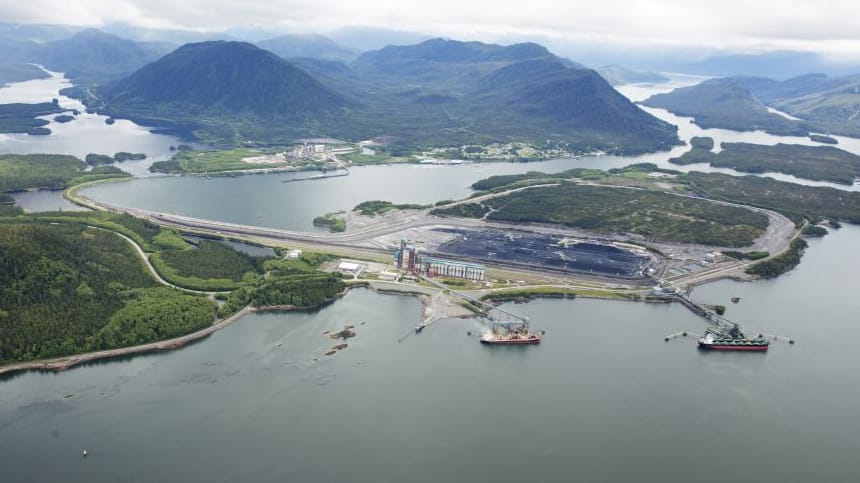
Canadian commodity firm Trigon Terminals plans to exploit opportunities in the expanding Asia-Pacific green-energy markets after completing the construction of a second berth at the Port of Prince Rupert, a project that was implemented at a cost of C$163 million (US$114.5 million). Built with hydrogen-based fuels in mind, it will be used for wood pellets and bulk mineral exports in the near term.
Trigon is announcing that after five years of construction, the company has completed the Berth Two Beyond Carbon (B2BC) project that effectively doubled its throughput with the addition of 15 million tonnes of capacity. Construction of the new berth started in 2022 and was financed partly through a C$75 million (US$52.7 million) grant from the National Trade Corridors Fund.
The new berth furthers Trigon’s ambitions to increase exports to Asia-Pacific markets. It is specifically designed for green hydrogen, renewable and biofuels, methanol/ethanol or additional liquefied petroleum gas, and potentially hydrogen itself.
But for now, it will increase capacity at the existing berth for wood pellets and biomass handling, and potentially other bulk exports such as grain, potash and mineral concentrates (including copper), the effect of which will be a significant increase in the company’s export capacity.
Trigon, a privately owned firm that now operates two multi-commodity bulk and liquefied gas export terminal at Canada’s third-busiest seaport, says it will be able to accommodate Supramax to Panamax vessels. The capacity to handle larger volumes of existing dry bulk commodities, combined with the company’s C$800 million (US$562.3 million) liquefied petroleum gas (LPG) export facility, supports new Canadian energy exports valued at up to C$4 billion (US$2.8 billion) annually.
A fortnight ago, Trigon said that it had made a major step in the implementation of the Trigon Pacific LPG project after the Impact Assessment Agency of Canada determined that the project did not require an impact assessment. The development allows the company to advance implementation of the export facility that will have a capacity of 2.5 million tonnes per annum and which is slated to come on stream in 2029.
“Our new berth is an important means of advancing Canada’s export growth goals and there’s no other ready-to-deploy infrastructure like it anywhere on North America’s Pacific coast,” said Craig Olley, Trigon President and CEO. “It’s time now to remove the roadblocks that stand in the way of greater trade and to get a return for Canada on this investment.”
that matters most
Get the latest maritime news delivered to your inbox daily.
Completion of the second berth project as well as pursuit of other growth strategies comes when the company is seeing rapid growth in export volumes. Last year, the company handled 10.4 million metric tonnes of dry and liquid bulk products. This represented 40 percent of all cargo exported through the entire Port of Prince Rupert and a 14 percent increase in terminal volumes compared to 2024.
The company has mainly been handling steelmaking and thermal coal, along with petcoke, with Japan and South Korea being the key destinations for its exports. Additional volumes headed to China, India and parts of Europe.