


To Speed Up Warship Deliveries, HII Leans Into Distributed Shipbuilding
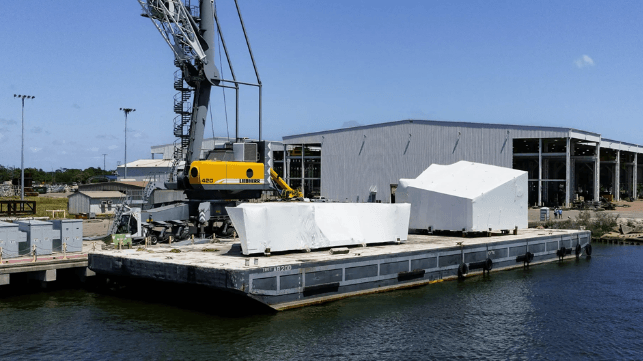
At this year's Sea-Air-Space conference in Maryland, Huntington Ingalls Industries announced a step change in its operations: it is outsourcing more and more of its work to partner companies in a "distributed shipbuilding" construction model. At this point, it is buying blocks and components from 25 different sites across 11 states, underwriting about 1,000 jobs and 2.5 million man-hours of labor.
All of the U.S. Navy's newbuild construction programs are behind schedule, due to a combination of workforce shortages and supply chain challenges. HII - by far the largest shipbuilder for the Navy, and the service's sole-source supplier for carriers and amphibs - is trying to increase throughput in order to catch up. Last year, production increased by 14 percent, HII says - and the yard hopes to repeat that gain again this year.
To get around local constraints on the supply of labor and facility capacity, HII is outsourcing more and more of its structural production to partners elsewhere. Complete hull units and modules are being built at other locations, under HII supervision, then moved to the shipbuilder's yards in Newport and Pascagoula. It has also "insourced" some of this work by buying and repurposing the W International plant in Charleston, South Carolina, giving it access to a large fabrication facility and a new regional labor pool.

that matters most
Get the latest maritime news delivered to your inbox daily.
Prominent partners include Trident Maritime Systems, a builder of units for Ford-class aircraft carriers; Gulf Copper, which builds hull modules for Ingalls' DDG program; and Keel, a builder of submarine modules.
The distributed shipbuilding model requires precision and standardization to ensure that the units line up, but done carefully, it can bypass bottlenecks at a space-constrained or workforce-limited shipyard. The most prominent example is the Royal Navy's Queen Elizabeth-class carrier series, which used blocks built at six different yards across the UK; the approach augmented the capabilities of Babcock's Rosyth Dockyard, and distributed the economic benefits of the shipbuilding program across multiple regions.
