


Russian Mediterranean Flotilla Heads for Tartus After Syrian Agreement
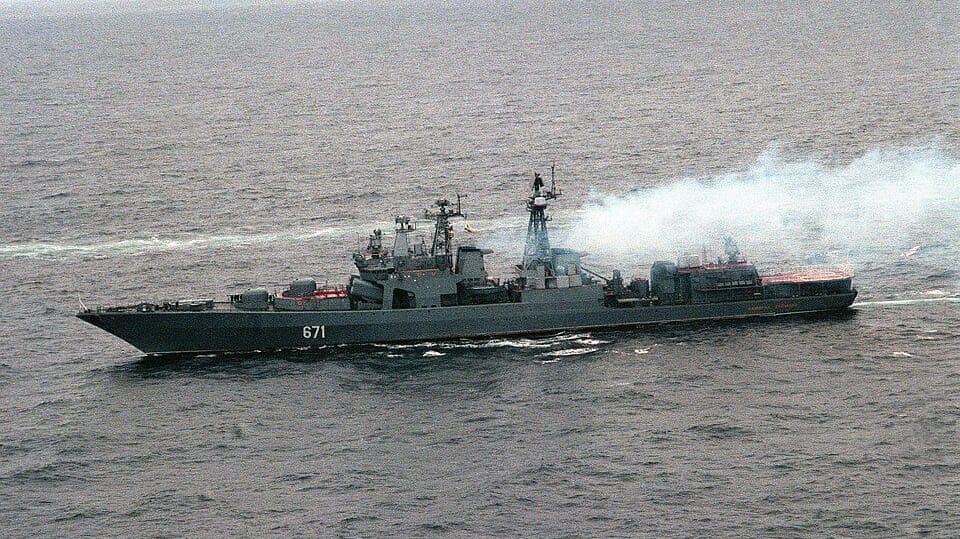
Weeks after Russia and Syria formally agreed to new terms under which a reduced Russian foothold would be maintained in Syria, a Russian naval force appears to be heading for Tartus.
The Mediterranean has been without a Russian naval presence since Gorshkov Class frigate RFS Admiral Kasatonov (F461), the oil product tanker General Skobelev (IMO 9503304), the Ro-Ro cargo vessel Sparta (IMO 9268710), and the Project 23130 oiler Akademik Pashin (IMO 9778193) sailed out of the Mediterranean through the Strait of Gibraltar at the end of June. That left no Russian naval ships in the Mediterranean, at a time when geopolitical events would suggest that Russia might need a presence, in particular off the Levant.
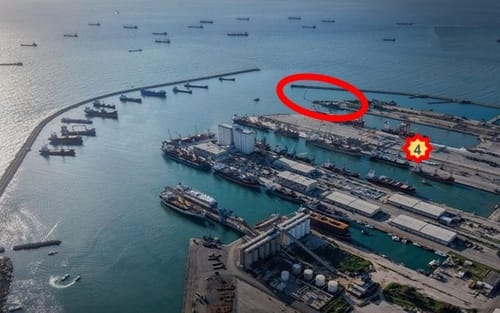
A Russian corvette docked in Tartus, behind an anti-drone barrier. Also present in June were a Grachonok Class and 2 x Raptor and port security vessels. Pier 4 will be given up for Syrian-Russian commercial use (SANA/CJRC)
The agreement with the Syrians allows the Russian Navy to maintain a presence on the northern wharf within the inner harbor of the port of Tartus. The Russian naval base dating from the 1970s, known as Station 720, occupied both the northern wharf and Pier 4 immediately to its south, so the newly re-licensed facility is smaller, and the scope of base maintenance, ship repair, and logistic functions it is able to perform may be much reduced. Time will tell how much use the Russian Navy will be able to make of Tartus, although the agreement with the Syrians is couched in terms of the Russians using the facility to provide training for their Syrian counterparts. The Russians will be pleased merely to have maintained their toehold in Tartus.
Heading back into the Mediterranean through the Strait of Gibraltar late on August 27 were the same three auxiliary vessels, the oil product tanker General Skobelev, the cargo vessel Sparta, and the oiler Akademik Pashin, but now they are being led by the Udaloy Class anti-submarine warfare destroyer RFS Admiral Levchenko (D605). Also led by the Admiral Levchenko, the flotilla passed through the Danish Strait on August 18, transited the English Channel (without the UK Ministry of Defence providing details of its escort coverage) and was off Spain on August 24.
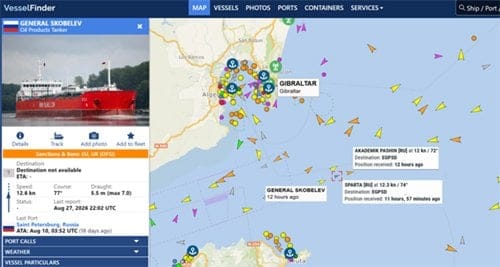
VesselFinder captured AIS signals from the three Russian auxiliary vessels, switched on in busy shipping lanes as they entered the Mediterranean late on August 27 (with permission from VesselFinder)

that matters most
Get the latest maritime news delivered to your inbox daily.
The Admiral Levchenko, as an anti-submarine warfare platform, is one of the Russian Navy’s older and less useful ships for prosecuting its aggression against Ukraine, as it is not able to fire long-range cruise and ballistic missiles at ground or surface targets. The destroyer has been switched from the Northern Fleet for the deployment, the Mediterranean presence is normally supported by the Baltic Fleet at Baltiysk in Kaliningrad, where the three other auxiliary vessels are home-based. Indeed, the three auxiliaries may have been permanently allocated to Mediterranean duties, so frequently are they spotted shuttling to and from the Mediterranean.
The key question for NATO military planners is whether or not the flotilla will merely visit or will be stationed in Tartus, and whether some form of rotation will be maintained. The Eastern Mediterranean is currently relatively quiet, although Russian dark fleet tankers are always at risk of seizure or from Ukrainian sanctions. But the IRGC leadership in Iran has threatened to strike US and UK targets in southeastern Europe if the US naval blockade of the Strait of Hormuz is maintained. Separately, the Russians have threatened to retaliate for the British gifting of Storm Shadow cruise missile intellectual property to Ukraine. In either scenario, the risk is rising that the British base at Akrotiri in Cyprus would be at heightened risk of attack from ballistic missiles, with a Russian presence in the area becoming an additional complication.
