


Oman Gives Owner of Stranded Tanker Caroline Bezengi 24 Hours to Act
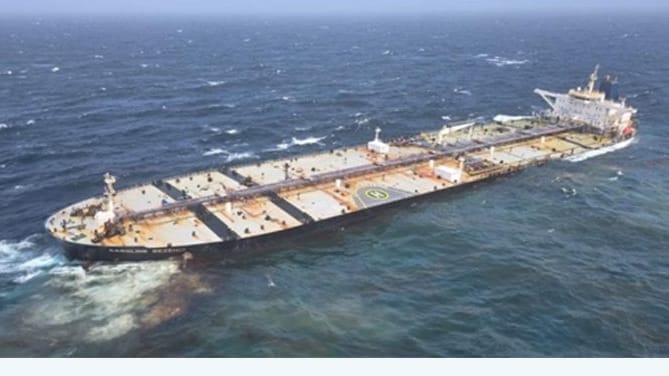
The Omani Ministry of Transport, Communications and Information Technology has issued an urgent 24-hour directive to the owners of the beached Cameroon-flagged Supermax Caroline Bezengi (IMO 9224439), according to the Muscat Daily. They are demanding the removal of the vessel from its current position, stranded on rocks off the southwest tip of Jazirat Al Qibliyyah, one of the Hallaniyat Islands off the coast of Dhofar in the southwest of Oman.
It is not clear if the Ministry has had acknowledgement of receipt of its directive from the owners, Rentoor Shipmanagement based in Huangpu Qu, Shanghai, or even if they have managed to get anyone to answer the telephone. It seems unlikely, as the address appears to be a dead-letter box in a residential block of flats in downtown Shanghai, as is typically found in the registration particulars of Russian dark fleet tankers. The Ministry is threatening legal action if its directive is not complied with.
The crew of the Caroline Bezengi (159,168 dwt) reported an explosion on board while the tanker was off Dhofar on June 8. The tanker, which is sanctioned by the EU, UK, and US (OFAC) and has a past association with Russian state ship-owner Sovcomflot, had loaded at Novorossiysk and was en route to India. The ship appears to have been abandoned by its crew about three days later. It is not known where the crew is now, but post-evacuation officers from the ship have been assisting the Omani authorities in assessing the condition of the stranded vessel.
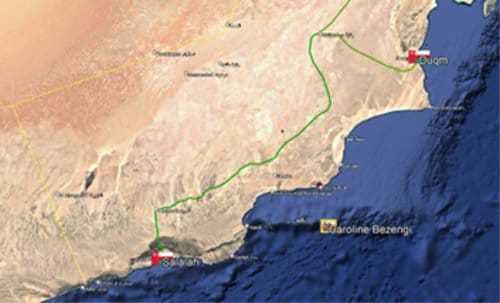
The position of the shipwrecked Caroline Bezengi off the Dhofar coast (Google Earth/CJRC)
The beached position of the ship is particularly difficult, with the ship exposed to the heavy seas that are normal in the monsoon season. While the ship appears to be stuck on the rocks forward, there are rocks off the port side which would catch the ship if it shifted, and also exposed rocks 500 yards off the stern of the ship.
The Omani maritime authorities conducted an onboard survey of the ship on July 12 and noted considerable deterioration in comparison with an aerial survey conducted a week previously. The tanker was fully laden save for one tank – this empty tank being the only one apparently not breached, with the remaining tanks all full and showing signs of seawater contamination. The tanker is sinking deeper into the water, and its list is increasing. Most worryingly, there is crude leakage into the ballast and the double hull spacing, the fumes from which are potentially explosive.
The Omani authorities have commissioned an independent evaluation from a leading salvage firm, which has confirmed the dangerous and deteriorating condition of the ship. The survey also identified a feasible plan for off-loading the Caroline Bezengi’s cargo, via a 1000-yard pipeline to a receiving tanker anchored in safer waters in the lee of the island, and for refloating the tanker as it was lightened – but all with the risks of on-board explosions and the ship breaking up further as the operation progresses.

that matters most
Get the latest maritime news delivered to your inbox daily.
A decision to commission immediate salvage work has not yet been made, frozen by the legal difficulties. Unless salvage begins immediately, it appears that the Caroline Bezengi will break up and spill its cargo, devastating the Hallaniyat Islands Marine Buffer Zone to which access is normally strictly controlled so as to preserve endangered humpback whale, seabird, and turtle populations. The contamination would also likely contaminate large stretches of the Dhofar coastline. It remains to be seen how quickly the Ministry can cut through the legal challenges which have so far paralyzed progress, and prevented the tanker from being taken under tow even before it hit the rocks. Unless the Ministry acts immediately, an entirely predictable and avoidable ecological disaster beckons. But in contrast, a salvage operation would open up the possibility of recovering the cargo of crude still on the tanker, which would be more than enough to cover the cost of the salvage operation.
The incident may give the Ministry an opportunity to consider the wisdom of having what appears to be 39 Russian dark fleet tankers on the Omani shipping register, out of a total of 44 vessels. The bulk of these 39 vessels will be registered to owners who will not answer the phone in an emergency, and who may have inadequately insured their vessels, if they are insured at all. The bulk of these vessels will also be old and prone to engine failures, and may potentially also unwittingly become engaged by the Ukrainian long-range sanctions program.
