

New Investigation Uncovers Iranian Smuggling Network
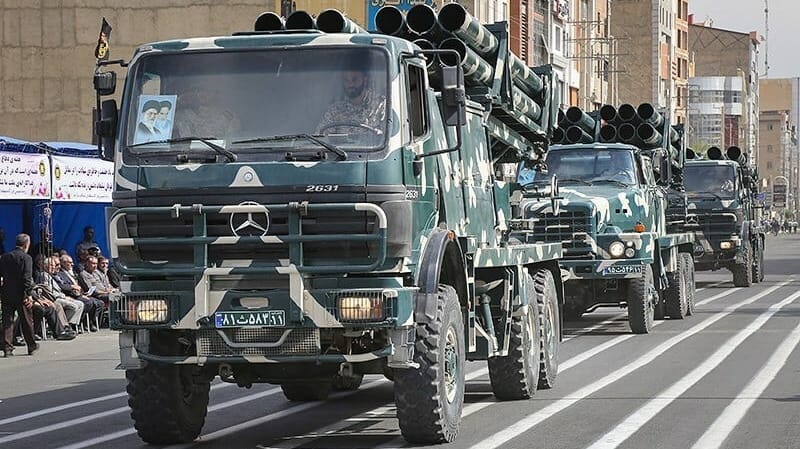
A painstaking investigation by Reuters has uncovered a vast network of accounts and companies used by Iran’s Islamic Revolutionary Guard Corps (IRGC) to import materials needed by missile, drone and front-line units of the IRGC, currently the United States’ principal adversary.
Readers of The Maritime Executive will be familiar with sophisticated mechanisms the IRGC uses to import the materials it needs to prosecute its warfare against neighboring states, Israel and the United States. These tools are what one would expect of an organization which conducts extensive drug smuggling operations as a means to circumvent sanctions and customs controls. It is an organization which has deep experience, and a nimbleness and flexibility to stay one step ahead as smuggling routes are closed down - always exploiting the slower responses of governments that generally want to stick to the slower mechanisms prevailing under the rule of law.
The Reuters investigation has utilized access it has obtained to internal banking and invoice documents held within the Armed Forces Logistics Department of Iran’s Ministry of Defense, clearly establishing that the IRGC has an overarching coordinating role, directing the activities of a network of entities involved in the ordering, delivery, invoicing and payments processes.
The documents examined stretch back many years, so the network uncovered is that which began operating before the naval blockade was imposed on Iran, and before the US Treasury’s much more robust Operation Economic Fury began to take effect. But given its past performance, the IRGC coordinators of the smuggler networks described in the Reuters investigation will now be adapting once again, rolling out new smuggling routes and financial mechanisms to keep the system going.
The system as described makes heavy use of the dual-use categorization of many materials which the IRGC needs to build its weapons and equip its forces. Iveco trucks built in Europe can, of course, be used for civilian purposes, but they can also be used to mount mobile missile launchers. Toyota Land Cruisers can legitimately be used for ranching, but can also mount anti-aircraft systems. Sodium perchlorate manufactured in China can be used in the manufacture of fertilizer, but can also be refined into ammonium perchlorate to make rocket fuel for IRGC Kheibar Shekan and Fattah missiles, and the shorter-range Fateh-110 and Zolfaghar missiles, at facilities in Parchin, south of Tehran, and Khojir – before they were demolished in airstrikes earlier this year.
The IRGC smuggling organization makes extensive use of front companies in neighboring countries to which goods can initially be consigned, and front companies inside Iran which have not yet come to the attention of the US Treasury. Vehicle manufacturers contacted by Reuters, for example, claimed to have had no idea that their trucks, once delivered to neighboring Central Asian countries, were then being sent forward into Iran, all the while being described in invoicing and consignment documents under non-contentious product codes.
Neither Russia nor China has much interest in sniffing out dubious consignments, particularly as President Trump repeated his belief on October 12 that Russia and China are “not helping at all” with the procurement of military capability for the IRGC. After the Reuters investigation, the US Treasury will no doubt be setting up sanctions on the export-import agencies and financial institutions identified in the report.
Given that the report covers the period both before and after the 100%-effective naval blockade was imposed, much of the movement of dual-use materials into Iran occurred when it was still possible to dock a ship at Bandar Abbas – which until then was the entry point for 80% of non-oil and gas imports into Iran. The IRGC will have priority, but the alternative routes into Iran – road, rail, air and across the Caspian by cargo vessel – are now heavily overloaded, and moreover the Iranian government is no longer earning any revenues from oil exports, which previously generated 40% of its income. The pressure will therefore be on.
But as always in Iran, the first to feel the effects will be ordinary Iranians, on whom the burden of hyperinflation and shortages will fall. Conversely, there will be a much higher content of goods ordered by the IRGC coming into Iran via the trade routes still open to it. These will include the truck route from Turkey, where the queue for trucks at Bazargan has doubled to five days. The rail routes from Russia through Inche-Burun and from China through Sarakhs will be maxed out. Shipping between Astrakhan and Bandar Anzali plus Amirabad on the Caspian coast will be largely reserved for what the IRGC deems essential.

that matters most
Get the latest maritime news delivered to your inbox daily.
But the US Treasury’s net is closing. The naval blockade stays tight. The border crossings to Pakistan at Rimdan and from Iraq at Al Sheeb and Mandali appear to be suffering “technical” delays holding up transits. Air routes are largely closed down, although one can expect to see additional Russian and Chinese military traffic flying in with transponders switched off. And with Starlink restored, perhaps the Ukrainians might be persuaded to lend a hand with curbing trans-Caspian shipping.
Top image: Tasnim News / CC BY 4.0