


Iranian Misrepresentations Over the Strait of Hormuz Addressed by Oman
Oman appears to have put its foot down over Iran’s misrepresentations about the state of their bilateral negotiations over the Strait of Hormuz. On August 25, Omani Foreign Minister Sayyid Badr Al Busaidi made yet another day trip to Tehran to meet his opposite number, the Iranian Foreign Minister Abbas Araghchi.
Once again, the main topics for discussion were the technical arrangements for reopening the Strait of Hormuz to shipping, another in the series of meetings held on this same topic, most of which have been held between Sayyid Badr and the Iranian Deputy Foreign Minister Kazem Gharibabadi. The always-busy telephone line between Tehran and Muscat will no doubt have carried forward negotiations in between the formal meetings, and Iran’s chief negotiator Mohammad Bagher Ghalibaf will also have been involved.
There is a familiar routine in these exchanges between Oman and Iran. An Iranian politician comments on the talks to the press, outlining its position – which more often than not bears little resemblance to what was actually said or agreed at the meeting, and reflects instead what Iran would like to have achieved. Oman has, after each meeting, tended to say little, other than acknowledging that the meeting has taken place.
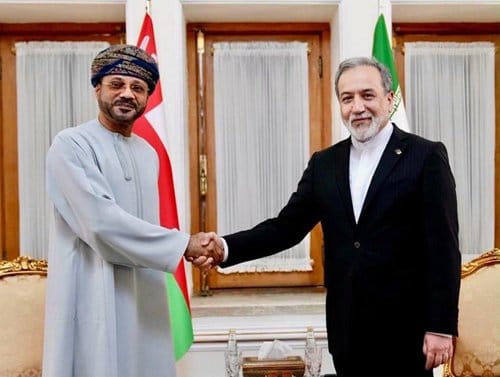
Sayyid Badr bin Hamad bin Hamoud Al-Busaidi, Minister of Foreign Affairs visiting his opposite number Abbas Araghchi in Tehran, August 25 (Omani MoFA)
Without any Omani statement to balance the Iranian position, international press commentary tends to take the Iranian version of events as being a true record, which the Iranians bolster by selective leaking to BBC journalists or those based in New York and Washington, not all of whom are necessarily well-versed in Iranian affairs. The false Iranian narrative then leaches into diplomatic and academic discourse.
The Iranians have been saying that agreement was close, there would be a unified shipping channel use of which would in effect be controlled by Iran, and that passage fees would be charged. After last week’s meeting, the IRGC went further, saying that the United States must also end the blockade, with Kazem Gharibabadi in Tehran stressing that the Strait would be managed by Iran alone, without mention of Oman.
The meeting on August 25, however, was different, because a joint statement was issued, agreed by both parties, and with the agreed version bearing little resemblance to the initial Iranian briefings. The joint statement issued first by the Omani Ministry of Foreign Affairs laid out Omani conditions which clearly had not yet been fulfilled, specifically that arrangements needed to be agreed with regional states (i.e. with GCC members), that the arrangements must fall within applicable international law (a reference to the UN Convention on Law of the Sea (UNCLOS), and should respect the sovereign rights of coastal states. But for the first time, the exact text of the joint statement was also published several days later in the Iranian press, contradicting the earlier informal briefings that the Iranians had given.
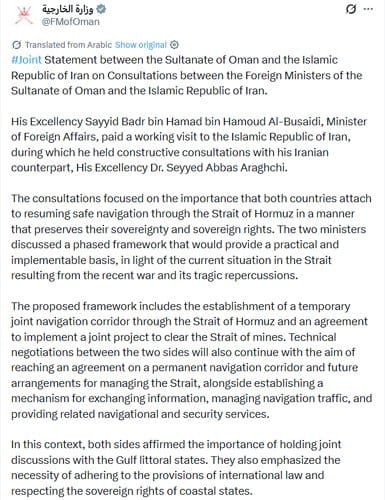
In effect, the Omanis are reiterating their long-standing and unchanged negotiating position, that while navigation dues can be imposed, passage fees cannot. Moreover, Iran cannot limit innocent passage through the Strait, and Oman will not accept any diminution of its sovereignty over its own territorial waters. In this regard, Oman is defending the rights of GCC states to use the Strait as they did before the war, and the flurry of meetings and communications between Sultan Haitham and heads of neighbouring GCC countries indicates that the Omanis are keeping their fellow GCC members well informed.
Previously, the Omanis had not contradicted Iranian false misrepresentations because they wished to keep relations with the Iranians cordial, so that the negotiation process could continue. Through these negotiations, the Omanis are attempting to bring the Iranians around to a more reasonable position. While the Iranians are proving stubborn, the Omanis are persevering and persistent, not abandoning their commitment to resolving issues through patient diplomacy.

that matters most
Get the latest maritime news delivered to your inbox daily.
That this is a correct reading of the situation appears to have been confirmed in Tehran. Iran’s chief negotiator Mohammad Bagher Ghalibaf has been criticised in Kayhan, the leading newspaper in Tehran representing Paydari-Hardliner views, which suggested he was compromising during negotiations. Ghalibaf responded by saying that the purpose of negotiations was, like warfare, to advance national interests, secure Iran’s rights and to consolidate the Islamic Revolution. He implied that if he was seen to be weakening by engaging in any negotiation, this was merely a tactic and not any watering down of the will to achieve the same revolutionary goals as sought by the Paydari-IRGC faction.
There is more than just an abstract statement of principle in the Omani position, because the unadvertised and ‘dark’ merchant vessel transits of the Strait, which Central Command is providing limited protection for, are being carried out through Omani territorial waters using the Omani Coastal route. These merchant vessel movements do not need to be licensed or approved by Oman, as they are the innocent passages of merchantmen through territorial waters, as defined by UNCLOS. But as can be seen by the extremely hazardous search and rescue operations carried out by the Omani Coastguard when the IRGC attacks innocent vessels and seafarers in Omani territorial waters, Oman clearly feels it has an obligation under UNCLOS to provide navigation aid to ships in transit through the Strait. This continuing activity asserts Oman’s sovereign rights and undermines the Iranian contention that they control the whole of the Strait of Hormuz.
