


Iran Keeps Up Pace of Strikes With Attack on Brand New LR2 Tanker
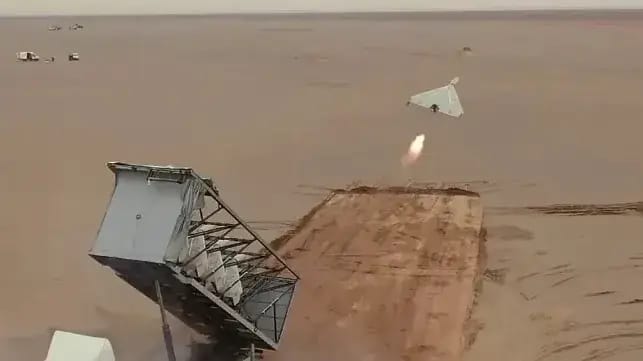
On Sunday, Iran hit another tanker in the Strait of Hormuz, extending a fast-paced run of attacks on the "shuttle" shipping trade between Gulf oil producers and the STS transfer zone in the Gulf of Oman.
Vanguard Tech has identified the latest tanker hit as the Lipsi, a brand new LR2 linked to a Greek operator and a Chinese owner. Industry media sources have reported that the vessel sustained engine room damage.
U.S. Central Command's Joint Maritime Information Center logged three more Strait of Hormuz incidents on Saturday. During the first tanker's Hormuz transit, a drone flew down the funnel and entered the engine room, causing a small fire and brief loss of power; the second tanker was hit on the port quarter, damaging the engine room and prompting a tow; and the third tanker was struck on the port quarter, causing it to lose propulsion. No injuries were reported in any of Saturday's incidents.
Over the past week, the pace of successful Iranian strikes has sped up following weeks of relative security. The attacks put pressure on the steady flow of tanker traffic through the waterway, which had recently rebounded to more than 12 million barrels per day - enough to restore total Gulf export volume to nearly prewar levels.
Strait of Hormuz: five tankers struck in four days Iranian forces struck the Kuwaiti VLCC KAZIMAH III in the Strait of Hormuz on 1 October. It is the fifth tanker hit since 28 September and the second Kuwaiti state VLCC in four days. Neither Kuwaiti tanker was on the PGSA NCV list. Most of the recent victims were transiting AIS-dark. Gulf crude flows are holding up through a dark tanker shuttle and ship-to-ship transfers. In the Black Sea, a Turkish-operated bulk carrier was disabled near Novorossiysk with one crew member missing. Off Somalia, Puntland has recovered two hijacked tankers, but the pirate networks remain intact as the monsoon ends.
— Martin Kelly (@_MartinKelly_) October 2, 2026
Confirmed Iranian strikes on ships in the Strait of Hormuz are at their highest level since the start of the war. Europe and other democracies need to be careful about overextending themselves via oil inventory releases. 1/2 https://t.co/rd1enOEUf0
— Joe Webster (@Joe_Webster_CRR) October 4, 2026
There may be technical factors behind the increased hit rate. Iran's ship-targeting capability appears to be getting better, one U.S. official told the Wall Street Journal.
A reduced emphasis on deterrence may also be allowing Iran greater latitude to strike shipping. After briefly pursuing a "head-for-an-eye" strategy of damaging or sinking Iranian tankers in retaliation, the U.S. appears to have ceased all publicized counterattacks on the Iran-linked merchant fleet. The last CENTCOM strike on an Iranian tanker was on September 8.

that matters most
Get the latest maritime news delivered to your inbox daily.
So far, at least some volume of tanker traffic through the U.S.-protected southern waterway continues, despite Iran's push to increase the pace of attacks. Naval analyst Tom Bike has identified three disabled tankers in the vicinity of the Musandam Peninsula and at least four additional tankers making a daylight transit through the channel.
They just keep going! ???????? Several ships spotted TODAY ???? transiting US ???????? Strait of Hormuz dangerous route at 06:06 AM on RADAR and 10:47 AM in true color. On RADAR satellite image circled in red are previous hit ships. Two still there and the other is being towed to Fujairah. https://t.co/9lS8k1VkxZ
— Tom Bike (@tom_bike) October 4, 2026
