Iran Increases Hormuz Pressure with Nearly Simultaneous Attacks on Tankers

Iran continues to apply pressure on the Strait of Hormuz despite the U.S. assertions that the shipping lane is open. On Monday night, it attacked two tankers carrying Saudi oil, raising fresh fears in the oil markets and possibly a quiet move by Saudi Arabia’s Bahri to hide some of its tankers. Late on Tuesday, U.S. Central Command reported that U.S. forces began striking Islamic Revolutionary Guard Corps (IRGC) targets in Iran. It said the strikes follow recent attempted attacks by the IRGC against commercial shipping in the Strait of Hormuz and against American service members deployed to the region.
The Joint Maritime Information Center (JMIC) issued an update listing only one of the recent attacks in the Strait of Hormuz, following a similar report from UK Maritime Trade Operations. Both are reporting the incident with a Sinokor tanker, Senegal Prosperity (320,780 dwt), which had been acquired by the South Korean company in February of this year. An incident with Saudi Arabia’s Bahri-managed tanker Sidr (300,759 dwt), however, appears to have gone unreported.
The Saudi-flagged tanker was sailing dark, attempting to exit through the Strait of Hormuz. It was last seen at the Fujairah anchorage almost two weeks ago, but it is believed to have loaded at Juaymah, Saudi Arabia. The tanker was approximately 17 nautical miles northeast of Khasab, Oman. Security consultants Marisks are reporting the tanker anchored in the strait near the Omani coast after the attack.
UKMTO is reporting the tanker Senegal Prosperity was hit a few minutes later, and as a result the crew abandoned the tanker and was rescued by local authorities. This tanker was hit by three rockets on its port side, writes UKMTO, resulting in damage to the engine room and ballast tank. It says that all communication was lost and the vessel was believed to be dead in the water and listing to port.
Oil markets responded on Tuesday, driving the price of crude up for the second day in a row. It was up about two percent each day, despite the assertions by the United States that oil is flowing out of the Gulf.
Donald Trump on Monday said, “We have the Strait of Hormuz in extremely good shape. You know, we’re taking over.” He asserted that the U.S. is guiding an average of 30 ships out each night.
Both the AI data intelligence firm Windward and Kpler are, however, showing much lower figures for the transits. They are saying 10 vessels transited the Strait of Hormuz on Sunday, but that it “declined sharply” on August 31, says Kpler. Windward says the highest number in the past week was 21 ships in a day. Kpler sets the crossing at just five confirmed vessels on Monday, saying four were inbound and only one exited.
Iran, in public statements from its president Masoud Pezeshkian, seemed to be pressing for the United States to return to the now-expired memorandum. He said if the U.S. sticks to the June agreement, Iran would reciprocate. Iran asserts free navigation would only be possible if the U.S. goes back to the terms of the agreement. This came after the U.S. attacked Larak Island and Iran responded with attacks on U.S. bases in Jordan and Kuwait.
Qatar said on Tuesday that it is trying to break the impasse. It said it is continuing with mediation efforts.
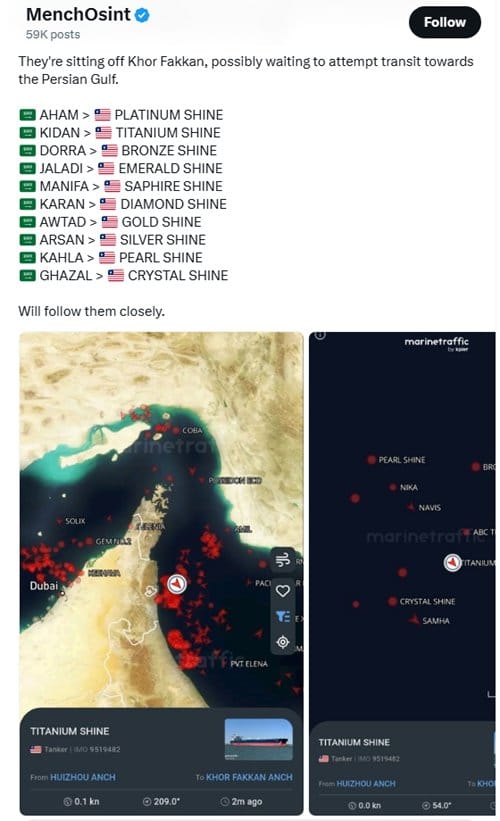
Saudi Arabia’s Bahri, however, seems to have quietly taken steps to change the identity of some of its tankers. Ten tankers, so far, have been detected in the past few days changing their names and the flags from Saudi Arabia to Liberia. Management appears to still be with Bahri, so it might be an effort to confuse the identity to possibly move some of the tankers through the Strait of Hormuz.

that matters most
Get the latest maritime news delivered to your inbox daily.