


Interview: Amrit Bhullar, CEO of Oceanbird

Wind-assisted propulsion is among the most promising options available for reducing a ship's fuel bill, and there are a growing number of options on the market. The newest (by date of first seagoing installation) is Oceanbird, a JV between the PCTC specialist Wallenius and technology conglomerate Alfa Laval. Oceanbird CEO Amrit Bhullar met with TME at SMM for an update on the technology's evolution - and on why she thinks that a return to "fully wind-powered" propulsion could be an option in the industry's future.
I was wondering if we could start with your personal journey - how did you get into maritime?
I actually started my career as a corporate M&A lawyer, a solicitor in London, doing transactional work: buying, selling, listing, restructuring, commercial negotiations. There was never any conscious intention, to be honest, to move into maritime, but I fell in love with Norway on a camping trip and decided that I wanted to move there. A year later, I found myself a job with Rolls-Royce Marine in Ålesund.
So I started in Rolls-Royce Marine in 2010 as a commercial negotiator for all the wild and wacky innovations that no one else really wanted to commercialize. They needed somebody to support the business developers, the guys with the dreams, to go out there and make sure we managed the risk of innovation. I spent time working on a potential deal with Washington State Ferries for a full design and full system equipment package from Rolls-Royce for 12 ferries, and I was also involved with early-generation LNG fuel systems. Rolls-Royce Marine then got bought by Kongsberg Maritime, and I joined the ship intelligence team, and worked on the commercial side of the remote-controlled tug project in Copenhagen and the first autonomous ferry demonstrator in Finland.
And when I got asked to join Vard, I got the responsibility to do everything that was non-standard - that is, not to sell and not to deliver, but everything in between. I was responsible for the first cyber class notation-approved ship under the new regulations, which was delivered out of Vard last year.
When I got asked to look at this role at Oceanbird, I thought, wow: we have an industrial product which can deliver real savings, we have an opportunity to commercialize it, and I believe in the technology. Coming into Oceanbird and being supported by two giants in the industry, Wallenius and Alfa Laval, it seemed like a brilliant opportunity.
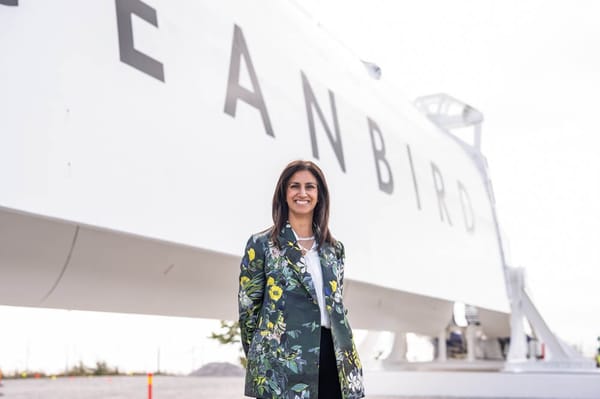
Courtesy Oceanbird
You've just celebrated the first installation of your rigid wing aboard the Wallenius Wilhelmsen PCTC Tirranna. How did that go?
I have been waiting with bated breath for the first installation, and we've delivered it without any issues so far. It's a fantastic achievement, and it is perhaps the first wind system that has had its first delivery go so smoothly. So I'm very proud of the team and the competency. It's literally all hands on deck.
What makes your rigid wing sail technology different?
I think that all the technologies that are being offered today have a space in the market, and it ultimately depends on the vessel type, the operation and the route of the vessel that will drive the different solutions that are on board. Another hugely relevant factor is the size. When you look at some of the suction wing installations, they are at the very small and - in my view - quite niche side of the market. Equally, the giant solutions that we're offering, the large wings, are for deep-sea vessels that operate on certain wind routes.
So I can't tell you today that there is a best technology or a best solution. I can tell you why I think Oceanbird will be a market leader, and it's because we're offering a valid technology that will deliver good value to the customer, improve their energy efficiency and give them fuel savings.
The wing sail is not disruptive. There are no fans or rotating parts that require a higher level of maintenance. My team has been on board with our first installation, and the feedback is that they're in awe, because it makes no noise. It stands like a giant on the vessel, and it's fantastic to see. The idea of having a real sail on your vessel, to go back to sailing, and it's fully automated so you can just watch it - it's a fantastic thing.
A second reason why I think Oceanbird will succeed is because we can take advantage today of the global service network that Alfa Laval has. We don't have to set up service or rely on a third party. We have an owner that has a fantastic global position on service that we can leverage, and place our competency out to support the customer wherever they want. When you put topside equipment on, you as a shipowner want to be supported in operation.
And the third thing is, we have the opportunity to offer optimization services. That is something we are building digital tools to do, along with StormGeo and Wallenius Marine.
You've said that shipping could return to a "fully wind-powered" operating model - what would that look like?
We have to go through a "wind assisted" period in the market, where our solution should deliver an energy efficiency gain to the customer — but that's not what we're aiming for. If you could get the majority of the propulsion from wind, that would be a massive cost savings. So how do you work that out? I think there is an opportunity. We've been focused on getting the technology installed and proving it, but that is absolutely where I believe Oceanbird will go.
What is your vision for this product line long term? Where do you see it in five years?
So we have a solution that's designed for PCTCs, pure car and truck carriers. We are also capable of adapting it quite easily to ro-ro vessels, but we also want to adapt it even further so that we can enter the tanker segment, because we believe that that's the big opportunity.
We haven't considered the kind of cargo, except that there is deck space available — you need airspace. But with the tanker, we will adapt our foundation to make it more suitable for installation on that vessel classs. That's where we see the market expansions: primarily focused on delivering to PCTC customers, opening up to the wider segment of ro-ro, then moving into tankers.
In five years' time, we want to have a portfolio of different wing sizes. We are already starting work on a smaller rigid wing. In five years, you could see Oceanbird having multi-technology options to catch the different markets, because we know rigid wing is a very solid solution for large and ocean-going vessels, but we don't know yet what will be best for smaller short-sea shipping vessels. We'll need to see the maturity of the market.
How does cost play into the discussion with customers?
What we do see is that if it's a newbuild discussion, where we are looking at putting this into a design, I would say it's a less difficult discussion on the capex side, because relative to the whole investment it is a small piece.
Ultimately, we think that if you can reduce the installation effort and footprint, that is what's going to drive success. Whether it's one large sail versus two small, we haven't seen a clear pathway on that. It will be fascinating to see how the market will take that.
It is a growing market - there are another 100 ships that are going to install wind-assisted propulsion from now until the end of '27. So there are a lot of installations coming, in part because the alternative fuel market is not really moving.
Where will you be scaling up production?

that matters most
Get the latest maritime news delivered to your inbox daily.
We're being very lean. We're not establishing our own production facility. We are so fortunate to leverage the sourcing and the supply chain that comes with Alfa Laval.
We will deliver the next two wings from our production facility in Landskrona, Sweden, and all following orders will be delivered from China. What we've established in Sweden, we will lift as a blueprint and take it to China. Our customers are building vessels and retrofitting there - why shouldn't we be close to the customer? -TME
