


Houthis Threaten Saudi Shipping Over Blockade
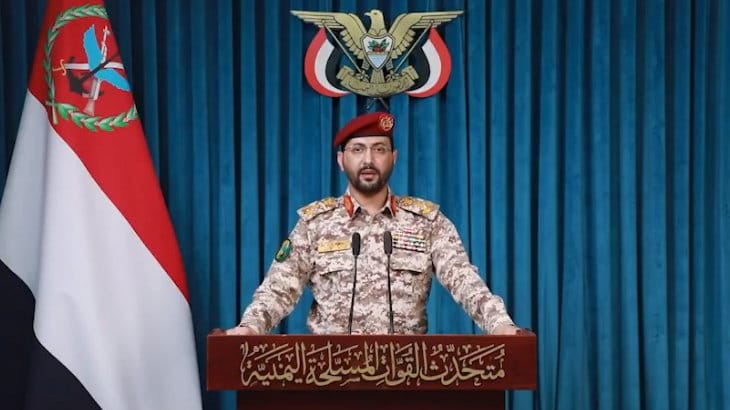
A dispute over the international blockade in place over Houthi-controlled areas of Yemen was threatening on July 20 to bring about a return to Houthi attacks on shipping in the southern Red Sea and Gulf of Aden.
The dispute has been running since a Houthi delegation managed to fly out of Sana’a International Airport at the beginning of the month to attend the funeral in Iran of the late Supreme Leader Ali Khamenei. Catching people unawares, and exploiting the fact that the flight was a special-purpose religiously-protected mourning flight, a Mahan Air flight landed in Sana’a, and conducted a quick turnaround, delivering a fait accompli. When the funeral delegation sought to return on another Mahan Air flight, someone had bombed the runway in Sana’a the night before, closing the airfield, although the aircraft was able to land in Houthi-controlled Hodeida instead.
Since then, the Houthis have been trying to exploit the half-open door to get a general lifting of the air blockade in place over Houthi-controlled Yemen. Although authorization of flights in and out of Houthi-controlled areas is primarily a matter for the Internationally Recognized Government (IRG), the Houthis have targeted the Saudis as the key influence in their search for a solution. It had been thought that a UN-brokered gesture, permitting a first air link to the outside world courtesy of a regular service to Jordan, might provide a pathway to a solution. But in a statement posted on Telegram, Brigadier General Yahya Saree, the excitable Houthi military spokesman, has announced that as part of a “blockade for blockade” strategy, an immediate blockade on Saudi shipping is to be introduced by the Houthis.
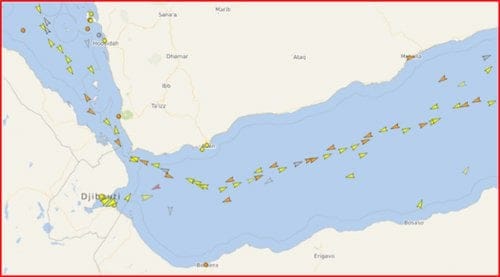
Heavy traffic on the Maritime Security Transit Corridor, July 16 (VesselFinder)
Statements from Brigadier Yahya normally reflect official policy, but in this instance, it is not clear where or to what the blockade will apply. As of midday on July 20, the official Houthi website used for posting instructions to shipping and hosted by the gloriously-misnamed Humanitarian Operations Coordination Centre (HOCC), had not posted any updated instructions, and indeed is still carrying a statement from the Houthi President of the Supreme Political Council Mahdi Al Mashat “affirming his commitment to freedom of navigation for all except the Zionist entity and those who support it in its aggression against our people in Gaza.”
It is not yet clear whether the statement from Brigadier Yahya represents a genuine policy change from the Houthis, or is yet another turn of the screw in negotiations between the Houthis and the Saudis over a final settlement to the conflict in Yemen. These negotiations have been dragging on since March 2022, when the current de facto ceasefire came into force in Yemen.
The Houthis have hoped they were making progress in their Omani-mediated negotiations with the Saudis, aiming for a full and final settlement to the Yemen civil war. The Houthis have been holding out for a recognition of their political autonomy, a lifting of the economic blockade which has isolated them from global trading, and last but very much not least, a huge financial subsidy which would have enabled the Houthis to consolidate their political control over the areas they control. The Houthis have been pitching for $13 billion, in effect the unpaid salary roll of the Houthi rebel movement for the last decade, payment for the very people who have been waging war on the Saudis and the forces of the IRG since 2014.
Houthi hopes had been rising that the Saudis were now more inclined to settle on favorable terms, having lost their export channel through the Strait of Hormuz, which has made them even more dependent on export routes through the Red Sea, which the Houthis can threaten. The Saudis have not seen it quite that way, believing that the IRG is now better able to match the Houthis on the battlefield, now that separatists previously sponsored by the Emiratis have been brought into the IRG unified military command structure.
The impact of a Houthi maritime blockade will very much depend on how it is enforced – and what any response to it will be. The Saudi interest in fighting back is now hugely magnified, given that Saudi oil exports to Asia from Yanbu are moving south through the Red Sea. Cutting off the bare minimum needed to keep critical services going in countries such as Korea and Japan would motivate others to join in as well.

that matters most
Get the latest maritime news delivered to your inbox daily.
The Houthis also know that the United States is thinking of developing its political-military presence both with Somaliland and Eritrea, a development in their immediate neighborhood which the Houthis would not wish to nurture by being provocative at this juncture. By going back to war, the Houthis risk more of the punishment that they suffered and did not enjoy during Operation Rough Rider, and also risk the Saudis moving from a policy of containment to one of resolution through the application of force.
A Houthi blockade this time round, however, is unlikely to attract much response from the United States, preoccupied by the conflict in Iran. This may be part of the calculation, and the crucial response this time may come instead from the EU Operations Atalanta and Aspides, which could be reinforced by naval forces from the Coalition of the Willing, which remain in the Arabian Sea, without, unfortunately, their key strike platform, the French carrier FNS Charles de Gaulle (R91), which is now safely back in Toulon.
