


HII Brings In Robotics for Shipyard Grinding, Blasting and Painting
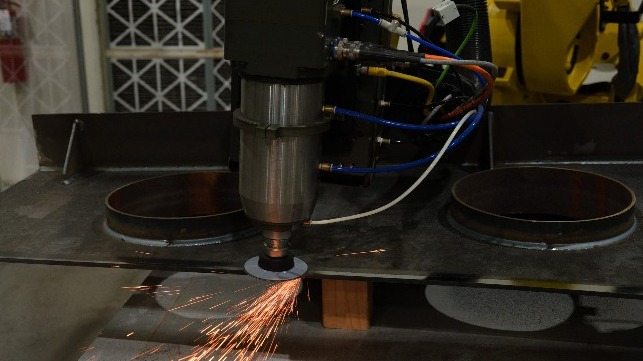
Most of the high-profile robotics initiatives in shipbuilding focus on welding or cutting, but there's much more that has to happen to get a ship into the water. Huntington Ingalls Industries (HII) wants to automate another few steps in the construction cycle - blasting, coating and inspection - and has enlisted the help of physical AI company GrayMatter Robotics (GMR) to move the work forward.
HII builds nearly all of the U.S. Navy's full-size surface combatants - the destroyers, amphibs and carriers that make up the most visible parts of the fleet. Save for General Dynamics Bath Ironworks, which builds one destroyer per year, all of the largest gray hulls entering commission come from HII's yards in Newport News and Pascagoula. That makes HII's production rate a critical factor for the U.S. Navy, and the company is working hard to increase it despite longstanding challenges in workforce development.
GrayMatter is in the business of automating factory-environment surface treatment processes, including grinding, sanding, blasting and spraying. It says that its robots are up to 12 times faster than skilled people at the same tasks, and that it can cut down rework by 95 percent thanks to higher consistency and quality. Its solutions eschew the humanoid robotic trend in favor of more a traditional industrial format: steel articulated arms with servo controls. Its value-adding innovation is in AI-enabled control software that can be set up quickly on new tasks, without advanced programming skills or precise fixturing.
"By working with new partners like GMR we can further augment our workforce and speed up U.S. Navy shipbuilding production," said Eric Chewning, HII’s executive vice president of maritime systems.
Earlier in the year, HII announced a deal with Path Robotics to bring advanced robotic welding technology into its shipyard environment, as is seen with increasing frequency in South Korea. Portable welding robots are making their way into Korean panel lines and even out into the yard, where smaller hand-carried "cobots" are gaining traction.

that matters most
Get the latest maritime news delivered to your inbox daily.
"Welding is one of the hardest processes to automate in any industry, and shipbuilding is no exception. Path’s physical AI is purpose-built for that challenge – seeing, understanding, and adapting to real world conditions in real time," said Andy Lonsberry, Path Robotics CEO and co-founder, in a statement earlier this year.
With help from tech vendors like Path and GrayMatter, HII hopes to boost throughput by another 15 percent this year, matching last year's performance growth.
