


Flood Wipes Away Chinese "Belt and Road" Border Port in Nepal
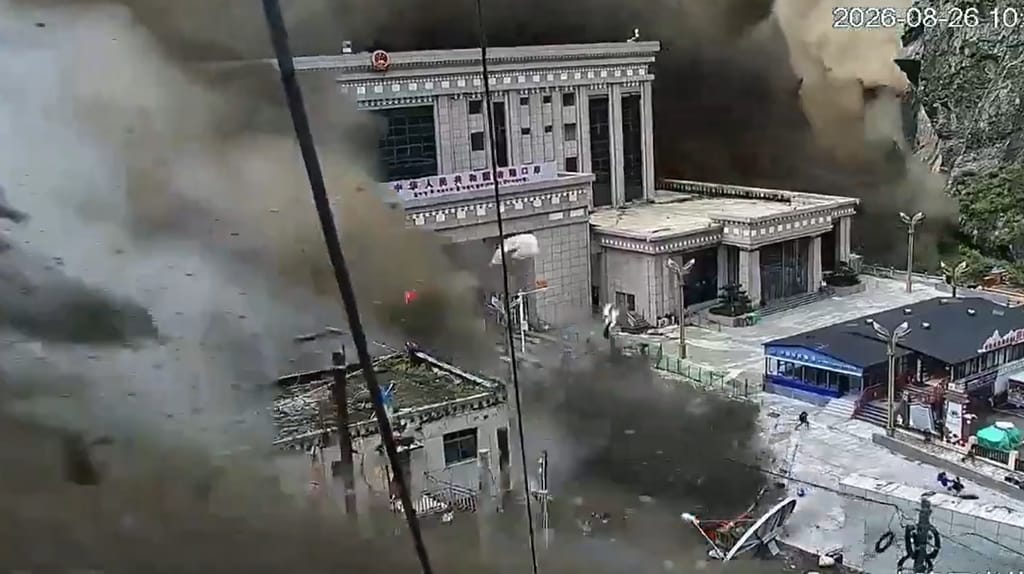
A flash flood initiated by a glacial collapse swept through mountain valleys on the Chinese-Nepalese border on Wednesday, erasing villages and leaving 1,400 people missing. Among the casualties was a key Chinese "Belt and Road" development project: a well-developed border crossing called Gyirong Port, which handled about $600 million in annual trade between Nepal and China. d
Videos from Gyirong show the force and inevitability of the powerful flash flood. Video taken from the Chinese side of the port shows locals running to escape about 30 seconds before a geyser of rock and mud envelops the border crossing, sweeping away buildings. Post-casualty satellite footage provided by Vantor shows an undeveloped landscape virtually free of roads, buildings or other signs of human habitation.
A massive mudslide struck Gyirong Port on the China-Nepal border, with CCTV footage showing a wall of debris slamming through the crossing in seconds, tossing vehicles and buses.
— Clash Report (@clashreport) August 26, 2026
Nepal reports at least 8-16 dead with hundreds of travelers listed as missing, including 291… pic.twitter.com/ZXfDIUaGsC
High-resolution satellite imagery from @vantortech shows the aftermath of the devastating floods along the Nepal-China border. This is the Gyirong Port/Rasuwagadhi border post (location: 28.280, 85.377). pic.twitter.com/mAtedv8DN2
— Christiaan Triebert (@trbrtc) August 27, 2026
Watch the final seconds.
— Zhai Xiang (@ZhaiXiang5) August 27, 2026
Newly released aerial footage from one of the first aircraft of the Chinese military's Xizang Command to reach the disaster zone shows the scale of the devastation from above.
Then Gyirong Port comes into view.
Entire sections of the border complex… https://t.co/fDEVIKqbp8 pic.twitter.com/wFHUXvGtyK
Gyirong Port was known to be vulnerable to flooding: it was closed for the second half of 2025 because of damage from last year's flooding on the Trishuli River, which took out the bridge at the border crossing.
This year's devastating flash flood followed the same path, but with far greater force. The 2025 flood was caused by the sudden overflow of a glacial lake upstream, in Tibet - a common and deadly hazard in Himalayan valleys, increasingly frequent because of glacial retreat, meltwater accumulation and thawing permafrost in the high mountains.
The 2026 flood was likely caused by the collapse of a glacier and a massive rock-ice avalanche on the north shoulder of Langtang Lirung, a mountain upstream on the Nepali side of the border. Post-accident imagery shows that the resulting flood of water and rock scoured the vegetation off the valley walls about 100 feet or more above the usual height of the riverbank.

that matters most
Get the latest maritime news delivered to your inbox daily.
Some of the debris from the mudflow has piled up into a natural dam a few miles upstream of the Gyirong border crossing, and is turning the location into a lake. That dam will continue to fill for days because of ongoing rainfall, according to Chinese authorities - and could burst and cause more flash flooding downstream.
Relief operations are under way to hunt for survivors and bring aid to villages that were cut off by the torrent of water, which wiped away the rudimentary roads that wind up the Trishuli River valley. The area is a popular tourism destination, and among the 1,400 missing are hundreds of foreign nationals, including 65 American citizens.
