
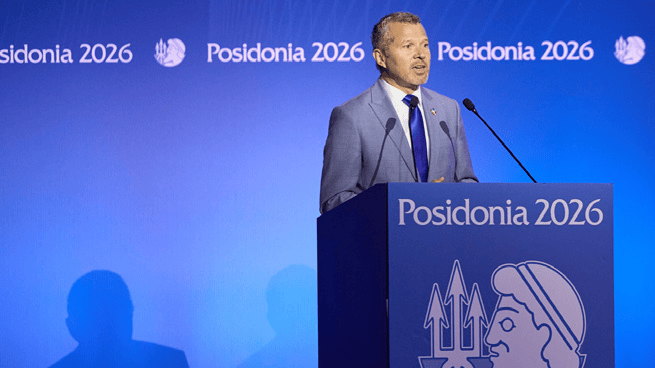
Executive Interview: Arsenio Dominguez, Secretary-General, IMO
He’s the face of the global maritime industry – and its voice, too. His energy and enthusiasm are contagious as is his concern for the safety and security of seafarers worldwide. In an industry that’s rapidly changing and a world that’s increasingly divid
(Article originally published in Sept/Oct 2026 edition.)
There are challenges galore, but that doesn't faze him. The charismatic leader of the IMO sees challenges as temporary obstacles – bumps in the road that need to be fixed or avoided – not as permanent roadblocks. His goal is to find solutions, not assign blame: "I prefer to always look at where we're making progress, where we can do something that brings important changes to the sector, particularly those that would allow us to be safer, more transparent, more secure, more inclusive and more diverse."
It's a comforting voice.
Learn more about the IMO chief – what drives him and what his vision is for the IMO and maritime itself – in our exclusive interview.
Welcome, Arsenio, and thanks for joining us! We're honored to have you on our cover. Tell our readers a bit about yourself – your background and education – and what attracted you to the maritime business in the first place.
Thank you, Jack.
I'm from Panama and grew up very close to the Panama Canal, and that's one of the things that attracted me to shipping at an early age – just watching the vessels going in and out of the canal. It's also the reason I decided to study naval architecture. I went to the University of Veracruz in Mexico, graduated in 1995 and came back to Panama where I started working at a shipyard in Panama.
After getting some very good practical experience, I was recruited by the Panama Maritime Authority to go to London and represent Panama at the IMO, and I did for nearly 20 years, during which I also earned an MBA. I eventually became Ambassador and Permanent Representative of Panama to the IMO.
In addition to improving the implementation of IMO rules and policies at the Panamanian registry, I learned more and more about the IMO itself and eventually began chairing meetings of various groups and major committees such as the Marine Environment Protection Committee (MEPC). In 2017, I was invited to join the IMO Secretariat as Chief of Staff. From there, I moved up to Director of the Administrative Division. In my last two years before being elected Secretary-General, I was Director of the Marine Environment Division.
In 2023, the Member States entrusted me with leading the Organization, and I started in 2024 as the 10th Secretary-General of IMO. So that's my life story in a nutshell!
Impressive! Is it a four-year term?
So yes, it's a four year term. My first term comes to an end in December of next year, and of course there's the possibility of reappointment for a second term, which the IMO Council is going to discuss at its next meeting in November. So we will find out soon whether I have a second term or not.
What is the role of the IMO?
We're a specialized agency of the United Nations, established in 1948, with responsibility for the safety and security of shipping and seafarers and the prevention of marine and atmospheric pollution by ships. Our mission is safe and secure shipping on clean oceans. Simply put, we're the ones who set the rules – the regulatory framework – for global shipping.
So every ship engaged in international trade needs to comply with the rules of the IMO. There are more than 50 international treaties and dozens of Codes – SOLAS, MARPOL, STCW, the ISM Code, to name a few. Those are all IMO conventions or what we call "regulations" adopted by our 176 Member States to help maintain a harmonized approach when it comes to safety and security of seafarers and the protection of the environment.
Our work also supports the U.N.'s sustainable development goals as ships deliver over 80 percent of the goods needed by everyone on the planet. Shipping plays an essential role in everyone's life, yet few people realize its importance. We're trying to change that – make shipping more visible and transparent and, in the process, highlight the importance of the seafarers who make it all happen.
Does each Member State get one vote – from the smallest country to the largest?
Yes, they are all equals. It's one Member, one vote. We tend to work on consensus rather than immediately thinking about voting.
The only area where there's a difference is the assessment of Member State contributions to the regular budget of IMO where our formula takes into account the tonnage of the flag States. So countries with the largest number of vessels by tonnage will contribute more to the IMO's budget than those with smaller tonnage.
But when it comes to the rule setting, every single Member State is equal.
Is the IMO self-sustaining and self-funded?
Yes. The main funding comes from the Member States, and our budget is not nearly as big as that of other agencies despite the fact that we regulate a huge mode of transportation that delivers over 80 percent of the world's goods. We're 270 people in the IMO Secretariat, with a budget of around $40 million per year.
Let's talk about war risk and what's going on in Hormuz and the Black Sea. What is the IMO doing to help reduce the risk to seafarers? What can the IMO do?
That's a very good way of putting it: What are we doing and what can we do? First of all, the number one message always is that seafarers are of the highest importance for us. I continue to condemn all the attacks on innocent seafarers and merchant ships in the Red Sea, the Black Sea and the Strait of Hormuz.
We're focusing first on assistance to the 6,000 seafarers who are still trapped in the Strait of Hormuz by ensuring they are provided with supplies and assistance with mental health issues, fatigue and stress. We work with organizations like the International Transport Workers' Federation, representatives of the different sectors in shipping, shipowners and the seafarers' home countries.
In that way we maintain the momentum not only to keep very much in the headlines that our priority is the seafarers, but the fact that we still need to do more.
We also engage in negotiations with all the Member States of IMO, particularly those involved in the conflicts and the surrounding countries affected, in order to see what practical mechanisms we can put in place – for example, the risk assessments that need to be carried out before any ship makes any decision to transit through these areas.
Unfortunately, many of the root causes are beyond the remit of IMO. We are mostly a technical Organization, but with geopolitics affecting seafarers and shipping, we need to engage with those who have a say so they understand the problems shipping faces and that we can assist with any information they need to bring about a final solution. And that's what we're doing.
You travel a lot and give a lot of speeches. What do you tell people in your travels?
The first message is always the seafarers because unfortunately they tend to be forgotten. And maybe one of my priorities in doing that is because, when it comes to the Middle East conflict in particular and even when I speak to the media, the focus is usually on the oil transits and the price of oil and how the global economy is affected.
For me, it's important that we look at the humanitarian side of things before we start talking about the economic impact and all the negative effects at the pump and in the grocery store. That's one of my first messages.
The second is continued engagement with countries at different levels because even though my direct points of contact are normally the ministers of transport or of maritime affairs, engaging as well with other entities and people in those countries helps them better understand the actions we're taking that need their support to bring them onto the table, either at the level of the U.N. General Assembly or U.N. Security Council or any other negotiation that's taking place.
Climate change and the Net Zero Framework is another important issue. You've been front and center on that for a long time and helped create the NZF, and there's another meeting of the MEPC coming up in December. What are your thoughts on the current situation and where we are, and what about nuclear energy as a possible solution?
The reduction of air pollution and of greenhouse gas emissions has been on the IMO's agenda since the 1990s when MARPOL Annex VI was developed and adopted. It entered into force in 2005. We've enhanced the efficiency of shipping greatly since 2011 when we introduced the first set of rules for the energy efficiency design index (EEDI). We've progressed ever since with technological developments and operational improvements.
The 2023 IMO GHG strategy is still very much in place, guiding us in formulating the next set of rules, and we're on track to meet our challenge to decarbonize the sector by around 2050. Geopolitics is, unfortunately, having an impact on the way some of our discussions are taking place, but what's important is that progress continues to be made.
The Member States are actively engaged in discussions and conversations, addressing the concerns that exist on both the measures we have in place and the technical and economic mechanisms that will allow us to progress the decarbonization process. And that's what we expect to focus on in the next round of negotiations – those areas that would allow us to move forward. Member States are continuing negotiations to address the concerns that exist and allow us to make the necessary progress toward meeting the goals of our 2023 strategy.
Equally, we're looking at not only training for seafarers when it comes to new technologies and fuels but also developing the safety regulations for ammonia, methanol, ethanol, biofuels, hydrogen-derived fuels – you name it – to be used in a safe manner because any transition has to be safe. Technologies like wind propulsion, solar, carbon capture and sequestration are also being discussed.
The most recent one that has come into focus and is gaining a lot of traction is nuclear, and in fact we already have it on the table.
We've agreed to revise our nuclear code because it's already due for a revision given all the new technological developments. We're at the beginning of this process and are working with the International Atomic Energy Agency on the ATLAS (Atomic Technologies Licensed for Applications at Sea) project.
Launched in August, ATLAS bridges the gap between the nuclear and maritime communities to support the safe deployment of nuclear power – specifically, Small Modular Reactors (SMRs) – for commercial ships. So that will help us in determining what safety measures are needed, and it's one of those areas that in the next few years will see a lot more development and experience being brought to the table to revise the code and make the transition safer.
You are such a charismatic leader and speaker – where does all that energy and enthusiasm come from?
I suppose I could just credit my parents. They're the ones who educated me and guided me in life.
I'm just a very positive person. I always like challenges. I like to engage with people, to find solutions, not to accuse or blame. It's one of the reasons that drove me to not only work at IMO but also to lead the Organization because there's so much more we can actually do.
There's so much negativity in the world right now, but I prefer to always look at where we're making progress, where we can do something that brings important changes to the sector that allow us to be more transparent, safer, more secure, more inclusive and more diverse – and in that way be more attractive to the younger generation, the ones who are going to take the mantle from us.
Yes, great point! What do you say to the younger generation? How do we encourage them to get involved with maritime – whether as seafarers or shoreside?
It's a big issue, and since the COVID pandemic and with all the global conflicts right now, it's becoming even more of a challenge because we need to provide security for them as well.
But at the same time, shipping is an incredibly enriching and wide-ranging career. You can start as a seafarer, then you can move onshore and start a whole new career as a ship broker or surveyor or cybersecurity expert or logistics manager. And with all the transformations going on – automation, the green transition, new technologies and fuels – it's a very exciting time to become part of the shipping sector.
And that includes being more welcoming for women. We've already introduced mandatory training requirements when it comes to addressing sexual harassment.
Shipping is evolving, and we need the younger generation to help us evolve to what they expect shipping to be in the future.
What is your vision for the IMO? You sit at the top and have been involved for years with the IMO and the maritime industry itself. How do you see the future?
It's particularly important that we enhance the visibility of shipping and of the IMO itself, because that makes it easier to attract people and for people to be involved in finding solutions, whenever shipping is concerned.
I see an industry that is becoming more adaptable and welcoming to change. We're traditionally a very male-dominated sector, but we talked about the shortage of qualified seafarers and what better opportunity than to tap the 50 percent of the population who are women? That would bring so much more into our industry. Equally, we need to be more transparent and more diverse, and that will allow us to be more welcoming to the younger generation and be more technologically savvy.
It's also important that we drive change rather than just adapt to it. To do that, we need to engage more beyond shipping.
For a long time we were comfortable working within our own environment. But whenever you talk about automation or areas like decarbonization and cybersecurity, we cannot do that alone because we're not the only ones facing those challenges. So we need to engage.
I see an IMO engaging beyond the shipping sector, learning from others and attracting them to be part of the solutions we're looking for, whether it be in decarbonization, cybersecurity, automation or other new technologies. And the more that we become visible, more open and transparent, the more shipping will benefit. The Organization is ready to embrace the future.
That's what I see. That's what I would like to at least lay the foundation for so that IMO can move in that direction. I don't think I'll be able to meet all the goals I have, but I'll be happy to have an organization that at least has the foundation in place and a membership that's happy to move forward in this way.

that matters most
Get the latest maritime news delivered to your inbox daily.
Excellent! Any final words for our readers?
Yes. As I'm sure you've noticed, I love my job and this industry and this organization. I thrive on bringing about positive change and helping make things better for seafarers and the industry itself.
The opinions expressed herein are the author's and not necessarily those of The Maritime Executive.