


How Next-Gen Hybrid and Electric Transmissions Power Modern Marine Fleets
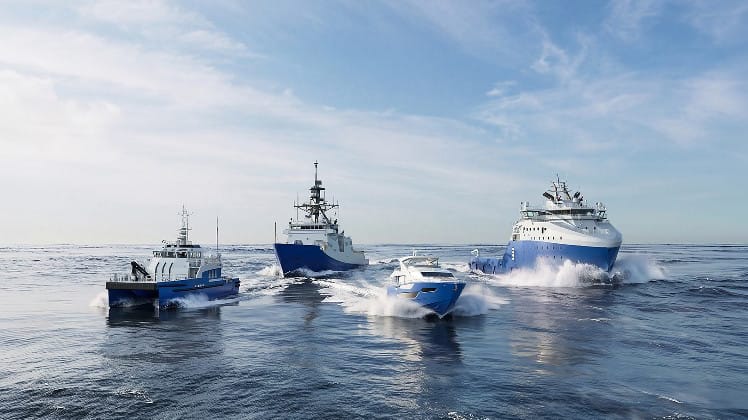
Whether navigating calm coastal waterways, managing demanding commercial towing operations, or responding to critical offshore emergencies, modern marine operators rely on precision, durability, and reliability. As the maritime industry encounters evolving operational demands, stricter environmental standards, and increasingly complex vessels, ZF remains steadfastly “Together in Every Water,” delivering world-class propulsion and service solutions engineered to conquer the toughest challenges afloat.
Building on major global showcases like SMM 2026, ZF is actively expanding its comprehensive portfolio of advanced marine technologies. From fully electric propulsion architectures to flexible hybrid systems and heavy-duty thrusters, the company’s engineering developments reflect a changing industry landscape where adaptability and power density are paramount.
Optimizing Full Electrification with ENC Transmissions
A significant milestone for the company and the greater industry is the introduction of ZF’s Electric No Clutch (ENC) transmission series. Built on the proven ZF marine gearbox platform, the ENC series is the first ZF transmission family explicitly engineered for pure e-ships and all-electric vessel applications. By eliminating the reversing clutch, the ENC design reduces clutch-related mechanical losses*. The revised lubrication system uses lower oil volume and pressure and a smaller oil pump.*
Designed to operate seamlessly with high-rpm electric motors, the ENC series optimizes power transfer to fixed-pitch propellers, controllable-pitch propellers, or waterjets. The lineup spans the ZF 2000 through ZF 9000 transmission families – covering power ratings from 650 kW up to 3,900 kW across A/V and straight configurations – making it an ideal fit for ferries, water taxis, tugs, supply boats, and tour vessels cruising on defined routes.
“There are definitely opportunities in full electrification and hybrids,” said ZF’s George Lewis, commercial/fast-craft senior manager. “People ask, ‘why don’t we just go fully electric?’ Then you get into: ‘What’s your operational profile? How do we plan to charge the vessel? Are you returning to the same location or a defined route?’ So, there are specific use cases in which a fully electric vessel makes sense. This comes down to the vessel design and operator’s needs. When you look at it, it can make for a pretty simple propulsion design.”
Lewis also highlighted the key advantage of pairing electric motors with dedicated reduction gears rather than driving propeller shafts directly: “Destroying an electric motor would be expensive and is more sensitive to thrust loads than a transmission that’s designed to handle the start and stop of the propeller itself. If we have an electric application, we take out the reversing clutch and add in a specialized oil-cooling system to ensure it can go in either direction based on the input with the electric motor. We still optimize the e-motor’s capabilities with a reduction gear compared to going direct with an e-motor to the propeller shaft.”
Heavy-Duty Hybrid and Propulsion Innovations
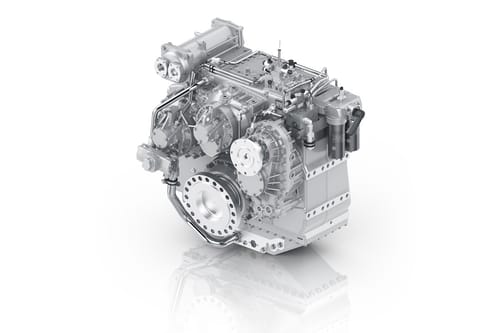
Beyond pure electric solutions, ZF continues to broaden its driveline portfolio across higher power classes. The recently released ZF 9200 A/V PTI hybrid transmission and the robust ZF AT 110 thruster demonstrate ZF's engineering leadership across commercial craft, workboats, and fast vessels.
The ZF 9200 A/V PTI represents the latest evolution in the established ZF 9000 series. Available in both V and down-angle (A) layouts, it grants significant design freedom. Accommodating up to 3,903 kW on the main diesel drive, its integrated power take-in (PTI) enables hybrid electric operation up to roughly 700 kW. Lightweight aluminum housing, full classification approval, wide gear ratios, and optional accessories – such as an integrated shaft brake or PTO units – ensure seamless integration across diverse vessel profiles.
“For heavier applications, the ZF AT 110 is the largest thruster developed by ZF to date,” said Lewis.
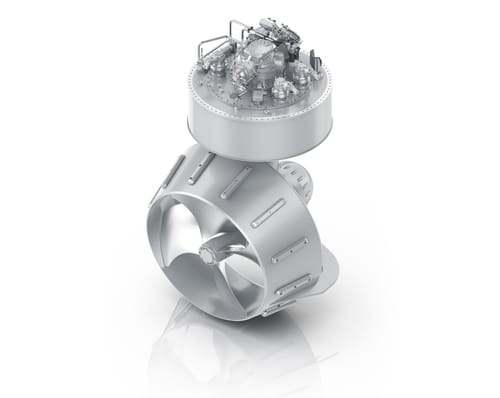
Compatible with power outputs up to 2,944 kW, the ZF AT 110 delivers bollard pull ratings around 100 tons to handle increasingly large merchant vessels in harbor and offshore duties. Designed with compact center-to-center dimensions (approximately 3,700 mm, or 3,825 mm with optional seal monitoring), the unit supports flexible hull layouts without sacrificing engine room space.
“As vessel builders navigate variable power setups, ZF transmissions can be tailored for every hull type,” Lewis added. “For lighter duty cycles, such as ferries, high-speed support vessels or pilot boats, aluminum cases save weight. Steel cases with deep reduction ratios serve heavy-duty offshore supply vessels, tugs, or pushboats. Furthermore, ZF transmissions cover applications requiring controllable-pitch propellers by pairing non-reversing (NR) units with dedicated hydraulic controls.”
Precision Handling with AutoTroll 2
Complementing these driveline platforms is the newest generation of the AutoTroll 2 speed control system. Designed to deliver precise, closed-loop low-speed maneuverability, AutoTroll 2 allows operators to slip the clutch safely during extended slow-speed maneuvers (such as dynamic positioning (DP), narrow channel transits, or delicate docking) without risking transmission damage.
The system provides five distinct rpm profiles, giving captains predictable control characteristics ranging from smooth, gradual shifting to dynamic responses. For specialized vessels like fireboats, towboats, or offshore workboats, ZF integrates AutoTroll 2 into azimuth thrusters and POD drives. In firefighting configurations, the optional AutoTroll Firefighting function slips the clutch so the main engine can run at elevated RPMs to drive high-capacity FiFi water pumps, while simultaneously delivering fine-tuned thrust control and vessel stability under severe thermal loads.
Dedicated Global Support
To explore these technologies firsthand, operators can meet with ZF’s marine team, including George Lewis, at the upcoming Pacific Marine Expo and the International WorkBoat Show. Real-world operator insights and case studies are also featured through ZF’s Profiles from the Helm content series.
ZF backs its hardware with round-the-clock technical support via 1-833-ZF-WRENCH and the ZF Marine app, providing vessel owners immediate access to component guidance, global parts networks, and expert service worldwide.
*Note that the verified effect depends on model and operating point.
This article is sponsored by ZF Marine
The opinions expressed herein are the author's and not necessarily those of The Maritime Executive.
