


Cruising Demonstrates Resiliency as Mainstream Vacation Business
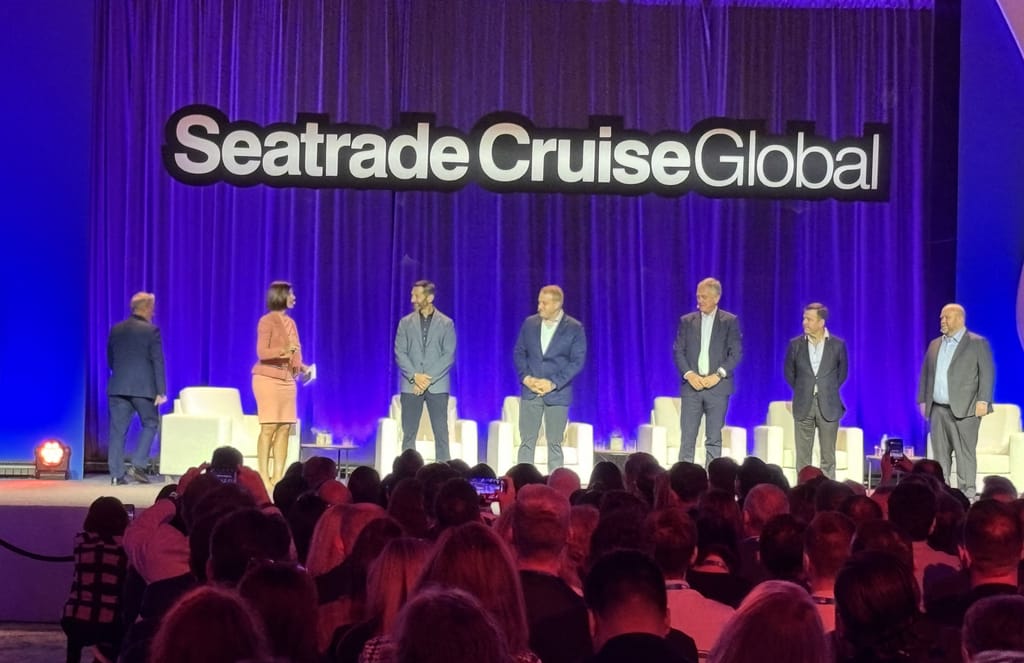
The executives leading the major cruise corporations point to the business demonstrating its resilience as they believe cruising has finally evolved into a mainstream option from its long-term position as an alternative vacation. However, they still point to the challenges of gaining recognition for the value proposition and achievements in areas such as sustainability and addressing issues of overtourism.
The executives presented an upbeat report card on the state of the industry in the opening general session of Seatrade Cruise Global 2026, the industry’s largest annual conference. Bud Darr, President and CEO of the trade group CLIA (Cruise Lines International Association), points to the 37.2 million people who cruised in 2025 while forecasting the industry will surpass 40 million passengers by the end of the decade. Even still, they recognize that cruises represent just two to three percent of the larger tourism industry.
Organizers of the event, Informa, highlight the continuing investment boom in cruise ship construction. Mary Bond, Group Director, Seatrade Cruise, highlights that their research shows the orderbook has grown to an all-time high of $86.2 billion. Further, she said two new projects, soon to be finalized, will likely take the total orderbook above $100 billion. Yet, CLIA notes that there are just 320 cruise ships among its membership (about 90 percent of the total industry) out of more than 60,000 commercial ships worldwide.
On the widely discussed issues such as sustainability and overtourism, Pierfrancesco Vago, Executive Chairman of MSC Cruises, asserts the industry needs to tell its story. “They were ‘pointing a finger’ over sustainability,” says Vago, asserting that by highlighting technology and the investment, the industry gained recognition for its efforts. He points to the successes working with local authorities in areas such as Dubrovnik, saying the industry can achieve the same recognition for its efforts to manage the impact as the ships grow larger and bring more people to a destination.
Private destinations, Jason Liberty, CEO of Royal Caribbean Group, says, are another tool to aid in managing the industry’s growth and impact. He points out that the company is investing in its private ports and beach club concepts, highlighting that Royal Caribbean will go from its current three destinations to eight, which contributes to distributing the impact of tourism when the ships reach port.
Darr confirmed that “unmanaged tourism” is a problem. He believes the industry is getting better through partnerships in meeting the challenges.
Curating experiences is also one of the big opportunities and challenges that they see for the industry. Liberty points out that the company is investing $200 to $300 million in disruptive technologies that add sensors to improve the efficiency of the ships’ operations but also to aid in making the experience “frictionless” to meet the customers’ changing expectations.
The executives acknowledge that the industry has big challenges ahead in sustainability, like all of shipping. While they point to the progress the cruise industry has made, such as its adoption of LNG-fueled ships, they note that much of the progress depends on the supply of future fuels. They believe cruise will likely focus on synthetic fuels such as methane and methanol derivatives, noting that ammonia, while likely to play a role in the broader shipping industry, is unlikely to meet the safety challenges to become a factor in cruise shipping.
Darr points out that cruising, like all of shipping, is hindered in its efforts by the lack of clarity from regulators. He points to the need for governments to achieve clear “fit for purpose” regulations, saying the lack of clarity is slowing down progress.
The cruise executives see the opportunities in personalizing and curating the cruise experience. Josh Weinstein, CEO of Carnival Corporation, points to “reducing friction” to make the cruise experience more enjoyable.
While there is much talk about how AI and technology will change society, Weinstein believes cruising will remain largely the same because it is driven by its people. He notes the humanization of the experience through the relationships formed by the crew who learn passengers' preferences and tailor the experience during their cruise.
In another demonstration of the resilience of cruising, they all agree the industry has advanced since incidents in 2012 (i.e., the wreck of Costa Concordia) and the 2013 incident, which became a media sensation (i.e., the infamous “poop cruise” when a Carnival Cruise Line ship blacked out and drifted for days with no power.
“Since the 2012 incident, Carnival Cruise Line has sailed with 50 million people safely,” says Weinstein. He, however, recognizes how the media and communication world has involved accepting that a “super vocal minority” draws attention and gets the clicks.”
However, they also see social media as a major tool that has helped to advance the image of cruising and part of the reason they no longer have to refute the images of old people and buffets as the cruise experience. Royal Caribbean’s Liberty calls social media an opportunity for “elevating the experience.”

that matters most
Get the latest maritime news delivered to your inbox daily.
They also note the growth of the luxury and expedition segments, which, while a smaller portion of the business, are the fastest growing. They also point to the entrance of the hotel brands (i.e, Ritz-Carlton and Four Seasons) as an opportunity for the industry. They believe the brands are coming to cruising as a way of engaging their loyal customer base and keeping them in the ecosystem. However, it brings new people to cruising and creates the opportunity to engage these consumers and build their interest in cruising.
“It is impossible to match the offering of a cruise,” asserts Norwegian Cruise Line Holding’s new President & Chief Executive Officer, John Chidsey. He points to the value proposition, the offerings ranging from entertainment to culinary, as remaining the key drivers and opportunity for cruising’s growth.
