


Op-Ed: The Jones Act Waiver Is Reshaping More Than Maritime Transportation
Temporary waivers are creating tax distortions, disadvantaging American operators, and undermining confidence in the merchant marine
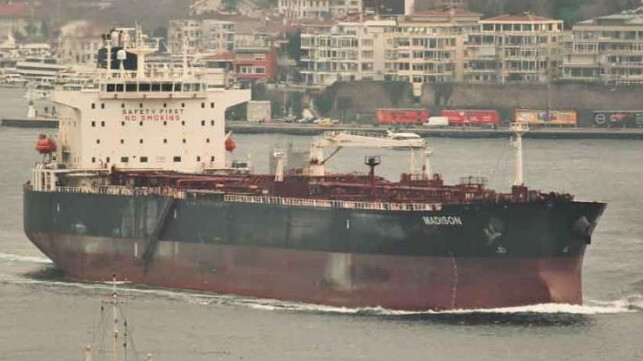
The recent Jones Act waiver debate has largely focused on vessel availability, fuel prices, and emergency logistics. Far less attention has been paid to a more consequential issue: the tax and regulatory distortions that arise when foreign-flag carriers enter domestic U.S. coastwise commerce, displacing American shipping companies and American merchant mariners.
The effects are no longer theoretical. They are unfolding in real time.
Consider two foreign-flag vessels currently operating under the Jones Act waiver environment.
The first is the Chinese-flagged Jin Zhou Wan, operated by COSCO Shipping, a company wholly owned and controlled by the government of the People's Republic of China. Throughout May, the vessel traded between U.S. ports carrying liquid cargoes between Paulsboro, New Jersey; Pascagoula, Mississippi; New Orleans, Louisiana; and New Haven, Connecticut. As of this writing, the vessel remains anchored in New Haven awaiting orders from its state-owned parent company in China.
The second is the Marshall Islands-flagged tanker Cabo Deseado. The vessel is commercially associated with Chile-based Cape Management and technically managed by Fleet Ship Management PTE, a Singapore-based company that is part of the Hong Kong, China-based Caravel Group. Since early April, the vessel has conducted multiple coastwise voyages entirely within California, transporting vacuum gas oil, low-sulfur gasoil, and heavy crude oil between Martinez, Long Beach, and Los Angeles. It is currently anchored in the Bahamas awaiting orders for its next commercial assignment.
Every voyage performed by a foreign-flag vessel under the waiver is a voyage not performed by a U.S.-flag operator. Every barrel moved by a foreign carrier is revenue unavailable to American shipping companies that pay U.S. taxes, employ American merchant mariners, support maritime academies, and invest billions of dollars in vessels built and operated under one of the world's most stringent regulatory systems.
The Jones Act waiver is creating a legal and financial windfall for foreign operators while opening the door to what increasingly appears to be a tax avoidance structure operating inside domestic U.S. commerce to the disadvantage of American companies, mariners, and shipyards.
The United States has long maintained a clear distinction between international shipping and domestic coastwise transportation. That distinction underpins federal tax law, maritime regulation, and the investment decisions of vessel owners, lenders, shipyards, cargo interests, and maritime labor.
Jones Act operators pay federal corporate income taxes, payroll taxes, state taxes, property taxes, and substantial compliance costs associated with labor, safety, environmental, and security requirements. They employ American mariners, build ships in American shipyards, and finance vessels with the expectation that the United States will maintain a stable and predictable coastwise regulatory framework.
Foreign operators function under a fundamentally different model. Many utilize flags of convenience, employ foreign labor, build ships overseas, and rely upon international shipping tax exemptions under Section 883 of the Internal Revenue Code and related reciprocal tax arrangements. Those provisions were designed to facilitate international commerce and not to be utilized for domestic U.S. coastwise trade.
This imbalance should concern anyone focused on market integrity.
Maritime and tax practitioners are already raising questions about whether foreign carriers engaged in domestic transportation may face exposure to effectively connected income rules, branch profits taxes, withholding obligations, and potential limitations on Section 883 protections. It increasingly appears that some foreign operators may be treating a temporary Jones Act waiver as a temporary tax amnesty. The Jones Act may be temporarily waived. The Internal Revenue Code has not been.
The issue extends beyond taxation. It goes directly to the long-term stability of the American maritime industry. Domestic operators cannot offshore their tax obligations, crews, regulatory compliance, or corporate responsibilities. They make long-term investments based on the expectation that the United States will preserve a predictable coastwise transportation system.
The Jones Act is not some one-off American anomaly. It reflects a principle embraced by maritime nations around the world: domestic transportation is a strategic national asset and fosters economic and national security. China, for example, strengthened its cabotage laws in the 1990s and continues to reserve its domestic waterborne commerce for Chinese interests. It does so because it understands that maritime capability is inseparable from economic security, industrial resilience, military readiness, and sovereign control over transportation infrastructure. The United States has long recognized those same principles.
The current waiver debate therefore extends well beyond short-term shipping economics. It raises fundamental questions about whether the United States intends to preserve a domestic maritime industry governed by consistent taxation, fair treatment of America’s organic fleet, and long-term policy stability.

that matters most
Get the latest maritime news delivered to your inbox daily.
These conversations are taking place right now within the corps of cadets at the state maritime academies and the United States Merchant Marine Academy. Cadets are asking a simple but important question: Is a career at sea still a stable and worthwhile path? We do not want confidence in the future of the U.S. Merchant Marine to erode. They are watching closely to see whether the United States remains committed to an American-built, American-owned, American-crewed, and American-flagged maritime industry. Today's cadets are tomorrow's captains, chief engineers, military sealift officers, and maritime industry leaders.
William P. Doyle is a former U.S. Federal Maritime Commissioner and officer in the U.S. Merchant Marine. He is a graduate of Massachusetts Maritime Academy and Widener Commonwealth Law School and serves as Chief Executive Officer of the Dredging Contractors of America.
The opinions expressed herein are the author's and not necessarily those of The Maritime Executive.
