
Coast Guard Concludes Domestic Icebreaking Operations
Following the severe winter season in the Eastern United States and the Great Lakes
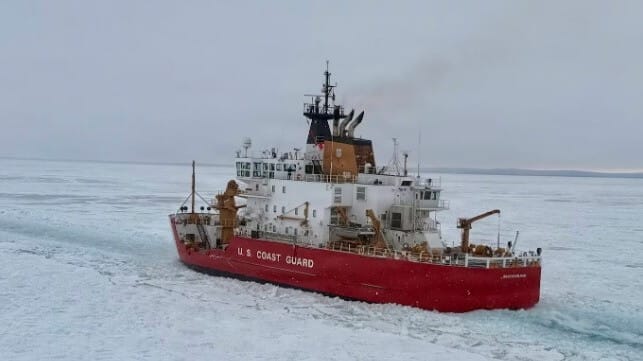
[By U.S. Coast Guard]
The U.S. Coast Guard concluded all domestic icebreaking operations in America’s Eastern and Great Lakes waterways, Thursday, following a severe winter season that continued well into spring in some regions.
Operation Taconite, the Coast Guard’s final ongoing domestic icebreaking operation, has ended as ice throughout the Western Great Lakes has nearly melted and ice breaking in support of commercial navigation is no longer required.
Throughout the 2025-2026 season, Coast Guard crews and icebreaking assets worked hard to ensure year-round movement of essential supplies, bolstering U.S. quality of life, commerce and national security.
“In the face of historic cold temperatures and icing conditions, the men and women of the Coast Guard answered the call. Powered by our domestic icebreaker fleet, the Coast Guard facilitated commerce and mitigated ice impacts to navigation and critical infrastructure on our waterways,” said Vice Admiral Nate Moore, Deputy Commandant for Operations. “From the Great Lakes to the Northeast to the Mid-Atlantic, the Coast Guard’s icebreaking operations underscored the importance of a robust, modern domestic icebreaker fleet to maintain American economic prosperity, energy security, and strategic mobility.”
Austere conditions and ice buildup that accrued after storms such as Winter Storm Fern required persistent efforts from our underway crews and assets. Coast Guard teams and partners maintained the majority of a navigable Marine Transportation System to support maritime shipping of vital products such as fuel to power plants in the mid-Atlantic, critical iron ore in the Great Lakes and home heating oil in New England.
A fleet of Coast Guard cutters that include heavy, medium and light icebreakers as well as ice-capable buoy tenders and boats worked in tandem with partner agencies and commercially contracted tugboats that were needed to augment service in areas typically used to milder ice conditions.
The Coast Guard’s leadership in icebreaking, being one of the service’s 11 statutory missions, helped keep U.S. waterways open for business and ensured navigational aids were corrected after ice flow displacement for safe navigation.
Throughout the icebreaking season, approximately 6,940 domestic ice breaking hours were provided by more than 30 Coast Guard cutters and boats to directly assist or enable the transit of 981 vessels while maintaining critical waterways availability.
Despite temperatures rising nationwide, always exercise caution when heading out onto the water due to the hazards of unseen ice and remember that hypothermia can set in within a matter of minutes.
Great Lakes Operations
Great Lakes District icebreaking missions fall under two major operations.
Operation Coal Shovel, overseen by Coast Guard Sector Detroit, is a domestic icebreaking operation that manages the safe maritime shipping of coal throughout an area spanning southern Lake Huron to the St. Clair-Detroit River system, and into Lake Erie and Lake Ontario, including the St. Lawrence Seaway.
Operation Taconite, overseen by Coast Guard Sector Northern Great Lakes, is the largest domestic icebreaking operation. It is responsible for the safe maritime shipping of taconite from mines at the Head of the Lakes to the steel mills in Lake Eerie and Lake Michigan.
Northeast District Operations
Coast Guard Northeast District winter icebreaking supports Operation Reliable Energy for Northeast Winters (RENEW) between Maine and New Jersey.
Ice breakers maintain open shipping lanes throughout the region to deliver essential goods and services, including home heating oil and other petroleum products.
East District Operations
Though icebreaking is less common in the Mid-Atlantic, recent winter weather conditions have necessitated that Coast Guard East District maintain navigable passage in areas that typically do not require icebreaking.
Utilizing Coast Guard assets to conduct targeted operations with partners and contracted assistance, the District was able to maintain navigable waterways throughout the Chesapeake Bay, and crews corrected 240 aids to navigation discrepancies to maintain the safety of essential waterways.
The products and services herein described in this press release are not endorsed by The Maritime Executive.
