
A Temporary Corridor Strategy for Hormuz
[By Frank Bell]
The Strait of Hormuz does not need to be made safe to reopen global shipping. It only needs to be made governable. Even as the United States has begun striking selected Iranian military targets—including recent operations against military facilities on Kharg Island—the fundamental challenge in the Gulf remains unchanged: restoring predictable commercial transit through a contested maritime chokepoint without triggering a broader regional war.
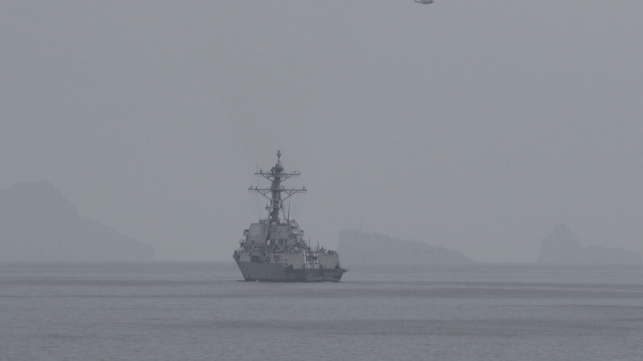
Attempts to eliminate every Iranian capability that could threaten shipping would require a prolonged campaign across the Persian Gulf. A more practical approach is to establish a temporary defended transit corridor, concentrating naval escort, airborne surveillance, shipborne helicopter protection, and a limited southern-shore defensive node into a narrow and defensible passage through the strait.
For months, analysts have treated the Strait of Hormuz as if it were either completely safe or completely impassable. In reality, maritime chokepoints rarely function in such absolute terms. Shipping does not require a perfectly safe ocean. It requires a corridor that is predictable, defensible, and credible enough for commercial operators and insurers to accept the risk.
The debate surrounding the Strait of Hormuz often assumes that the only way to restore shipping is to eliminate Iran’s ability to threaten the waterway. That assumption leads immediately to the prospect of a large regional war—air campaigns against coastal missile batteries, naval battles across the Gulf, and months of escalation.
But history suggests a different path. During past maritime crises, naval powers have frequently restored commerce not by eliminating every threat but by establishing managed transit systems that compress risk into a narrow and controllable space.
The solution for Hormuz may therefore lie not in dominating the entire Persian Gulf but in creating a temporary defended corridor through the chokepoint.
Such a corridor would rely on a layered structure of naval escort, airborne surveillance, close maritime protection, and a small defensive presence on the southern side of the strait. The goal would not be to make the Gulf harmless. The goal would be to make passage governable.
A surface escort layer would provide command and air-defense protection for merchant vessels approaching the chokepoint. Overhead surveillance aircraft and supporting fighter coverage would maintain a continuous operational picture, allowing rapid response to emerging threats. Shipborne helicopters would monitor the corridor closely, investigating suspicious vessels and countering small craft or unmanned surface threats.
One of the most important—and most overlooked—components of such a system would be a small but visible defensive node on the southern side of the strait, operating in cooperation with regional partners. Positioned near the tip of the chokepoint, this element would provide persistent radar coverage, counter-UAS capability, and rapid-response support for the corridor.
Such a presence would serve not only operational purposes but also political ones. It would demonstrate that the coalition physically holds the non-Iranian side of the chokepoint, reinforcing the legitimacy of the corridor and strengthening deterrence.
A defended corridor strategy would also emphasize scheduling. Instead of allowing ships to transit independently at random times, merchant vessels would move through the chokepoint in controlled waves under escort. This approach concentrates defensive assets during the moments of greatest risk while reducing operational costs and exposure.
The corridor would not eliminate Iranian capabilities. Mobile launchers, drones, and small craft would still exist. But the layered defensive structure would compress the time and space available for attacks, raising the probability that hostile actions would fail.
Most importantly, the corridor strategy would be temporary.
Rather than establishing a permanent naval security regime, the mission could be designed with a fixed six-month duration. During that period, repeated successful transits would restore commercial confidence and stabilize insurance markets. If the corridor proves effective, the operational burden could gradually shift toward regional partners and routine commercial practices.
The alternative to such a strategy is a choice between paralysis and escalation: either accept the disruption of global shipping or embark on a large military campaign aimed at destroying Iran’s entire coastal defense network.
A temporary defended corridor offers a third option. It acknowledges that the Gulf will remain dangerous while demonstrating that danger does not automatically translate into closure.
The Strait of Hormuz does not have to be perfectly safe. It only has to be open.

that matters most
Get the latest maritime news delivered to your inbox daily.
Francis J. Bell is a graduate of Temple University’s Fox School of Business. He works as a private consultant with interests in strategy and international security. His writing focuses on maritime doctrine, deterrence, and emerging operational concepts.
This article appears courtesy of CIMSEC and may be found in its original form here.
The opinions expressed herein are the author's and not necessarily those of The Maritime Executive.