

When the Hacker Comes Aboard
Maritime cyber gets real as incidents rise.
(Article originally published in Sept/Oct 2026 edition.)
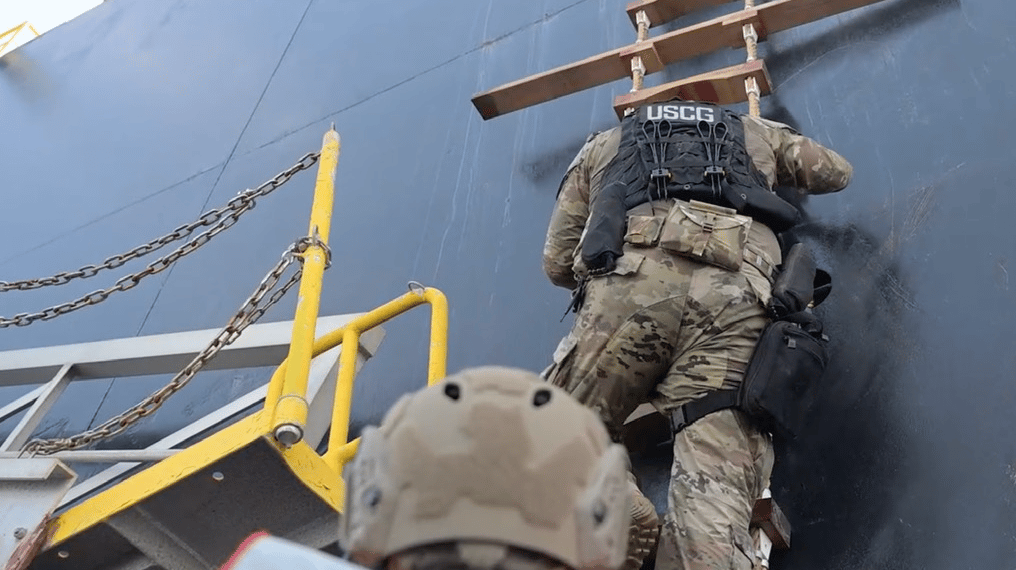
Somewhere offshore in the Gulf, a foreign-flagged commercial vessel is inbound for the U.S. But this won't be a routine port call.
A Coast Guard team approaches at sea. Alongside law enforcement personnel and a vessel inspector are specialists from a Coast Guard Cyber Protection Team and operators from the FBI's Cyber Action Team.
Their target is not hidden contraband or a suspicious crew member.
It's the ship's network.
On August 21, U.S. authorities boarded the first of two inbound foreign-flagged commercial vessels after indications their networks had been compromised. Three days later, another multi-agency team boarded the second vessel.
The Maritime Executive reached out to the FBI which, together with the Coast Guard, confirmed the operations. "The measures were designed to ensure the integrity of the vessel's operational and information technology systems following indications that the networks of both vessels were compromised," the agencies said.
No operational disruptions, vessel instability, danger to crews or environmental impacts were reported. Early speculation had raced ahead of what investigators confirmed.
But what came next should command the industry's attention.
On September 4, Coast Guard Cyber Command and the FBI issued a Maritime Cyber Alert warning that they had observed nation-state threat actors exploiting vulnerabilities in Fortinet FortiGate devices used by vessels and facilities throughout the marine transportation system (MTS).
Citing the Cybersecurity and Infrastructure Security Agency (CISA), the alert said credentials associated with 74,000 Fortinet devices, including firewalls and VPN gateways, had been compromised and leaked. Attackers were using compromised credentials, brute-force attacks and vulnerabilities to gain access, move laterally through networks, escalate privileges and establish persistence.
The trend is moving in the wrong direction. Coast Guard Cyber Command recorded 42 reported MTS cyber incidents in 2025, up 17 percent from 36 in 2024. Operational technology (OT) was included in 62 percent of its cyber missions, up from 46 percent the previous year, while demand for Coast Guard OT testing increased 35 percent.
Someone is already knocking on the door.
Inside the Ship
To understand what they might find once inside, we spoke with Russell Kempley, CEO of CyberOwl, a DNV company monitoring cyber activity aboard operating vessels.
"Malware that creates a backdoor or remote access is the most common type of malware," Kempley said, estimating it accounts for over 60 percent of the malware CyberOwl detects.
Often, the first attacker establishes a foothold and sells access to another actor for ransomware, data theft or another objective. CyberOwl's goal is to stop the intrusion before the next stage. On one container vessel, CyberOwl discovered remote-access malware on business computers while a cargo system was also improperly connected to that network.
The cargo computers receive manifests and calculate loading and weight distribution, functions an attacker might try to manipulate. Kempley stressed that, in this case, there was no evidence the attacker intended to target the cargo system, and several barriers remained between the malware and physical consequences.
But the pathway existed.
"We're talking about a very common thing," he explained, "which is some kind of remote access malware, and then a less common thing, which is a credible pathway to an OT risk."
CyberOwl sometimes discovers up to 20 unexpected, connected devices aboard a single vessel including personal devices, CCTV systems and IoT sensors installed without Information Technology (IT) departments knowing they exist.
Kempley described a potential risk from engine-room business computers equipped with two network interfaces. An extra Ethernet port or USB adapter can inadvertently bridge networks that should remain separate. CyberOwl sees a handful of these segmentation breaches each month as more vessels enable monitoring, although serious cases are much rarer.
Incorrect firewall rules can similarly open paths between IT and OT. Occasionally, crews have even connected systems to crew Wi-Fi to make access or updates easier.
Then there are the vendors. If a supplier's legitimate VPN access remains open too long and the supplier is compromised, an attacker could "jump through that remote access and into your engine system," Kempley said.
The defenses are not exotic. The FBI and Coast Guard recommend patching known vulnerabilities, inspecting firewall and VPN logs, resetting potentially compromised credentials, enforcing multi-factor authentication, replacing unsupported equipment and, critically, confirming segmentation between IT and OT.
CyberOwl tackles the problem from inside the vessel: Know what is connected, continuously monitor network behavior, tightly control vendor access and find small vulnerabilities before an attacker can exploit them.
That kind of visibility matters at sea, where crews troubleshoot equipment far from shoreside support and sometimes create workarounds that solve an immediate operational problem while quietly creating a cybersecurity one.
The basics still matter. During 2025 Coast Guard cyber missions, its teams successfully gained initial access through phishing in 53 percent of attempts. Across all missions, they cracked 4,605 passwords and identified 273 known exploitable vulnerabilities.
IACS Unified Requirement E26 addresses a ship's cyber resilience as an integrated IT/OT environment while E27 addresses onboard systems and equipment. The revised requirements apply to new ships contracted for construction from July 1, 2024, leaving a formidable legacy fleet built before those protections were installed.
From Digital Access to Physical Consequence
Could someone actually take control of a ship?
A cyberattack causing major operational or safety impact remains extraordinarily difficult. An attacker must compromise the right ship, reach relevant OT, understand proprietary equipment, defeat controls and act before the crew recovers through redundancy or manual procedures.
"Ships are intended to be resilient," Kempley said. "You've got lots of backup systems. You've got crew processes."
In the container-vessel example, an attacker might have obtained credentials using a keylogger to move from the infected business PC to the cargo computer. Then they would likely need to find an exploitable vulnerability to manipulate it without the crew intervening.
Artificial intelligence could begin shifting that equation. Kempley believes AI may accelerate vulnerability discovery in specialized OT equipment, making weaknesses that once required significant expertise easier to uncover.
Some cyber-adjacent consequences are already visible on the bridge. During GNSS spoofing, ships can suddenly appear to "jump" hundreds of nautical miles or more to false coordinates. Affected vessels also rebroadcast false coordinates through AIS.
"You might have tens of vessels on AIS all telling you they're at the same location," Kempley said. AIS may scream that dozens of vessels occupy the same water while failing to warn accurately about the ship actually ahead. Mariners can fall back on radar, visual lookout and conventional navigation.
Turn On the Lights
Ask Kempley what happens when CyberOwl turns monitoring on aboard a ten-year-old merchant ship, and he compares it to curing blindness. Usually, there's no single catastrophic discovery.
Instead, the lights come on.
Software nobody knew was installed. OT systems that are calling home. Operating systems that missed updates. Stale antivirus. Emergency administrator credentials that became everyday passwords. Personal devices attached to business networks. IoT sensors installed without IT knowing.
Hundreds of small cracks rather than one gaping hole.
The problem also scales. Ship managers must defend entire fleets, not individual vessels. Different generations of ships, OT systems and cyber requirements make repeatable cybersecurity practices increasingly important.
The nightmare scenario remains difficult. Ships are resilient. Crews are resourceful, and turning digital access into physical consequences requires a formidable chain of failures.
that matters most
Get the latest maritime news delivered to your inbox daily.
But the FBI and Coast Guard are now boarding ships after network compromises and warning that nation-state actors are targeting technology used throughout the MTS. Before an owner can defend the ship, there's a more fundamental question: Do you actually know what's connected to it?
Based in Asia, Sean Holt is a technology columnist for The Maritime Executive. His work spans maritime, AI, autonomy and emerging industrial technologies.
The opinions expressed herein are the author's and not necessarily those of The Maritime Executive.