

Massive Attack on Russian Shipping in Benghazi
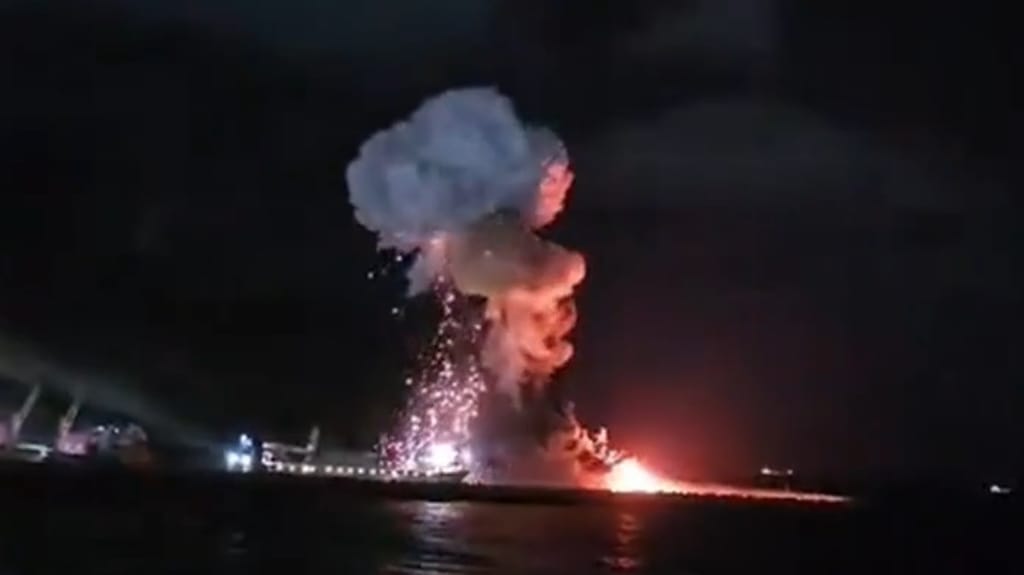
The Russian Navy's Steregushchiy-class corvette RFS Merkury (F535) has from all appearances suffered a catastrophic explosion, having been attacked in Benghazi harbor. There is no indication of a heat flare detected on the NASA FIRMS system, but video of the explosion appears to place the vessel on one of the outer walls of Benghazi harbor. Analysts with access to satellite imagery sources have confirmed having seen evidence of a massive explosion, with the ship seen submerged on its side several hours later.
In the video of the explosion, it appears that the explosion has initiated the launch of a number of missiles from the 12 vertical launch system cells with which Steregushchiy-class corvettes are equipped. The explosion also illuminated the profiles of two cargo ships further along the mole which were equipped with derrick cranes, as are the Russian military cargo vessels previously used to make deliveries to Mediterranean ports.
The attack is reported to have been carried out by up to six explosive-laden uncrewed surface vessels (USVs), and the size of the explosion would tend to confirm this.
After the attack on RFS Merkury, two cargo ships were also attacked, one of which has been identified as the sanctioned civilian-manned military cargo vessel Ascalon (IMO 9198226). Ascalon and Anastasiia (IMO 9349291) set off together on October 31 from Baltiysk in Kaliningrad, passed through the Strait of Gibraltar on the evening of November 13, and had been traveling dark without AIS since then. The second vessel reportedly attacked was Maltese-flagged, and it is possible the attackers believed this second ship was the Anastasiia.
Naval News reported that the warship had been in Benghazi harbor for several days and had been escorting several Russian civilian-manned military cargo vessels.
A second escorted Russian military convoy was noted off southern Sardinia on November 18. This convoy was being escorted by the Admiral Gorshkov-class frigate RFS Admiral Golovko (F456), and consisted of three sanctioned military cargo vessels, the Lady R (IMO 9161003), Lady D (IMO 9349289) and the Maia-1 (IMO 9358010). The three ships were previously seen forming up in convoy and leaving Baltiysk in Kaliningrad on November 5. The convoy was being supported by the Altay-class oiler Yelnya (IMO 6813095).
Libyan authorities from the unrecognized administration of Field Marshal Khalifa Haftar tried to suggest that the ships attacked were "making a call on their way back to Russia." But deliveries of arms to Field Marshal Haftar's Libyan National Army in Benghazi have been a regular occurrence for several years. They are part of a strange alliance in which both the United Arab Emirates and Russia are supporting one faction in Libya, while the United Nations and Turkey support the internationally recognized government which is based in the capital Tripoli. The United States engages with both factions.
There has been a series of attacks on Russian-associated dark fleet tankers in the Mediterranean off Libya in the last two years. Two attacks have been acknowledged by the Ukrainians, on what was then the Omani-flagged dark fleet Aframax tanker Qendil (IMO 9310525) in December last year, and on the Russian military cargo vessel Lady Mariia (IMO 9220641), more recently on September 7.

that matters most
Get the latest maritime news delivered to your inbox daily.
A report in the Libyan Observer denied reports that Ukraine is maintaining a drone detachment at the Misrata Air Base, where Turkey also has a presence. But both CNN and French broadcaster RFI have substantiated that presence by interviewing Ukrainian members of the detachment, which is likely to be from the Ukrainian SBU. Misrata, which in effect is a semi-independent city-state, is aligned only loosely with the government in Tripoli, but has a powerful dislike of Field Marshal Haftar.
Previously, Ukrainian attacks off Libya have been carried out using Volyniaka hexacopter drones, which tend to drop bombs which disable rather than destroy targets. Use of USVs enables targets to be attacked with terminally destructive explosive charges.