


Stepping Stones to Security: Pacifying the Iranian-Held Tunb Islands
[By Francis J. Bell]
Abu Musa, Greater Tunb, and Lesser Tunb occupy positions of strategic importance disproportionate to their size. Situated near the Strait of Hormuz, the three islands provide forward positions for surveillance, missiles, unmanned systems, and maritime interdiction. A territorial dispute dating back more than five decades has become part of the military architecture, and the ongoing war between the United States and Iran, surrounding one of the world’s most important maritime chokepoints.
This creates a problem separate from sovereignty. If forces operating from disputed territory threaten commercial navigation or neighboring states during an armed conflict, destroying those forces may solve the immediate tactical problem without solving the longer-term security problem. Weapons can be replaced. Abandoned positions can be reoccupied. Suppression can interrupt coercion without eliminating the geographic advantage that made it possible.
The United States should degrade Iran’s ability to defend and employ Abu Musa, Greater Tunb, and Lesser Tunb as military positions. Afterwards, an Arab-led coalition should temporarily administer and demilitarize the islands while U.S. military power remains available as an external deterrent. Such an arrangement could prevent the regeneration of Iranian maritime coercive capabilities without determining the islands’ ultimate sovereignty.
The purpose would be limited: pacify the islands without annexing them and create conditions under which responsibility for security in the Strait can pass to the regional states that depend upon it.
Geography, Sovereignty, and Militarization
The dispute over Abu Musa, Greater Tunb, and Lesser Tunb predates the establishment of the United Arab Emirates (UAE) in 1971. Before federation, the individual emirates conducted their territorial affairs under British protection. Sharjah claimed Abu Musa, while Ras al-Khaimah claimed Greater and Lesser Tunb. Sharjah became one of the six founding emirates of the UAE on December 2, 1971; Ras al-Khaimah joined the federation the following year. The UAE subsequently inherited and has maintained those territorial claims.
The circumstances surrounding Iran’s assumption of control differed between Abu Musa and the Tunbs. As Britain prepared to end its treaty relationships with the Trucial States and withdraw its military presence from the Gulf, it sought settlements between Iran and the Arab rulers. Sharjah reached a last-minute memorandum of understanding with Iran concerning Abu Musa. Neither party surrendered its sovereignty claim, but the agreement permitted Iranian forces to occupy designated areas while Sharjah retained a presence on the island.
No comparable agreement was reached over Greater and Lesser Tunb. On November 30, 1971, two days before the UAE was formally established, Iranian forces landed on the Tunbs after negotiations with Ras al-Khaimah failed. Armed resistance occurred on Greater Tunb and casualties resulted. Iran regarded the action as the restoration of Iranian sovereignty; the Arab side regarded it as a forcible seizure. Iran has controlled the islands since.
The distinction remains important. Iran’s initial military presence on Abu Musa resulted from a negotiated arrangement that deliberately left sovereignty unresolved. Its control of Greater and Lesser Tunb followed military action without a comparable agreement with Ras al-Khaimah. Today, the UAE maintains the claims inherited through Sharjah and Ras al-Khaimah, while Iran claims sovereignty over all three islands.
Their contemporary strategic importance derives as much from geography as sovereignty. The Islamic Revolutionary Guard Corps (IRGC) has used the islands as military positions within Iran’s wider defense network surrounding Hormuz. Independent reporting has documented IRGC garrisons and military infrastructure on the islands, while recent U.S. military operations identified coastal-defense systems and cruise-missile storage and launch facilities on Greater Tunb among targets associated with threats to commercial navigation.
This does not mean every component of Iran’s maritime-denial network is deployed on every island. Their significance comes from their contribution to a wider system of surveillance, missiles, unmanned systems, air defense, and maritime forces extending along Iran’s southern coast and into the approaches to Hormuz.
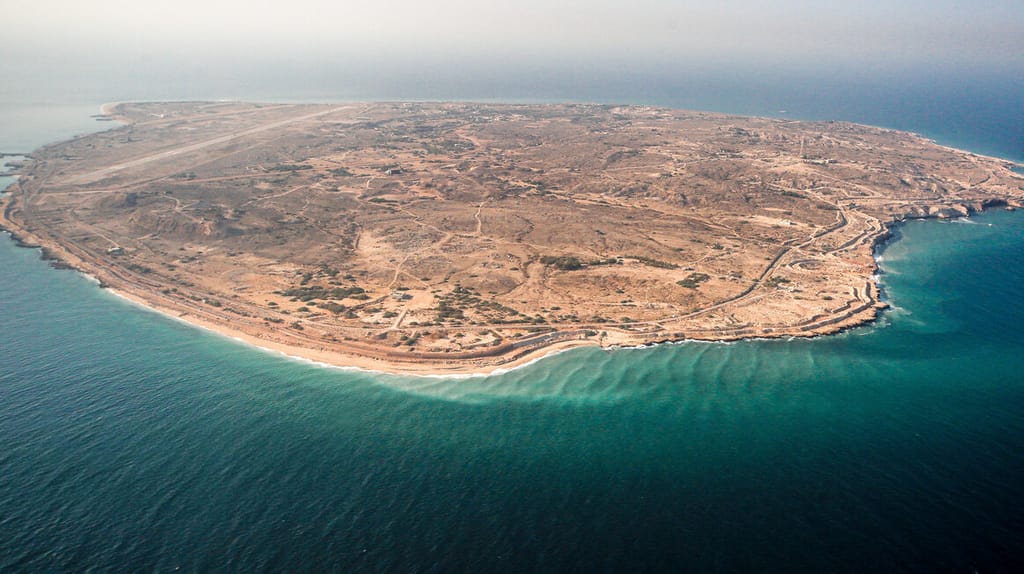
The three islands are also not identical military positions. Abu Musa is the most significant from a civilian standpoint, with a resident population generally estimated at around 2,000 alongside Iranian military facilities. Greater Tunb has a much smaller civilian footprint and an Iranian military presence, while Lesser Tunb is effectively a military outpost. Reliable public estimates of the current strength of the Iranian garrisons on the islands are scarce.
That uncertainty matters in considering military options. Removing an isolated and degraded garrison presents a very different problem from assaulting intact defensive positions. Operations involving Abu Musa would also have to account for its civilian population. Intelligence on surviving forces, civilians, and island defenses would therefore shape how pacification was attempted.
The islands are thus two things at once: disputed territory whose sovereignty remains unresolved and military terrain capable of affecting international navigation. A workable policy must address the latter without pretending to resolve the former.
From Suppression to Pacification
Military action can destroy a missile launcher, radar installation, or drone facility. It cannot determine what happens to the position afterward.
If military infrastructure on the islands were neutralized during a wider conflict and Iranian forces subsequently returned, the problem could regenerate. New systems could replace those destroyed. Surveillance could resume. Fortifications could be rebuilt.
The policy question therefore extends beyond whether the islands constitute legitimate military targets during a conflict. It is what security arrangement should follow their neutralization. Simply destroying military installations provides suppression. It does not necessarily provide security.
Pacification describes the desired condition, not a prescribed method of assault. An opposed amphibious seizure by the United States should not be the automatic next step after strikes against the islands. Once a garrison has been isolated and its military capabilities sufficiently degraded, surviving personnel could first be offered an opportunity to surrender. If they refused, continued isolation, additional strikes, a raid, or ultimately seizure would remain options depending upon conditions at the time.
The distinction is important because territorial possession is not the strategic objective; denial of renewed military use is. Coalition forces do not require the islands as bases for further operations. The requirement is to remove the IRGC military presence and infrastructure and prevent the islands from again becoming forward positions for maritime coercion.
Temporary administration offers a middle course between restoring the military status quo and using military victory to impose a territorial settlement. Military systems could be removed or destroyed, remilitarization prohibited and monitored, and competing sovereignty claims preserved for peaceful resolution.
The strategic benefit is not simply the destruction of weapons. It is denying the positions from which those weapons can repeatedly return.
This also gives the operation an endpoint. Once the IRGC military presence has been removed, the islands demilitarized, and safeguards against renewed military use established, direct American control would be unnecessary. The result would be narrower than conquest but more durable than suppression.
Legal and Diplomatic Obstacles
The proposal carries substantial legal and diplomatic risks.
Iran exercises effective control over the islands while the UAE maintains sovereignty claims. A military operation followed by an externally imposed administration could be interpreted as an attempt to alter territorial control through force rather than as a limited maritime-security measure.
Any temporary authority would need narrow limits. Participation could not confer sovereignty. Existing territorial claims would remain intact. The authority would be responsible for security, demilitarization, essential civil functions, and protection of civilian property and economic activity.
Regional governments may support the security objective while remaining wary of any mechanism that appears to transfer disputed territory through military action. Legitimacy will depend heavily on Arab state participation, preservation of the competing sovereignty claims, and a credible endpoint.
Without that endpoint, temporary administration risks becoming occupation by another name.
Who Governs the Islands?
Several administrative models are possible, but replacing Iranian military control with indefinite American administration would defeat the purpose of the proposal.
United Nations administration would offer formal international legitimacy but could prove politically difficult to establish. A broader multinational coalition would provide greater operational flexibility, yet an administration dominated by outside powers could gradually assume the characteristics of an open-ended foreign occupation.
An Arab-led regional coalition deserves greater consideration. Gulf states could provide the principal administrative and security presence following demilitarization, supported where useful by international observers and technical personnel. No participating state would exercise sovereignty through the coalition, and any forces deployed on the islands would remain limited to security, monitoring, and enforcement of demilitarization.
The UAE would necessarily have an important role because of its sovereignty claims, but participation should not itself constitute recognition of those claims. Involving other Arab states would help distinguish regional security administration from simply transferring disputed territory from one claimant to another.
The underlying principle is straightforward: security on the Arab side of the Gulf should increasingly become an Arab responsibility. American military power should support regional security institutions rather than substitute for them indefinitely. An Arab-led coalition administering the islands, supported by regional maritime forces and backed by American deterrence, would reflect that division of responsibility.
The United States would not need to administer or permanently garrison the islands. Its more useful role would remain outside them. American naval and air forces operating in the wider region could provide intelligence, surveillance, logistics, and credible deterrence against remilitarization without transforming the islands into permanent American bases.
An Iranian attempt to return personnel and military equipment would therefore become a problem of detecting and denying remilitarization, rather than necessarily defending the islands against a conventional counter-invasion.
The coalition would administer and monitor the islands. Regional states would increasingly secure the surrounding maritime environment. American military power would remain available as a strategic backstop.
This arrangement offers an alternative to abandoning the islands after destroying their military infrastructure or turning a limited security operation into an indefinite American occupation.
The Strait After Pacification
The consequences would extend beyond the islands.
The Strait of Hormuz is both a military operating environment and a commercial artery. Changes in its security posture affect naval calculations, shipping schedules, chartering decisions, insurance premiums, energy markets, and perceptions of regional risk.
Removing offensive military infrastructure from forward positions could reduce one source of uncertainty confronting commercial operators. Demilitarization would not eliminate the wider risks of conflict with Iran or guarantee unrestricted navigation. It could, however, reduce the ability to use the islands for surveillance, interdiction, or attacks against maritime traffic.
Greater regional responsibility for maritime security need not mean American disengagement. U.S. naval power, intelligence, logistics, and deterrence would remain important, but in support. American military action would create the conditions for an Arab-led regional security arrangement rather than becoming the arrangement itself.
The islands’ eventual disposition could also reshape the longer-term balance of maritime influence within Hormuz, particularly by limiting the ability of any single coastal state—or combination of states—to impose unilateral conditions upon commercial transit. Decisions made during a conflict could influence the maritime balance for decades afterward.
How Does It End?
The credibility of temporary administration depends upon a simple question: temporary until when?
An arbitrary deadline says little about whether the security problem has been resolved. Termination should instead be conditions-based.
Those conditions could include removal of offensive military infrastructure, a durable monitoring regime, limitations on future military deployments, sufficient regional capacity to maintain the security arrangement, and an accepted diplomatic or legal process through which sovereignty claims can proceed without threatening freedom of navigation.
Once those conditions are satisfied, the temporary authority should leave.
The aim is not permanent foreign control or indefinite demilitarization enforced by American troops. Temporary administration provides a bridge between military action and political settlement.
Conclusion
Abu Musa, Greater Tunb, and Lesser Tunb present a strategic problem that military strikes alone cannot resolve. Offensive systems can be destroyed and military forces removed, but neither action prevents strategically valuable positions from being rebuilt and used again.
Temporary administration offers one possible bridge between military necessity and political settlement. Properly structured, it would neither determine sovereignty nor require permanent American occupation. Its narrower purpose would be to deny renewed IRGC military use while shifting responsibility for the islands’ security toward regional states.
The larger principle extends beyond these islands. Military operations around strategic maritime chokepoints should be judged not only by whether they destroy an immediate threat, but by whether the security arrangement that follows prevents that threat from returning.
If cleared during military operations in support of its war against Iran, the Tunbs and Abu Musa should not become permanent American positions, nor should their ultimate ownership be decided by the United States.
The objective is to pacify the positions, secure the maritime approaches, transfer responsibility to a sustainable Arab-led regional security arrangement, and leave sovereignty to diplomacy.
In that sense, these small islands could become stepping stones—not toward occupation, but toward a more durable security order in the Strait of Hormuz.
Francis J. Bell is a graduate of Temple University’s Fox School of Business. He works as a private consultant with interests in strategy and international security. His writing focuses on maritime doctrine, deterrence, and emerging operational concepts.

that matters most
Get the latest maritime news delivered to your inbox daily.
This article appears courtesy of CIMSEC and may be found in its original form here.
Top image: Greater Tunb (Mehr News / CC BY SA 4.0)
The opinions expressed herein are the author's and not necessarily those of The Maritime Executive.


.jpg)