


Investigating the Hidden Costs of World’s Farmed Seafood
For nearly a decade, the Outlaw Ocean Project, the non-profit journalistic organization that I founded, has produced high-impact investigative stories about lawlessness at sea and the variety of threats posed to the people and biodiversity of a space that covers two thirds of our planet.
The oceans bear a heavy and largely invisible burden. The public usually takes it for granted, a forever self-replenishing resource that we use to fill our stomachs or line our wallets. Our journalism intends to stoke urgency and to help the public reimagine the oceans, less a grocery store than a library or a cathedral, a protected common.
Aquaculture was meant to ease pressure on the oceans. By raising fish, fewer would need to be taken from the wild—or so the logic went. In practice, the opposite has occurred. More than a fifth of all marine life removed from the oceans is used for feed, primarily for farmed fish. And demand for farm-raised fish is increasing. More than half of the seafood eaten globally comes from aquaculture, which is a $313-billion industry and the fastest-growing segment of global food production.
Over the past 5 years, an international team of journalists at The Outlaw Ocean Project examined the largely unaccounted-for toll of using food for feed. We focused on one of the world’s most important feed ingredients: fishmeal.
Consisting of two dozen stories and documentary films, the Food for Feed investigation offers a sobering picture of what fish-farming really entails, including forced labor, avoidable worker deaths, rampant stench, lost livelihoods, civil unrest, illegal fishing, food insecurity and species disappearance. Obscured behind aquaculture’s well-marketed reputation for sustainability and clever, eco-friendly adaptation, most of these ills have remained invisible to the consumers of farmed fish. Until now.
What We Did
The reporting began by identifying the locations of more than 1,400 fishmeal factories across 64 countries—facilities responsible for nearly the entire global supply of this lucrative, protein-rich, dark-yellow powder and its oil counterpart. We assessed more than 2,400 ships tied to fishmeal production, operating in the waters of at least 30 countries.
To do that, we assembled a global network of more than two dozen journalists operating in as many countries. The team included coders who scraped and structured data from government databases and researchers who monitored local reporting, court records, and social media for evidence of labor abuses, environmental violations, community complaints, and other issues linked to fishmeal production.
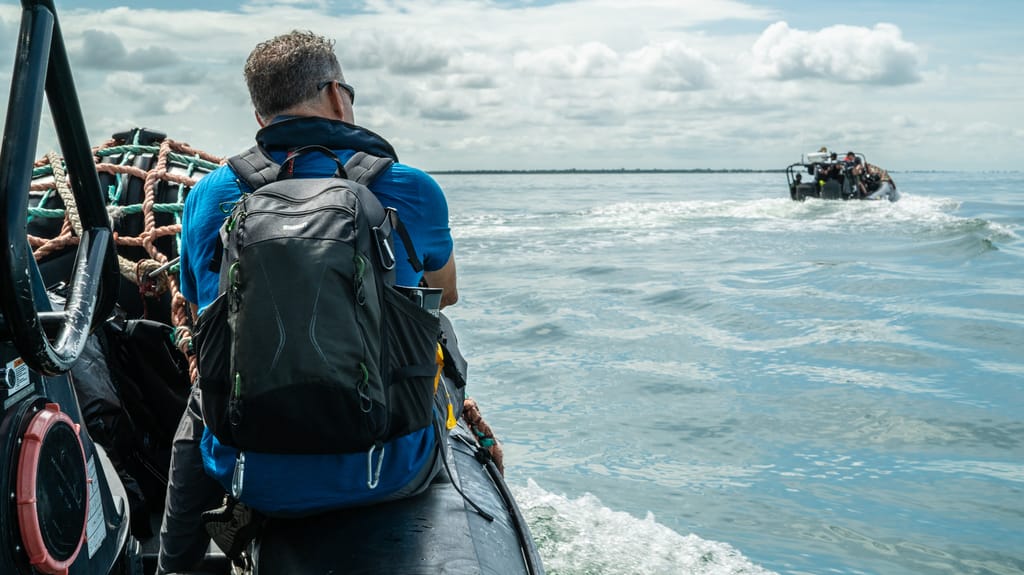
The reporting also involved intensive, on-the-ground work. Reporting teams took six voyages at sea, including the South China Sea, the Southern Ocean near Antarctica, and the North Atlantic Ocean. These expeditions involved boarding fishmeal vessels to review logbooks, inspect living conditions, interview workers, and document potentially illegal practices. On land, reporters visited fishmeal factories and aquaculture sites across Senegal, Thailand, Peru, Gambia, Vietnam, Indonesia, Cambodia, Greece, and India.
Along these supply chains, the investigation documented a wide range of impacts: The depletion of local fish stocks; food insecurity in communities where inexpensive, edible fish is diverted to animal feed; and exposure to hazardous chemicals among residents living near fishmeal plants and waste-dumping sites. The reporting also tracked worker deaths and injuries on fishmeal-associated vessels or in fishmeal plants. The industry impacted the climate by clearing forests of carbon-capturing mangroves and meadows of seagrass to make way for fish farms, and shipping feed to customers thousands of miles away.
To counter these hidden costs and hold the industry accountable, documenting the abuses was only the first step. It was equally important to make the evidence transparent, accessible, and usable by others. To that end, The Outlaw Ocean Project developed several additional tools designed to increase transparency around both our reporting and the fishmeal industry.
The Discussion page documents the correspondence between our journalists and more than 400 companies, government agencies, and certification bodies cited in the reporting. Several months before publication, we contacted each organization, presented them with the relevant findings and methodology, and invited them to respond to specific questions. We published these exchanges in full.
In the stories, we published footnotes that provided the sourcing behind every reported claim, including archived links to all cited documents, news articles, raw data, and web pages.
The methodology page provides a comprehensive public account of the entire investigation’s approach, including the documents, websites, code, and raw data utilized throughout the project. Additionally, case-by-case methodology is offered by way of superscript notes attached to key paragraphs or sections of the investigation.
Bait to Plate
Bait to Plate is an interactive tool that maps seafood supply chains and indicates the crimes and concerns hidden within them. Rather than telling one story or giving one explanation, this tool offers an infinite variety. Think of it as a smart fact-shuffler: it takes tens of thousands of reports from the Outlaw Ocean Project and elsewhere about ships, plants, and companies, then snaps them together like Legos to answer a user’s exact question.
To better navigate Bait to Plate, we created the B2P Bot, which allows users to ask any question they can imagine. The database holds thousands of entities and tens of thousands of connections. A journalist or other researcher who doesn’t know exactly what to look for can spend hours clicking through tables and filters. The B2P Bot allows real-world questions instead. The bot also sees the specific information on a user’s page and what entity they are viewing, and which visualization is open. As a result, a user can ask “What can you tell me about this company?”, and the bot understands the context of the question based on the page the user is on.
The bot has been leashed in ways we think are important. For example, it is limited to foregrounding existing reporting rather than writing its own prose or analysis. The content that it surfaces is always clearly cited to its source type so that a user can discern whether they find that source trustworthy.
What Comes Next

that matters most
Get the latest maritime news delivered to your inbox daily.
Bait to Plate will continue to grow. Daily, staff at the Outlaw Ocean Project culls hundreds of news articles, NGO or government reports pertaining to ships, plants and farms for additional supply-chain mapping. Our goal with this tool is to be a one-stop-shopping reference for journalists, advocates, researchers, law enforcement and company sustainability officers. By sharing data and investigative resources, the Outlaw Ocean Project seeks not only to expose wrongdoing, but to help create the transparency necessary for institutions, companies, and governments to be held accountable.
(The Food for Feed investigation was conducted by an international team of journalists based at The Outlaw Ocean Project.)
The opinions expressed herein are the author's and not necessarily those of The Maritime Executive.
