
Op-Ed: An America-First Approach in Yemen
Riyadh wanted Washington’s help against the Houthis – it has thus far gotten intelligence sharing and little else.
[By Grace Wermenbol]
On May 6, 2025, following a weeks-long bombardment on Houthi targets in Yemen, US President Donald Trump declared the fight to be over.
The Houthis, “a band of individuals with advanced weaponry that were threatening global shipping”, had – according to the US president – “capitulated” and agreed to halt their attacks on maritime traffic in the Red Sea.
In one of the first “America-First” deals of the second Trump administration, the United States had extracted itself from one regional conflict, not fixed it. Despite being threatened with annihilation, the Houthis had suffered limited military degradation. They could also continue fighting Israel, which had been excluded from the agreement. As Trump headed to Saudi Arabia for his first major international trip a week later, observers concluded that Israel had been sidelined and left to confront the Houthi threat alone.
Over a year later, Saudi Arabia now finds itself sidelined and largely alone.
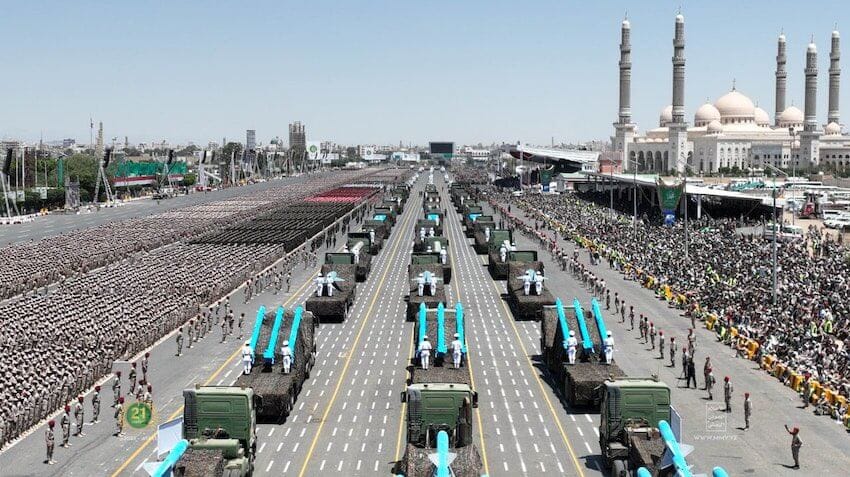
Fighting between the Iran-backed Houthis and Saudi Arabia has reignited in recent weeks, unravelling an informal ceasefire that had been in place since 2022. Recent Houthi attacks have targeted Riyadh and Mecca, as well as critical infrastructure sites, including the East-West oil pipeline and facilities at Yanbu port. The Houthis have also declared a blockade on Saudi-linked vessels in the Red Sea and launched attacks on Saudi ships.
Saudi Arabia, for its part, has sought to disrupt Houthi operations and reinforcement efforts on the Red Sea coast that offer the group strategic control over the Bab-el-Mandab Strait. Alongside Saudi-backed government-aligned forces, Saudi Arabia has conducted hundreds of airstrikes on Houthi positions in south-western Yemen, exacerbating an already-dire humanitarian situation in Yemen.
The escalation on Saudi Arabia’s southern border comes amid heightened pressure on Riyadh. The ongoing US war with Iran, and the latter’s blockade of the Strait of Hormuz, has restricted Saudi Arabia’s oil exports, leading Saudi Arabia to shift some oil exports to a Red Sea bypass – a route that is now being threatened by the Houthis.
Saudi Crown Prince Mohammed bin Salman, Saudi Arabia’s de facto ruler, reportedly called Trump twice in September to request military backing against the Houthis. While Trump offered intelligence sharing and targeting data, the president has so far rejected new US military operations against the group, claiming that the US–Houthi agreement was still in place. For Saudi Arabia, which saw itself designated a major non-NATO ally by Washington following a commitment to invest $1 trillion in the US economy less than a year ago, it has proven a bitter pill to swallow. As one commentator put it, “Riyadh’s bet on Trumpism has failed.”
The US is loath to recommit extensive military resources to Yemen in the near term. Seven months on, the US remains bogged down in a war with Iran that was only supposed to last weeks. The war, which started off seeking regime change, is now centred on finding a solution to the Strait of Hormuz with a new, more hardline Iranian leadership. The White House, meanwhile, faces increased political and public criticism over the war’s staggering costs ahead of the US midterm elections.
Smoke plumes rise over the Aramco oil terminal at Jizan/Jazan, Saudi Arabia, after Houthi missile strikes launched from Yemen. Satellite image 26 July 2026 (Gallo Images/Orbital Horizon/Copernicus Sentinel Data 2026 via Getty Images)
Washington’s prior counter-Houthi efforts presaged the vulnerabilities exposed during the war with Iran. When the Houthis started attacking maritime targets in the Red Sea in the aftermath of the Hamas-led attacks on Israel on 7 October 2023, I was the Middle East Director for Strategic Planning at the US Office of the Director of National Intelligence. The Houthis, even then, were clearly not a ragtag of sandal-wearing rebels: honing the tactics of asymmetric warfare, the group used low-cost drones, cutting Suez Canal traffic by 50% in 2024. Operation Prosperity Guardian, the US-led maritime coalition to secure passage through the Red Sea that began in December 2023, struggled to reverse this – many shipping companies rerouted around Africa via the Cape of Good Hope to avoid higher insurance premiums and Houthi attack. Even months after the Houthis ceased their attacks, traffic was still 60% lower than mid-2023 levels.
Prior campaigns by Washington to attack the Houthi from the air have only had limited effects. By the time Trump declared victory, the Houthis had moved critical assets to underground bunkers while continuing to fire low-cost drones and missiles at ships in the Red Sea. Meanwhile, the US burned through precision munitions, raising further concerns among military planners on stockpiles and readiness in the Indo-Pacific. Just as the Iranians have shown in recent months, the Houthis’ use of precision mass – the deployment of accurate weapons alongside low-cost scalable systems – is a poor match for the limited, costly interceptor systems used by the US and its regional allies.
Saudi Arabia has now pinned its hopes on other partners. France has announced the deployment of troops and radar systems to protect operations at Yanbu to help minimize further energy price hikes. The UK, for its part, has pledged a “purely defensive” effort focused on refuelling Saudi aircraft. Meanwhile, Saudi Arabia’s recently penned military pact with Pakistan and Türkiye has seen its first real test. Even though the pact has not directly had a coherent operational response, Washington’s recent stance will likely only raise its importance for Riyadh.

that matters most
Get the latest maritime news delivered to your inbox daily.
Grace Wermenbol is a senior visiting fellow at the German Marshall Fund, a senior fellow at the Hague Centre for Strategic Studies, and an adjunct professor at Georgetown University. She is the Executive Director of Boussole Mondiale, a boutique geopolitical analysis firm based in Paris.
This article appears courtesy of The Lowy Interpreter and may be found in its original form here.
The opinions expressed herein are the author's and not necessarily those of The Maritime Executive.
