


China Opens New Arctic Trade Route–But Obstacles Will Prevent Its Wider Use
[By Edward Rhys Jones}
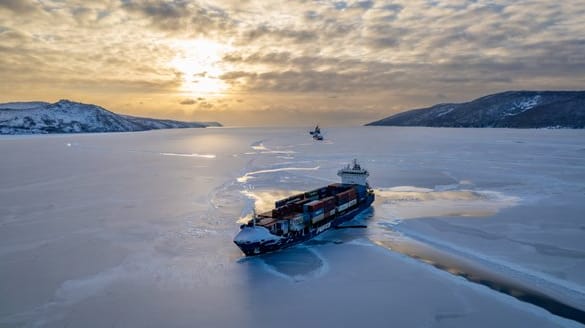
Sea Legend, a Chinese shipping line, recently announced it was launching a regular container service between China and Europe via the Arctic. The announcement follows a trial crossing in 2025 that saw a container ship travel from the port of Ningbo-Zhoushan in eastern China to Felixstowe in the UK in 20 days.
This will not have gone unnoticed in the west. While the Iran war has not halted shipping traffic through the Suez Canal, it has sharply elevated risks around the Red Sea, complicating travel between Europe and Asia. The Arctic’s northern sea route, which shaves up to 40% off the journey, could present a solution. But various obstacles remain.
The northern sea route has stirred the imaginations of policymakers for centuries. During the 1904-05 Russo-Japanese war, Russia was unable to take Japan by surprise by making use of icy Siberian waters. Instead, its Baltic Fleet travelled around southern Africa and across the Indian Ocean to East Asia, where it was crushed by the Japanese Navy in the Tsushima Strait.
With this in mind, Soviet planners after the 1917 revolution set about conducting surveys along Russia’s northern coast. The Soviets came to see the route as necessary for the industrial expansion of Russia’s extreme north and, as the cold war set in from 1945, vital for the construction of military installations.
As cold war tensions wound down, Soviet leader Mikhail Gorbachev suggested in a 1987 speech that the passage be opened for use by foreign ships for the first time. And shortly thereafter the International Northern Sea Route Programme – a collaboration between Japanese, Norwegian and Russian institutions – sought to create a base of scientific and technical knowledge to inform commercial shipping in the region.
The programme’s findings were clear: despite its potential, the northern sea route faced severe physical and technical bottlenecks. Shallow straits along eastern parts of the route and floating ice led to the imposition of size restrictions on the ships that could use it.
At the time, it was calculated that vessels would need to be capped at roughly 20,000-50,000 deadweight tonnage, a measure of the maximum weight a vessel can safely carry. This was considerably less than the 70,000 to 80,000 tonne container ships that were being introduced on other global routes in the late 1990s.
Changing climate
Over the past 30 years, however, climate change has had a severe effect on the Arctic. Warming there has taken place at almost three times the global average, with scientists estimating the Arctic Ocean could have its first ice-free day as early as 2030.
This is devastating news for Arctic wildlife, infrastructure, the global climate and sea levels, as well as the way of life for the region’s 400,000 to 500,000 indigenous inhabitants. But various countries are being drawn to the more “open” northern sea route.
China, Japan and South Korea have all made some reference to the use of the northern sea route in their official Arctic policies. Each is also capable of building the icebreaker vessels that are currently necessary to navigate the Arctic – something the US has struggled with in recent years following decades of declining American shipbuilding capacity.
Earlier in 2026, South Korea passed ambitious legislation to turn its southern port city of Busan into a major Arctic shipping hub. On August 19, it also announced its intention to trial the route using a container ship in September. This has caused a minor stir among European diplomats, because such a test would involve the coordination of Russian authorities.
China has been the most proactive non-Arctic nation in developments related to the northern sea route. For Beijing, the route offers a crucial alternative to the Malacca Strait. China currently relies on this strait for about 80% of its imported oil and a vast share of its trade, and therefore sees it as a major strategic vulnerability.
In 2018, China introduced the Polar Silk Road initiative, linked to its vast Belt and Road initiative. After dozens of test transits on Chinese vessels, primarily between China and Russia, the introduction of Sea Legend’s route represents a turning point from isolated trial voyages to regular services to Europe.
Japan also views the Arctic passage as a vital energy shortcut. Deep-water ports on the islands of Hokkaido and Honshu are geographically primed to serve as major entry points for liquified natural gas from the Arctic. However, Japan maintains a far more cautious approach than its neighbours, reflecting its historically frosty relations with Russia.
Several operational and economic obstacles prevent the Arctic from becoming a mainstream alternative to more conventional shipping routes.
Currently, the northern sea route remains open only during a narrow late-summer window, with ice conditions and weather varying drastically year-to-year. The ships themselves require reinforced hulls, specialised crews and permits. Escorts from Russian icebreakers are also a legal requirement for part of the northern sea route.
At the same time, ships using this route face steep insurance premiums, in part because there is sparse emergency infrastructure if anything goes wrong. While climate change may be expected to ease some of these operational constraints, it will not eliminate the region’s inherent hazards entirely.
Then there is the matter of reputation. Association with Russia is a key reason for European absence from these developments. In that way, the northern sea route remains less of a Suez alternative and more of a seasonal gambit – defined as much by geopolitical ice as the physical kind.
Edward Rhys Jones is a DPhil Candidate in Area Studies, University of Oxford
This article appears courtesy of The Conversation and may be found in its original form here.

that matters most
Get the latest maritime news delivered to your inbox daily.
The opinions expressed herein are the author's and not necessarily those of The Maritime Executive.
