

Russian Navy Back in the Mediterranean Escorting a Cargo Flotilla
The Russian Navy is under increasing pressure, having lost ships in the Black Sea, and stretched further by having to escort sanctioned dark fleet tankers and Russian-flagged merchantmen to deter boardings and seizures. The shortage of ships has been particularly seen in the Baltic, where, as part of the Baltic Sentry standing force, NATO is often deploying over 30 vessels. By contrast, the Russians can monitor activity off their critical ports of Kaliningrad, St Petersburg and the oil terminals of Ust-Luga and Primorsk with just four vessels.
The available Russian force in the Baltic Fleet fell by a further one frigate when the Buyan-M-class corvette RFS Naro-Fominsk (F595) was attacked on November 11 by Ukraine’s SBU, forcing it to limp back home to the Kronstadt naval base.
The shortage of units available for deployment has also been seen in the Mediterranean, where, after the downgrading of its Station 720 facility in Tartus, the Russians have struggled to maintain presence. Until recently, the last vessel seen flying the naval flag of St Andrew was the Udaloy-class anti-submarine warfare destroyer RFS Admiral Levchenko (D605), which escorted the oil products tanker General Skobelev (IMO 9503304), the Ro-Ro cargo vessel Sparta (IMO 9268710) and the oiler Akademik Pashin (IMO 9778193) into Tartus in September.
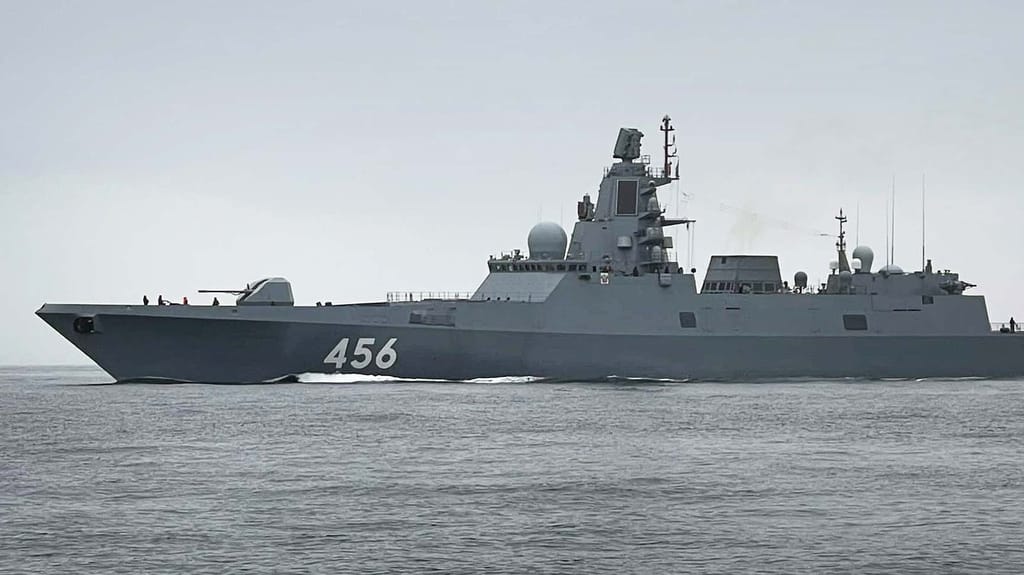
The Russian Navy is now back in the Mediterranean, again on convoy escort duty, with the Admiral Gorshkov-class frigate RFS Admiral Golovko (F456) from the Northern Fleet in the lead. The fill-ins for the now-defunct Mediterranean Flotilla have hitherto been ships provided by the Baltic Fleet, and the Northern Fleet may have been drafted in to help cover the shortage of ships.
On November 18, the Golovko was south of Sardinia, looking as if it might be about to commence a replenishment at sea with the Altay-class oiler Yelnya (IMO 6813095). Keeping company are three sanctioned military cargo vessels, the Lady R (IMO 9161003), Lady D (IMO 9349289) and the Maia-1 (IMO 9358010). These were previously seen forming up in convoy and leaving Baltiysk in Kaliningrad on November 5.
The Golovko is a capable ship, commissioned in December 2023, and fitted with 16 vertical launch tubes for Kalibr, Oniks or Zircon anti-ship cruise missiles, plus a hangar for an onboard Ka-27 helicopter.
The presence of this large convoy off Sardinia is giving rise to some concerns. Italian sources have suggested that, as they made their way south toward the English Channel on their outward journey, the three cargo vessels may have been connected to a 20-minute window of GPS interference which affected approximately 80 aircraft flying in Dutch airspace. A week later, Dutch-built and supplied Ruta cruise missiles were the only foreign weapons used in the Ukrainian attack on the Kerch Bridge.

that matters most
Get the latest maritime news delivered to your inbox daily.
There is also another Russian military cargo convoy still probably elsewhere in the Mediterranean, the first of the two-part convoy of military cargo ships which formed up in Baltiysk at the end of October. The first two ships to leave Baltiysk were the Ascalon (IMO 9198226) and Anastasiia (IMO 9349291), which set off together on October 31 and passed through the Strait of Gibraltar on the evening of November 13.
It is not clear where these two ships are now. But as they were escorted successively en route by the German Coast Guard vessel Bamburg (IMO 9830020), the Danish Coast Guard vessel Merkur (MMSI 219167000), and HDMS Rota (P525), then handed off to the French and Spanish navies, NATO appears to be well set up to be monitoring their current activities and locations. The ships are likely to be unloading in either Algeria or Tobruk, or are possibly on their way to Tartus.