

MARAD Awards $498M in Port Grants as AAPA Calls for New Appropriations
The Maritime Administration (MARAD) announced the recipients of its annual Port Infrastructure Development Program (PIDP). While it is highlighted that the program is delivering funding to 35 projects across 19 states, at a total value of $498 million, it is the lowest level of funding through PIDP in five years and the final advanced appropriations funding for PIDP from the $2.25 billion included in the Bipartisan Infrastructure Law, signed into law by President Joe Biden on November 15, 2021.
The grants are made under the Port Infrastructure Development Program (PIDP), which was authorized by Congress in 2010 and is administered by the Department of Transportation’s Maritime Administration. PIDP aims to modernize America’s ports and strengthen supply chains, helping reduce time and costs for shippers. The U.S. has more than 300 ports operated by states, counties, municipalities, and private corporations, which can apply under the annual grant program.
“The strength of our nation’s economy is directly tied to the state of our ports,” said U.S. Transportation Secretary Sean P. Duffy. “This nearly half-billion-dollar investment will deliver critical upgrades to ports across America so we can enhance supply chains, lower shipping costs, and create good-paying jobs.”
The largest single grant this year was awarded to Whittier, Alaska, which received more than $50.5 million for a project to replace its DeLong Dock with a new 1,150-foot facility. Alaska overall continues to receive a strong share of the total grants. An additional $26 million is awarded to support the Saint Herman Harbor recapitalization program. Anchorage received more than $6.3 million for stevedore facilities.
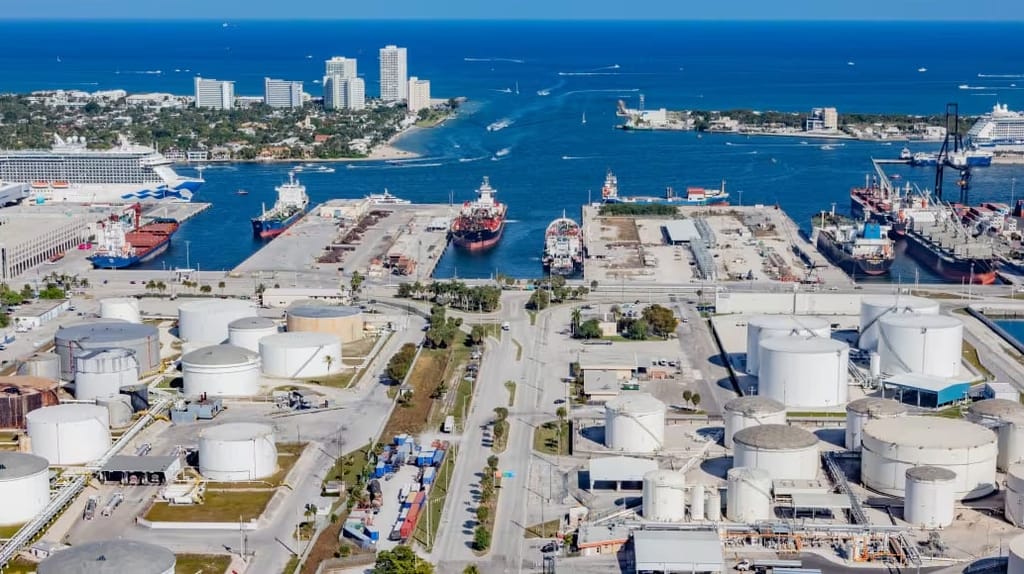
Several projects are each receiving $40 million grants, including efforts to reconstruct the Blount Island Marine Terminal berth in Jacksonville, Florida, and the Port of Kahului cargo yard expansion in Hawaii. Paducah, Kentucky, receives a grant for fixed barge berths and other supporting infrastructure. Port Everglades in Florida receives more than $30.7 million for the relocation and development of Slip 1 at the liquid bulk facility.
While significant, this year's grant total for the PIDP program is lower than in recent years. In April, MARAD highlighted that it was supporting 37 projects with a total of $774 million in grants. The November 2024 awards totalled $580 million for 31 projects, while November 2023 was $653 million for 41 projects, and October 2022 was $703 million for 41 projects.
The American Association of Port Authorities (AAPA) highlights that funding for PIDP is set to decline dramatically next year, barring much-needed Congressional action. AAPA is calling for the next Surface Transportation Reauthorization to include advance appropriations for PIDP so America’s ports have the funding they need to keep the nation’s supply chains strong and fluid.
“Ports don’t want government handouts,” says AAPA. “For every dollar ports apply for in competitive grants from PIDP, they match it with a dollar of state, local, or private investment, averaging a 50 percent non-federal cost share, unlocking significant non-federal infrastructure investment. In the six years since PIDP was created, ports have applied for $4.51 for every $1 that was awarded. If Congress expands PIDP, ports will unlock additional private investment and use taxpayers’ dollars in projects that will bolster the American economy. Without help from Congress in the next Surface Transportation Reauthorization, American ports will have an infrastructure investment deficit of $10.9 billion over the next 5 years.”

that matters most
Get the latest maritime news delivered to your inbox daily.
MARAD Administrator Stephen M. Carmel highlights that the grants are part of the commitment to modernizing the United States' port and maritime infrastructure. MARAD reports that it has delivered nearly $1.4 billion in funding to upgrade America’s ports and marine highways, while other projects include accelerating the modernization of the United States Merchant Marine Academy campus. It is also seeking to streamline environmental reviews for deepwater ports to expand American energy production and is pursuing projects to support innovation into small modular nuclear reactors to create next-generation ship technology.
A full list of the 2026 awards and descriptions of the projects can be found on the MARAD webpage.