

Japanese Integrate Ammonia System with Car Carriers, Supply and Bunkering
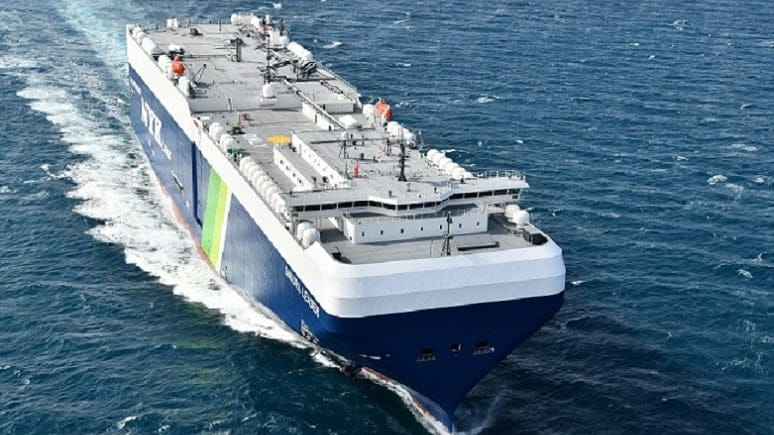
A partnership of Japanese companies plans to develop the first integrated system for the use of ammonia as a marine fuel. The system aligns the development and supply of green ammonia with fuel sales, bunkering, and the operation of ammonia-fueled car carriers to develop a fully integrated system.
The companies believe it will be the first commercial supply chain integrated with applications for ammonia fuel. They report the effort will promote decarbonization while also supporting the broader utilization of ammonia for industrial and other applications.
“By combining their respective technologies, expertise, and infrastructure, the seven companies will establish an advanced integrated business model that brings together ammonia fuel procurement and supply, the construction of ammonia-fueled car carriers, and development of an ammonia bunkering vessel,” the companies wrote in the announcement.
To build the demand and support the development of the full system, NYK and Kawasaki Kisen Kaisha (“K” Line) had agreed to build a total of four car carriers that operate with dual-fuel ammonia engines. Each company will introduce two of the car carriers scheduled for completion in 2030. Imabari Shipbuilding, Shin Kurushima Dockyard Co., and Nihon Shipyard Co. will be responsible for the design and construction of the four vessels.
The announcement did include the size of the vessels but said they will have dual-fuel engines and be capable of trans-Pacific voyages using solely ammonia fuel. They expect the car carriers will transport finished vehicles for customers, including Toyota Motor Corporation.
The supply chain will begin with the production of green ammonia in an effort led by JERA. They noted that the industrial company is already advancing the development of a low-carbon ammonia value chain, including initiatives to use the low-carbon ammonia at the Hekinan Thermal Power Station and a tank truck loading and unloading system. JERA will produce green ammonia with renewable energy coming from regions including India. To support the shipping initiative, JERA will develop new ship loading facilities at the ammonia receiving terminal adjacent to the Hekinan Thermal Power Station. It will establish a stable supply system for the bunkering vessel.
The bunkering vessel will be designed and built by Kyokuyo Shipyard and is also scheduled for completion in 2030 and will be owned/operated by NYK. It will be a specialised, dedicated vessel built with advanced systems to prevent leakage. It will also incorporate equipment designed to address ammonia's toxicity and corrosiveness. Furthermore, it will be designed to support ship-to-ship (STS) bunkering.

that matters most
Get the latest maritime news delivered to your inbox daily.
The project will complete the integration by establishing a fuel sales joint venture. It will be established by NYK and “K” Line.
The seven companies in the initiative report that they aim to establish a stable ammonia fuel supply system through the integrated development of the supply chain. They said this project will be the world’s first commercial supply chain, with the Chubu region of Japan serving as the hub, integrating fuel procurement, supply infrastructure at the Hekinan terminal, and vessel operations.