

Hanwha Transitions Ownership of Philly Shipyard as It Seeks Defense Work
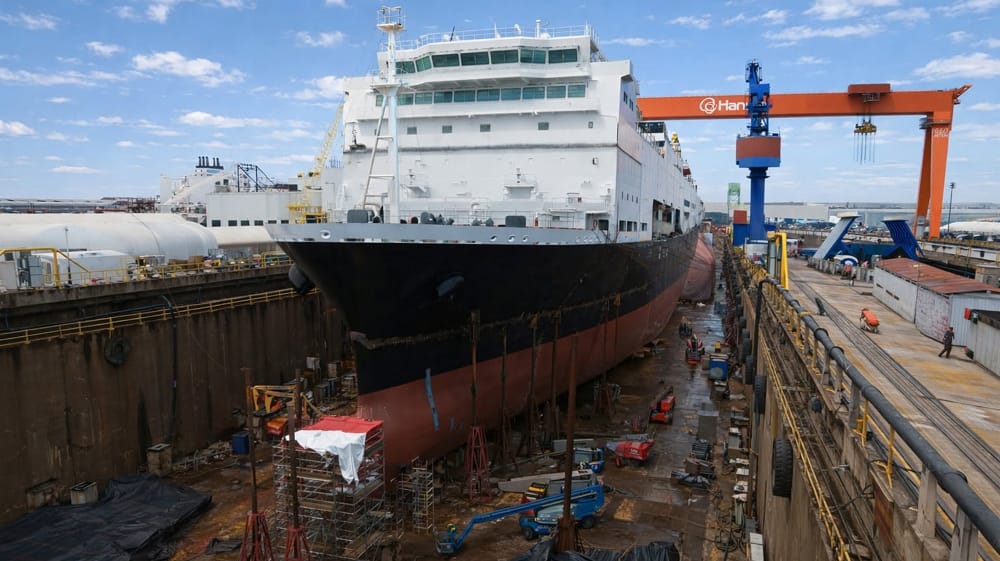
Hanwha Group is reorganizing the ownership and management of the Philly Shipyard, which it acquired nearly two years ago, as it continues to seek U.S. defense naval shipbuilding contracts. It acquired the yard seeking to break into naval shipbuilding in the U.S., and in this latest move, it says it continues to transition toward dual-use for naval and commercial work at the yard.
The group paid approximately $100 million to acquire Philly Shipyard in December 2024, with Hanwha Systems owning 60 percent and the remaining 40 percent owned by Hanwha Ocean, the group’s Korean shipbuilder. Under the terms of the new agreement, the 60 percent share will transfer to Hanwha Defense USA, a subsidiary of Hanwha Aerospace, with RADM Tom Anderson (Ret. U.S. Navy) serving as Hanwha Defense USA President of Shipbuilding.
The company calls the move part of its strategy to strengthen its presence in the U.S. shipbuilding and defense market. It reports its goal is to transition the yard into a dual-use yard building for the U.S. Navy and commercial customers. To that end, Hanwha Defense earlier this year also established a presence at the yard.
“As Hanwha Defense USA continues to grow its multi-domain presence across the U.S., bringing the Philly Shipyard under HDUSA will further align our government and commercial shipbuilding efforts,” said Michael Coulter, President and CEO of Hanwha Defense USA. “We look forward to continuing to invest in our Philly Shipyard facilities and workforce in preparation for exciting work ahead.”
When it acquired the yard in 2024, Hanwha said it wanted to build on its history as having built around 50 percent of all large ocean-going U.S. Jones Act commercial ships since 2000. Established in 1997 at the site of the old Philadelphia Naval Shipyard, the yard built product tankers and containerships before winning the contract to build MARAD’s training ships.
Hanwha has been open about its goal to break into naval shipbuilding in the U.S., although the yard has never done naval shipbuilding. Reports have said it is working toward obtaining full certification for U.S. naval shipbuilding by 2028.
Hanwha has invested approximately $350 million in facility upgrades, according to a recent report in The Wall Street Journal. The company said it has approved an additional $400 million in investment in the yard and, longer term, plans a $5 billion investment in expanding its production capacity and modernizing its operations.
The yard had a long history of financial challenges with losses for seven consecutive years from 2018 to 2024. Reports said Hanwha had six consecutive quarters of losses since the acquisition, including a more than $14 million operating loss in the second quarter of this year. The group has cited Philly Shipyard as one of the factors impacting its overall financial performance.

that matters most
Get the latest maritime news delivered to your inbox daily.
The company has spoken about space constraints at the current site in Philadelphia, along with challenges in labor and training. Media reports from Korea highlight frustrations with high production costs, shortages of supplies, and labor recruitment. Reports have emphasized that the yard lacks a cost-competitive structure with limited commercial newbuilding demand in the United States. Hanwha has doubled the workforce at the yard to 2,500 employees and recently won a U.S. government contract to build three specialized auxiliary vessels, the Missile Range Instrumentation Vessel (MRIV), based on the hull of training ships. Longer term, it has said its goal is to push the yard from its current capacity of 1.5 ships per year to as many as 20 vessels per year.
Hanwha Defense is the same group that in August 2026 made the preliminary, non-binding offer to acquire Austal’s U.S. shipbuilding business. Austal recently said the primary due diligence had been completed and discussions were underway. It extended the due diligence period with Hanwha to address some outstanding issues. Hanwha, however, faces a potential competitor for Austal, as Wildcat Infrastructure also came forward with a separate “non-binding indication of interest” for the U.S. operations of Austal, suggesting a higher valuation than Hanwha.