


The Floating Answer to the Green Steel Challenge
[By Emma Bryce]
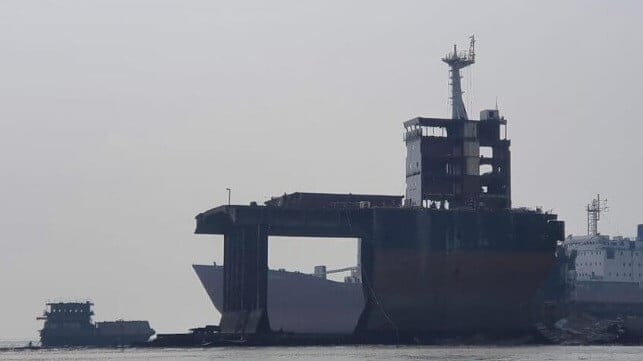
Rushi Kanakiya recycles ships from a 50-meter beachside plot overlooking the sea in Alang, India. Since 1985 his family enterprise, Triveni Shipbreakers, has been receiving and dismantling old vessels here, in the world’s largest shipbreaking yard. Triveni is capable of processing some 2,000 metric tonnes of steel every month.
There is a mind-boggling amount of steel locked up in ships: over 500 million tonnes by one estimate from 2019.
Alang’s 150 or so shipyards have the capacity to recycle roughly one-third of the world’s scrapped ships, according to the NGO Climate Group. They can work on 4.5 million metric tonnes of vessels at one time, claims marketplace platform Alang World. From the steel they recycle, the shipyards send 75-85% of a vessel’s weight back into the shipping, construction and automotive industries.
As countries and steelmakers grow keener to reduce emissions from the industry, shipbreaking has been highlighted as a promising source of scrap steel. This can then be used to feed steelmaking in electric furnaces that produce less emissions than the coal-dependent process used to make virgin steel.
The capacity to recycle these ships “is already in place, there is no multimillion-dollar investment needed”, as there is with other approaches being taken to reduce industrial emissions such as carbon capture and greener fuels, Kanakiya says.
In the coming decade, some 16,000 ships will require recycling, double the number of the previous decade. That could potentially release almost 700 million tonnes of vessels and their steel content into the marketplace.
In spite of this, for now, Kanakiya’s yard lies dormant: “We employ close to 120 people, but that is when we are operational. Currently, we have been without a vessel for more than four years.” His situation reveals a complex wider picture in which markets, international trade and politics complicate the flow of ships to yards, and scrap steel from ships into industry.
The promise of ships’ scrap steel
Most of the world’s vessels are dismantled and recycled far from the countries where the companies that own them are based. As a continent, Europe is the single largest owner of the global shipping fleet, possessing over a third of all ships, and yet just 1% of these are recycled on European Union shores. Over 80% of the global shipping fleet is recycled in South Asia, primarily India, Pakistan and Bangladesh, with ship owners attracted there in part by higher payments for ship steel.
This has concentrated huge amounts of scrap steel in some locations and driven large, domestic industries. In Bangladesh, 40% of steel production comes directly from scrap salvaged from shipyards. In Europe, a significant quantity of low-grade scrap steel is exported while exports of high-grade scrap from some industries are restricted. Yet the continent continues to lose a large amount of quality steel in the form of old ships that are considered more waste than resource.
Several factors are now changing the status and demand for recycled shipping steel.
Steel manufacturing contributes around 11% of global CO2 emissions, and pressure is mounting to use more scrap in production, which can cut emissions by between 80-90% compared to the traditional blast-furnace route. Some steelmakers have been investing in the buildout of electric arc furnaces, which can be fed with 100% recycled steel. Blast furnaces can only incorporate up to 20% scrap, and otherwise require coal-fired processing of iron ore.
The quality of ship steel is especially attractive to the industry: “When big steelmakers are looking for scrap, they start looking into ship recycling, because one ship has thousands of tonnes of steel, and this is high-grade steel,” says Henning Gramann, an international expert in green ship recycling and guest professor at the World Maritime University in Sweden.
BIMCO, one of the world’s largest international shipping associations, notes that the Hong Kong Convention, a treaty brought into force last year, could also help unlock steel from ships – and do so more sustainably. There has long been concern over the environmental and human rights impacts of breaking practices, particularly in South Asia. There, instead of taking place inside contained dry docks, ship-recycling often happens in shallow coastal waters, a practice known as “beaching”. This can lead to hazardous substances leaching directly into the environment.
The convention aims to make shipyards compliant with international environmental and human rights standards. (Kanakiya says operations at his yard already follow the convention’s norms.) Ships carrying the flag of ratifying countries must be sent to compliant yards. With some of the world’s biggest ship-owning nations having ratified, this could create a steadier flow of ships to those yards.
Challenges in the yard
Local conditions mean that scrap steel doesn’t always flow easily from the world’s major shipbreaking hubs into the steelmaking industry.
Kanakiya says the biggest obstacle Indian shipyards currently face is availability of ships, which has ”been consistently coming down” over the past five years. Data shows that annual global ship recycling has declined from 37 million gross tonnes in 2012, to under 5 million by 2024. There are many drivers, but Kanakiya notes ship owners have been finding it more profitable to keep vessels at sea than to scrap them.
Shipbreaking overall suffers from a lack of standardised recycling and traceability requirements. This makes it hard to show that, when recycled, scrap steel is free of hazardous substances and is of the stated quality. That can drive down prices for ship steel and weaken the marketplace for it.
Price has a big impact on where scrap ends up. Indian recyclers have been unable to offer as much for old ships as their neighbors. Bangladeshi and Pakistani competitors have reportedly been prepared to pay more given the countries’ near-total dependence on imports to meet scrap demand. In 2023-24, shipbreaking contributed only between 0.5-2% of India’s 144 million tonnes of steel production, according to a report by the NGO Climate Group India.
The NGO also notes that higher prices in Bangladesh and Pakistan have been enabled by weaker environmental and worker protections. That may shift future trade towards India, where 75% of shipyards have reportedly met the conditions of the Hong Kong Convention, it adds.
EU’s recycling push
On the world stage, experts worry that a shifting regulatory environment may squeeze future global scrap steel supply.
Countries increasingly see scrap steel as a strategic resource for production and decarbonization, one that is threatened by wars, political tensions and trade disputes. In recent years, dozens of countries in Africa, Asia and South America have brought in full or partial bans on scrap steel exports, says Benedetta Mantoan, policy manager at the Brussels-based NGO Shipbreaking Platform. In Brussels, the EU steel lobby is catching on: “They want their members to recognize scrap steel as a kind of critical secondary raw material.”
The EU has also introduced an EU Ship Recycling Regulation (SRR), which could divert more vessels from current recycling hubs. Since 2018, this law has limited where EU-flagged end-of-life vessels can go for recycling, by putting much tighter restrictions on sites using beaching methods, and requiring yards outside the EU to undergo detailed site inspections by third-party auditors. Its requirements are stricter than those under the Hong Kong Convention, and the bloc has approved just 41 shipyards for recycling: 30 in Europe, 10 in Turkey, one in the United States – and none in India, Bangladesh or Pakistan.
Mantoan says a big loophole is that most EU vessels get reflagged to other countries during their voyages. Such “flags of convenience” enable ships to escape scrutiny and the grip of regulations.
“The ratio of ships sent to the beaches hasn’t changed since the entry into force of the EU SRR,” she explains. “Still 90% of the global tonnage [being recycled] is ending up on beaches today.”
NGO Shipbreaking Platform believes that EU regulations do have a critical role to play in this, because they can help build up the bloc’s nascent shipbreaking industry. Last year, together with EU steel and recycling trade lobbies, the NGO called for the SRR to be strengthened with “concrete action” to close the ship-reflagging loophole and to direct all EU vessels to approved yards. They also called for more financing to support EU ship recycling capacity, which could then build the business case for steel companies to buy scrap from local yards.
New recycling yards are planned for Denmark and Germany, and one study indicates that developing a new industrial recycling centre at the German port city of Bremen could take care of 90% of EU ships. Other research, however, found that the list of EU-approved facilities will be insufficient to meet the bloc’s growing ship-recycling demands up to 2050.
According to an analysis by Henning Gramann, who helps shipping companies reach compliance with the Hong Kong Convention, the world will have about 320 HKC-approved recycling facilities in 2035, up from just 129 today. That capacity falls far short of what’s needed to deal with the 16,000 vessels due to be retired by 2035.
Gramann also argues that there is a double standard inherent in the EU’s requirement for stringent third party audits in foreign yards. In the EU, it is left to local administrations to check their own yards using their varying approaches. Some substandard yards in the bloc may therefore go under the radar, he says.
“All these discussions about beaching/no beaching, are not helping. They try to cut off the vast majority of the global ship recycling capacity, and they’re not looking into the standards and quality approaches achieved,” Gramann adds.
Climate Group India notes that many Indian shipyards have made large investments in improving their environmental operations and labour conditions, in a bid for inclusion on EU-approved lists. Many South Asian shipbreakers believe the EU and other ship-owning countries ought to recognise this progress and help build on it rather than shutting them out, it says.
Without enough approved yards, there’s a possibility that future recycling capacity won’t be enough to meet the growing need.
The money issue
If there is one thing everyone involved seems to agree on, it is that solutions are needed to increase recycling and unlock ships’ soon-to-be-available mountains of scrap steel.
South Asian shipbreakers pay three times more for ships than their European counterparts, Mantoan says. “This is the main issue. The missing link is to find a solution for this business equation to work. If steelmakers are not able to pay more for this scrap steel coming from ships, ship recyclers will not be able to offer more.”
One company trying to change this picture is Nordic Circles. The Norwegian enterprise has developed a method to harvest the highest-quality steel plates from ships and sell them directly on to the construction industry after being cleaned and cut to size, with no smelting or processing required. The rest they sell to electric arc furnaces in Europe.
The harvesting not only reduces the recycled steel’s CO2 footprint by 94% compared to virgin steel, but they’re also able to sell their steel for ten times more than when conventionally recycled, says CEO John Jacobsen.
“That’s when we can pay the yards what they need in Europe,” Jacobsen says, the hope being that this will make shipbreaking in the EU more competitive than elsewhere.
The company is currently focused on working with ships in EU-approved yards, but Jacobsen adds: “I would actually love to work with any yard that wants to go in the same direction that we are fighting for.”
Kanakiya worries that what the EU is doing is essentially limiting the global capacity for ship recycling when it is going to be needed more than ever.
Rather than sidestepping hubs like Alang – where the Indian government finds the majority of recycling yards to be compliant with the Hong Kong Convention – major shipowning countries should instead build on their experience, he says.
“We welcome every country to set up whatever capacity they can for ship recycling, which needs to happen at scale. But competitively we do offer something, because we have been in the business for more than 40 years.”
Considering the coming capacity squeeze and the potential of shipbreaking to help the globe decarbonize, undermining any of the world’s recycling facilities is a “scary” prospect, Kanakiya says. “The contribution which this industry is poised to give is too huge.”

that matters most
Get the latest maritime news delivered to your inbox daily.
Emma Bryce is a freelance journalist who covers stories focused on the environment, conservation and climate change.
This article appears courtesy of Dialogue Earth under a CC BY license, and it may be found in its original form here.
The opinions expressed herein are the author's and not necessarily those of The Maritime Executive.
