


Switch to Digital Speeds Up Certification for Commercial Divers
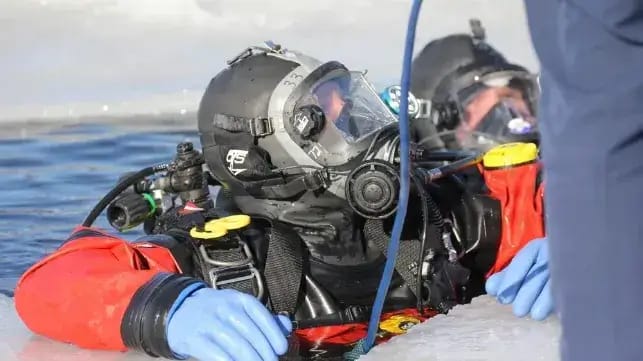
Commercial divers have begun 2026 with an exciting new system for certification. While many of the requirements remain the same, the real upgrade is in digital verification and approval time, which can now be measured in days. This approach is a light speed advancement in efficiency from the previous system in which the credentials of a diver were manually verified, sometimes taking up to 60 days.
To keep this all in perspective, the USCG recommends that mariners start their license renewal process at least 90 days prior to their expiration, though the prudent professional mariner begins the process at least 1 year from expiration. Many mariners still may experience a lapse in their license, especially when one considers the constant looming possibility of a government shutdown, or the constant back and forth of emails requiring additional documentation for sea service letters or medical forms.
The commercial diving industry is not regulated in the same way as mariners; flag states do not issue a credential or license for divers. These come from trade associations, the International Maritime Contractors Association (IMCA) and the Association of Diving Contractors International Inc. (ADCI) being the two most prominent.
Broadly speaking, IMCA is widely recognized by companies that operate or originated in Europe, while the ADCI is the primary association for diving in the United States and Asia. For major companies that routinely utilize diving contractors, the ADCI or IMCA, depending on the region, become almost like a flag state for a maritime operator. The association issues the divers' certifications and helps determine their competence level while also vetting the dive contractor, ensuring that the contractor adheres to the safety consensus standards of the association.
Like flag states, these associations must dedicate an extensive amount of time and effort to manually verify that each and every certificate and credential is authentic and that the recipient of each certification is deserving and adequately prepared for the responsibility that will most certainly come with the new certification.
Falsification of ADCI documentation has been an ongoing issue. The largest concentration of cases comes from Asia, though the problem occurs to varying degrees throughout the world. In response to the antiquated certification process and countless lost time spent distinguishing legitimate documents from fraudulent ones, Phil Newsum, the ADCI's Executive Director, and the association's executive board made the decision to work with Tony Greenwood and the team at Skill N Depth with the intent of getting the ADCI on the path toward digitalization.
"The ADCI is improving the efficiency and vetting process of submitted credentials for applications through a comprehensive digital review of logbook entries and CVs to mitigate fraud," Newsum says.
Skill N Depth is a specialized database platform that was established to address the lack of a reliable, centralized, and verifiable digital record of competence, experience, and compliance. "We have identified a persistent and systemic gap in the occupational diving and marine workforce sector and are providing the industry with a digital infrastructure that supports safety, transparency, and workforce mobility while providing global regulatory compliance," says Jovana Sokolovic, Skill N Depth's COO. The Skill N Depth team consists of divers, diving regulators, safety consultants, and software developers, and they are starting to get results that could become a blueprint for any flag state that issues a marine license.

that matters most
Get the latest maritime news delivered to your inbox daily.
Jovana says that "the distinguishing strength can be simply stated as verification at scale," an attribute that the ADCI is keen to use. The ADCI states that there are 8,699 active diving personnel in its database, with many holding multiple certifications (for example, someone may have a certification for Air Diving Supervisor, Mixed Gas Supervisor, Air Diver, and Mixed Gas Diver). Like mariners, divers must renew their certifications every five years and must pass a rigorous annual dive physical; this is where verification at scale becomes very valuable to the process. With the Skill N Depth platform, individual divers are able to digitally upload their documentation, eliminating the need to carry paper dive logs or keep copies of dive physicals.
Skill N Depth and the ADCI might be on a path that will have the entire marine industry going digital.
The opinions expressed herein are the author's and not necessarily those of The Maritime Executive.
