


From Alternative to Anchor: Charting the LNG Surge in Global Shipping
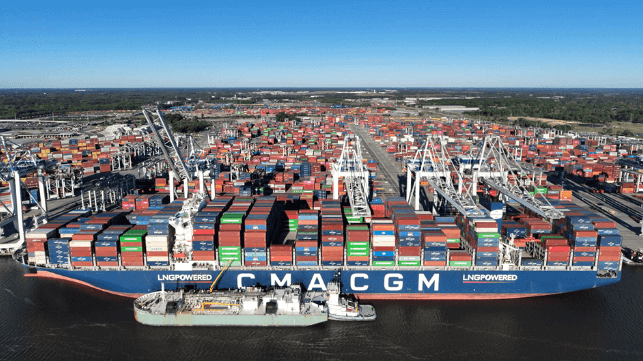
In a seismic era for shipping and global sustainability efforts, the perception of LNG as a marine fuel has shifted dramatically in recent years. Once seen as one of many ‘alternatives’ in the future fuels bucket, LNG together with liquefied biomethane (Bio-LNG/LBM/RNG) are firmly becoming mainstream options for owners and operators looking to decarbonize.
Over the past three years, investment into the fuel has accelerated driven by a number of factors, including:
- Immediate regulatory compliance: LNG, in its fossil form, is currently compliant with both local emissions and greenhouse gas emissions regulations. LNG emits virtually zero SOx, NOx and particulate matter emissions and reduces GHG emissions by up to 23%.
- Pathway for industry decarbonization: The use of RNG reduces GHG emissions by an average of 80% and, depending on feedstock, offers negative emissions of up to -190%. Looking further ahead, e-methane promises a scalable solution for full maritime decarbonization.
- Compelling investment case: LNG dual-fuel vessels provide the lowest cost of compliance with EU regulations, such as FuelEU Maritime and EU ETS, and the IMO’s proposed Net Zero Framework. The optionality dual-fuel vessels provide protects investment returns amid fluctuating regulations and fuel prices.
- Growing availability of bunkers: The infrastructure for LNG and biomethane bunkering is available in over 200 ports worldwide and counting. The LNG bunker vessel fleet is growing rapidly and increasing volumes of the fuel are becoming available on a spot basis.
Increasing industry adoption
Data from DNV shows that the number of LNG fueled vessels has increased from 159 in 2019 to more than 1,400 in operation and on order today. Adoption is seen in all vessel sectors but led by the container sector, car carriers and crude and product tankers. The cruise sector, although relatively small in terms of numbers, has been a highly influential first mover.
The majority of orders in 2025 have been for large and ultra-large container ships which use large volumes of fuel making for a compelling investment case. Examples include recent investments announced by industry giants such as MSC, CMA CGM, Hapag Lloyd and Maersk.
Biomethane bunkering is growing…
LNG bunker volumes grew 4-fold in Singapore between 2023 and 2024; 50% in Rotterdam and 65% in Shanghai. This strong growth has continued into 2025. LNG bunkering is taking off in the US and Canada in ports such as Jacksonville, Canaveral, Miami, Houston, LA/Long Beach, Tacoma and Vancouver.
Similarly, biomethane bunkering has taken off in 2025 driven by companies’ voluntary decarbonization commitments and regulations. Biomethane operations have taken place in key ports across Europe, servicing container lines, the cruise sector, car carriers amongst others over the past 12 months. This trend is extending to the USA which has an established biomethane or RNG market with massive potential for growth.
But what about methane emissions?
Methane emissions, in particular the issue of methane slip in LNG dual-fuel engines, has long been a point of contention for LNG adoption.
High-pressure 2-stroke, diesel-cycle engines which account for approximately 75% of the LNG-fuelled vessel order book have effectively eliminated methane slip. For low-pressure, Otto-cycle engines levels of methane slip have been reduced from 2.5% in 2019 to less than 1.4% today in the 4-stroke technologies and from 1.5% to 0.8% for the 2-strokes. Post combustion abatement technologies are also being piloted.
These technological advances demonstrate that the industry is well on its way to solving the matter of the slip by the end of the decade.
Methane emissions in the LNG supply chain are important, accounting for about 4% of total (Well-to-Wake) GHG emissions. Here LNG suppliers have been making progress on a voluntary basis and in response to regulations, particularly in the US and Europe. Rystad Energy’s recently published definitive study on supply chain GHG emissions finds average Well-to-Tank emissions to be 13.9gCO2eq/MJ, well below the 18.8g default emissions factor adopted by the EU in FuelEU Maritime regulations. Further reductions are expected as supply chains evolve and the use of certification increases.
Looking towards the future
LNG is not a silver bullet. In reality, shipping needs a broad suite of viable options to be made available. Solutions which not only support full decarbonization by 2050, but which cater to changing technological advances, market and geopolitical shifts, investment levels, and of course, infrastructure.

that matters most
Get the latest maritime news delivered to your inbox daily.
Waiting is not an option, and LNG is a pragmatic choice. It is currently the only safe, scalable and commercially viable way for the industry to comply with today’s regulations and meet tomorrow’s compliance targets. Investing in LNG enables the industry to make immediate progress on decarbonization while also providing cleaner air. Then the LNG assets the industry is investing in can incrementally switch to liquefied biomethane and e-methane as these low and zero emission versions of the methane molecule scale.
Steve Esau is Chief Operating Officer at SEA-LNG.
The opinions expressed herein are the author's and not necessarily those of The Maritime Executive.
