


MARPOWER Advances Key Technologies for Maritime Decarbonisation
[By:
Maritime transport remains one of the most challenging sectors to decarbonise due to its high energy requirements, reliance on fossil fuels and the long operational lifetime of vessels. Against this backdrop, the EU-funded MARPOWER project (Efficient zero-emissions gas turbine POWER system for MARitime transport) is developing an advanced gas turbine-based energy conversion system for power generation and cogeneration on board ships, designed to operate with different sustainable fuels while improving overall efficiency.
Two years into the project, the overall cycle and system design has been completed and detailed designs have been developed for its main components. Several critical technologies have also progressed into manufacturing and experimental testing, while the Digital Twin is becoming increasingly detailed. These advances range from optimised compressors and turbines and the successful testing of a combustion chamber prototype with 100% hydrogen to heat recovery technologies, active magnetic bearing systems and increasingly integrated digital models.
Turbomachinery adapted to MARPOWER's system architecture
Efficient operation of the MARPOWER system depends in part on the performance of its compressors and turbines. Designs for both the low- and high-pressure compressors have now been completed, together with the aerodynamic and cooling design of the high-pressure turbine and the design and optimisation of the low-pressure turbine.
Their development has had to take into account several particular characteristics of the MARPOWER architecture. These include its two-shaft configuration, with both spools operating at the same angular speed, and the integration of active magnetic bearings (AMBs), which requires larger clearances to be considered in the aerodynamic design. Fuel flexibility adds another requirement, as operation with different fuels can result in variations in turbine inlet temperature.
The work has also produced dedicated optimisation tools. For the high-pressure turbine, a new procedure was developed to optimise its internal cooling channels. The resulting design was assessed through advanced conjugate heat-transfer simulations and requires a coolant flow rate approximately 15% lower than estimates based on standard literature correlations. The low-pressure turbine has meanwhile been optimised using fully three-dimensional blade shapes tailored to its particular geometry.
With the detailed three-dimensional configurations now available, further work will focus on characterising turbomachinery performance under off-design, transient and fuel-flexible operating conditions.
Developing combustion for fuel flexibility
Fuel flexibility is a central feature of the MARPOWER concept. The system is being developed to accommodate different sustainable and net-zero fuel options, including hydrogen, ammonia, renewable methanol and renewable methane, with limited modifications to the combustion system.
The first MARPOWER combustion chamber prototype has been manufactured, instrumented and successfully tested with 100% hydrogen in an atmospheric test rig, following extensive Computational Fluid Dynamics (CFD) simulations and the build-up of the necessary hydrogen supply and distribution infrastructure.
The experimental results, together with further simulations, are now supporting the design of a second prototype. This includes a flexible air distribution system and further geometry optimisations, intended to increase the fuel flexibility of the combustion system.
Making greater use of available heat
Improving the overall efficiency of MARPOWER depends not only on the performance of the gas turbine itself, but also on making greater use of thermal energy available within and downstream of the cycle. A scaled recuperator prototype has been manufactured and assembled and has passed non-destructive testing and pressure testing at 22.3 bar, around 22 times atmospheric pressure.
The recuperator recovers heat within the gas turbine cycle. Its 1:100 capacity-scale prototype incorporates a new heat-transfer surface geometry, while automated robotic laser welding has been implemented in its manufacture. Preparatory tests have been carried out and final modifications to the test facility are under way ahead of further experimental validation.
The MARPOWER project combines recuperation with a complementary Waste Heat Recovery System to make further use of exhaust heat. The design of this system has been completed, covering the WHR boiler and the associated cycle, including the steam turbine, pump, generator, AMBs and rotor dynamics. Together, these approaches are intended to increase overall efficiency and reduce fuel consumption.
Active magnetic bearings for high-speed machinery MARPOWER's high-speed rotating machinery requires bearing and control technologies capable of supporting the rotor while limiting mechanical wear. Active magnetic bearings (AMBs) support the rotor without conventional mechanical contact and allow its position to be actively controlled, making them an important part of the MARPOWER energy conversion system.
A new axial AMB has been designed, manufactured and integrated into an existing flywheel test rig, where initial rotor impact and recovery tests have been successfully conducted. A multiphysics mathematical model combining rotor dynamics, electromagnetics and the thermal behaviour of the AMBs has also been developed, providing a basis for future model-based control strategies that account for temperature-dependent effects.
The project is also addressing the challenge of testing the 2.7 MW rotor system under ship movements. Similarity theory is being used to develop a smaller rotor reproducing the relevant dynamic characteristics of the full-scale system, together with a hydraulically actuated moving platform capable of reproducing surge, pitch and roll. This will allow rotor dynamics and AMB control to be investigated experimentally under representative movements at a manageable scale and compared with the full-scale system.
In parallel, the high-pressure shaft prototype is progressing through mechanical design, Finite Element Analysis, rotor dynamics and AMB modelling, with work continuing towards manufacturing and subsequent experimental validation.
Bringing the technologies together through a Digital Twin
Understanding how the different MARPOWER technologies interact at system level requires their models and data to be brought together. A first calibrated version of the MARPOWER Digital Twin general model has been established around the selected system design point, with increasingly detailed component information being progressively incorporated.
The simulation workflow has been automated to support systematic studies of different operating conditions, including part-load, non-nominal operation and fuel switching. A first system-level sensitivity analysis has also identified parameters with a significant influence on generated power and thermal efficiency, including turbine inlet temperature, ambient temperature and low-pressure compressor efficiency, helping prioritise subsequent parametric studies.
A dedicated AMB sub-model has also been packaged as a Functional Mock-up Unit (FMU), allowing the rotor dynamics and thermodynamic models to exchange information and run together in co-simulation. As experimental data become available from the different technologies, they will progressively be used to refine and cross-validate the Digital Twin.
Next steps: from individual technologies to maritime integration During the second half of the MARPOWER project, work will increasingly move towards further experimental testing, integration and validation under more representative conditions.
Among the most immediate activities are further testing of the combustion chamber and recuperator, manufacture and assembly of the second combustion chamber prototype, further development and testing of the shaft and AMB configurations, and refinement of the Digital Twin using higher-fidelity component models and experimental data.
The project is also entering the stage in which the complete energy conversion system will be assessed in the context of its integration on board ships. Two case studies will consider reference container and cruise vessels, examining basic engine-room arrangements and using digital simulations to assess energy and emissions performance under different operating scenarios.
The vessel studies will also be relevant to the potential integration of MARPOWER technologies into existing ships. This is particularly important given the long operational lifetime of vessels and the technical and economic challenges involved in incorporating new technologies into the existing fleet. Technical performance alone will not determine the potential applicability of the MARPOWER system. Regulatory compliance activities will assess the proposed technologies against applicable safety regulations, standards and engineering practices, including consideration of an Approval in Principle (AiP) and a Technology Qualification Process (TQP), and support their progression towards future certification.
Further work will address safety and risk, maintenance, Life Cycle Assessment and Life Cycle Costing. Together with the vessel studies and technical validation, these activities will provide a broader basis for assessing the integration, safety, environmental performance and economic implications of the complete MARPOWER system.
Building on MARPOWER's first two years
The results generated during the first half of MARPOWER are also beginning to reach the wider scientific and engineering community. Technical advances from the project have already been presented at relevant international events, including ASME Turbo Expo and IFToMM Rotordynamics 2026. As experimental, modelling and validation activities progress, further results are expected to lead to scientific publications and new conference contributions.
For Professor Jussi Sopanen, MARPOWER Project Coordinator at LUT University, the halfway point marks a transition towards a more integrated phase of the project: “During the first half of MARPOWER, we have advanced the system design, developed key technologies and started generating experimental results. The challenge now is to bring these developments progressively together, extend testing under more representative conditions and generate the evidence needed to assess the complete system and its integration on board ships."
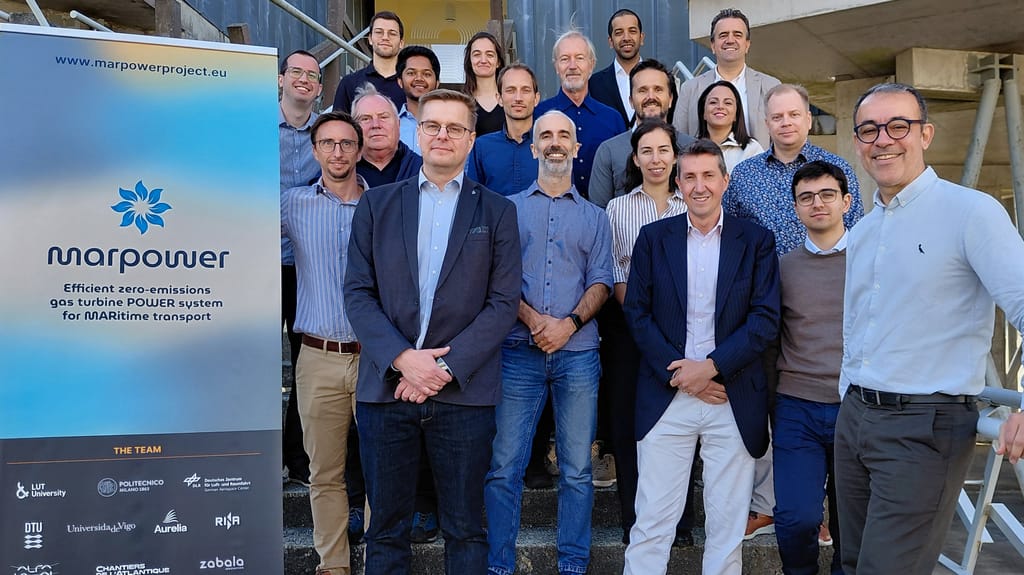
The MARPOWER project brings together eleven partners from six European countries, combining complementary expertise across the technologies and disciplines required to develop and assess the proposed energy conversion system. Coordinated by LUT University, the consortium includes Aurelia Technologies, Alfa Laval, Politecnico di Milano, RINA Consulting, RINA Services, University of Vigo, the German Aerospace Center (DLR), the Technical University of Denmark (DTU), Chantiers de l'Atlantique and Zabala Innovation. The project will continue until August 2028.
The products and services herein described in this press release are not endorsed by The Maritime Executive.
