
World Leaders Call for Restraint After Strikes on Iran
IMO calls on states and shipowners to prioritize the safety of seafarers
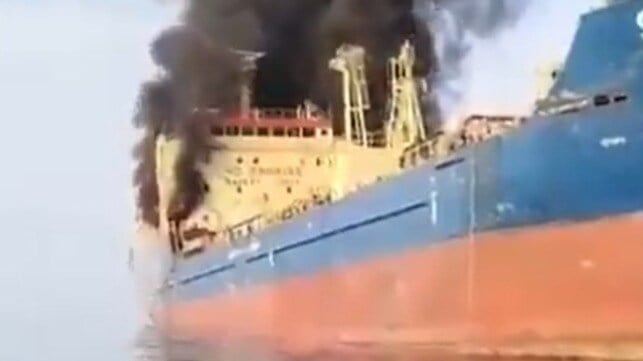
Following multiple Iranian attacks on shipping, resulting in seafarer injuries and at least one shipboard fatality, IMO Secretary General Arsenio Dominguez called for restraint and a cessation of the targeting of merchant vessels.
"No attack on innocent seafarers or civilian shipping is ever justified. These crews are simply doing their jobs and must be protected from the effects of wider geopolitical tensions," Dominguez said in a statement. "Freedom of navigation is a fundamental principle of international maritime law, and it must be respected by all parties, with no exception."
In the meantime, Dominguez called for vessel operators to suspend transits near Iran until the situation has stabilized. He also warned against trusting unverified information, especially when it comes to making navigational decisions. Iranian sources have been broadcasting misleading information and issuing orders over VHF in the Strait of Hormuz.
"My thoughts are with the injured seafarers and their families. Their safety and welfare are our highest priority, and the IMO will continue working closely with Member States and partners to support safe navigation and to uphold the principle that civilian mariners must never be harmed," Dominguez said.
Reactions to the weekend's events have been varied. The UN Secretary-General has condemned all of the various military actions; the EU has condemned only the Iranian response; and China and Russia have only condemned the initial American attack.
"Everything must be done to prevent a further escalation in the Middle East," said UN Secretary General Antonio Guterres in a statement. I condemn the military escalation in the Middle East today. The strikes by the US and Israel against Iran and the subsequent attacks by Iran undermine international security. These actions carry the risk of igniting a chain of events that no one can control in the most volatile region of the world."
Guterres called for a return to diplomatic negotiations and adherence to the terms of the UN Charter. "I reiterate that there is no viable alternative to the peaceful settlement of international disputes, in full accordance with international law," he said. "The Charter provides the foundation for the maintenance of international peace and security."
By contrast, top EU diplomat Kaja Kallas was notably silent on the merits of the American attacks. Instead, she criticized the human rights record of the Ayatollah's regime; its support for terrorist proxy groups throughout the region; its ballistic and nuclear weapons programs; and Sunday's Iranian retaliatory strikes on neighboring states. She also pointed to the new possibilities that the U.S.-Israeli attacks may have opened up for the Iranian people.
"The death of Ali Khamenei is a defining moment in Iran’s history. What comes next is uncertain. But there is now an open path to a different Iran, one that its people may have greater freedom to shape," Kallas said. "The Iranian regime’s indiscriminate attacks against its neighbors carry the risk of dragging the region into a broader war and we condemn this."
Kallas also pledged that Europe's naval mission in the Red Sea is prepared and standing by to respond in the event of renewed Houthi strikes on shipping - a legitimate possibility, as the Iranian-allied militant group has previously warned that it could resume its "blockade" of the Red Sea in the event of an attack on its sponsors in Tehran. Houthi leaders have informed multiple news outlets that they intend to resume strikes, and have received instructions from Iran to carry out attacks.
In their own responses, China and Russia focused their critique on the initial U.S.-Israeli strikes. China's foreign minister, Wang Yi, condemned the attack on Iran and warned against a return to a time when the world was ruled by "the law of the jungle."
"The attacks launched by the United States and Israel against Iran during the US-Iran negotiations are unacceptable; the blatant killing of a sovereign leader and the incitement of regime change are unacceptable," Chinese Foreign Minister Wang Yi said in a statement. "The conflict has now spread throughout the Persian Gulf, and the situation in the Middle East could be pushed into a dangerous abyss. . . . China values ??the security of the Gulf states and supports their restraint."
Russia coordinated its response with China, and warned that interference with shipping in the Persian Gulf could disrupt oil and gas markets. Any shutdown in tanker traffic in the region could help bolster currently-low global energy prices; Russia's federal budget and military spending are heavily dependent upon oil sales, and would benefit from any improved economics resulting from the disruption.

that matters most
Get the latest maritime news delivered to your inbox daily.
"The Russian Federation resolutely and consistently condemns the practice of political assassinations and the 'hunting' of leaders of sovereign states, which contradicts the fundamental principles of civilized interstate relations and grossly violates international law," said the Russian foreign ministry in a statement. "We call for immediate de-escalation, a cessation of hostilities, and a return to the political and diplomatic process."
For its part, Iran's surviving leaders appeared disinclined to back down, and in joint and individual statements, they pledged further retaliation. “We will take revenge on the Americans and Israelis. You have crossed our red line. We will strike you with such terrible blows that you will beg for mercy,” Iranian Parliament Speaker Mohammad Baqer Qalibaf threatened in a statement.
The opinions expressed herein are the author's and not necessarily those of The Maritime Executive.