


Italian Navy Surges Ahead with Carrier TB-3 Strike Drones
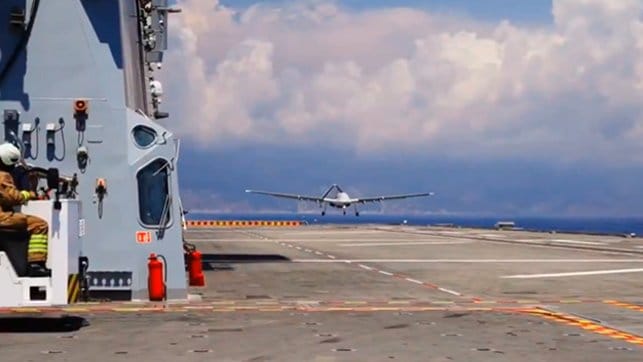
Last year, The Maritime Executive reported on the Turkish Navy and drone manufacturer Bayraktar’s apparent success in mounting TB-3 strike drone missions from the deck of TCG Anadolu (L400), the Turkish Navy’s amphibious assault ship. During Exercise Sea Wolf 2025 held in the Eastern Mediterranean in mid-May 2025, Bayraktar’s TB-3 navalized drones, an upgraded version of the widely-exported TB-2 drone but featuring a retractable undercarriage and folding wings to permit below deck hangar storage, were seen conducting take-offs and landings from the flat top. These same drones were seen carrying out strike missions on ground targets using Rokestan MAM-L precision-guided missiles, which have a 22kg warhead and a stand-off range of 10 miles.
The armed TB-3s took off without catapult assistance using the full 720 feet length of TCG Anadolu’s flight deck and ski ramp, and recovered using about 330 feet of deck. Landings and take-offs were conducted using an autonomous flight control system.
The TB-3 has extremely attractive flight characteristics: long endurance of up to 32 hours, and a range of more than 500 miles at medium altitude. Carrying a multi-mode AESA (Active Electronically Scanned Array) radar, developed for the TB-3 by Turkish company Arselan, a carrier strike group with a constellation of TB-3s could have persistent, wide area surveillance, with redundancy and overlap, plus the capacity to take on, for example, asymmetric warfare targets or coastal anti-ship missile batteries at range. A capability to maintain continuous wide-area surveillance using the TB-3’s radar would be a huge operational enhancement even for navies flying the Hawkeye E2-C surveillance aircraft, let alone for those such as the Royal Navy relying on makeshift helicopter-borne surveillance systems.
The TB-3 was developed in Turkey when it was thought that TB-3s could be deployed on the TCG Anadolu in tandem with F-35Bs. The operational concept was to preserve the F-35Bs for difficult and priority missions, leaving the TB-3s to mount a continuous low-cost overhead surveillance presence, with the capability to engage unsophisticated targets well beyond the range before they could present a close-in engagement threat. But while the Turkish Navy could not realize this dual capability concept, the Italian Navy, with F-35Bs replacing Sea Harriers aboard its light carrier ITS Cavour (C550), was ready to do so.
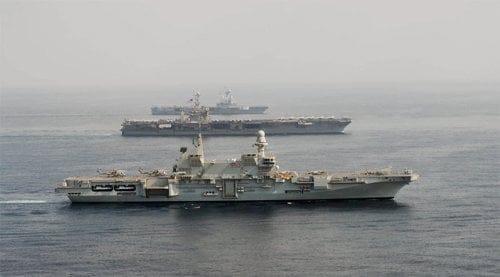
ITS Cavour, alongside USS Harry S. Truman and FS Charles de Gaulle (USN)

that matters most
Get the latest maritime news delivered to your inbox daily.
The Italian TB-3s are being built in Italy in a joint venture with Leonardo, and are due for operational certification this year.
The deployment of Italian TB-3s is a stark illustration of how some navies have adopted the Ukrainian survivalist model of rapid, low-cost procurement, leveraging technical innovation, whilst others string out the development and experimental phase for years without quite managing to find funding for operational deployments. It took a long time for the tank to replace the horse. But in a period of rapid technological change in the nature of warfare, victory usually goes to the side forced to innovate the fastest.
