


War in Yemen Now Impacting the Whole Gulf Region
The Houthis have intensified their attacks on the forces of Yemen’s Internationally Recognized Government (IRG) over the last week but have also widened their campaign by mounting very damaging attacks on infrastructure in Saudi Arabia.
Targeting of civilian airports in Saudi Arabia, which has led to the temporary closure of Riyadh International Airport, places further pressure on transport routes into and out of Saudi Arabia, which have also been exacerbated by continued drone and missile attacks on oil pipelines and port infrastructure on Saudi Arabia’s west coast. These attacks threaten wider commercial interests than just those of Saudi Arabia itself, which has prompted offers of additional support from Saudi allies – but not yet of offensive capability, which would be sufficient to alter the course of the war in Yemen itself.
Within Yemen, the most intense fighting has been concentrated around Taiz, held by the IRG and now under effective siege, but which so far has resisted Houthi incursions into the city itself. A major element of the Houthi campaign has been a persistent psychological warfare attack. But inhabitants of Taiz are resistant, having no tribal or religious connections to the Houthis, who are seen despite the propaganda as alien invaders.
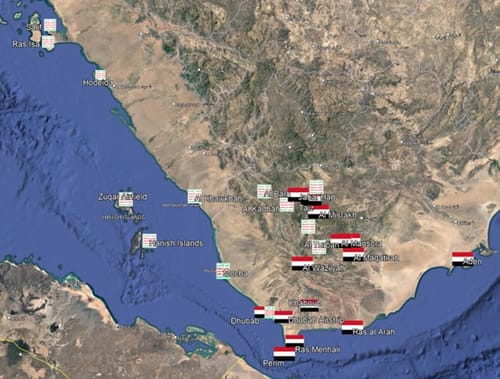
Houthi and Yemeni Government positions in SW Yemen as reflected in reporting on October 16.
(Google Earth/CJRC)
On the south-west coast, now that the situation has somewhat settled, it appears that the IRG counterattack to recapture ground lost earlier in the month to the Houthis was not as successful as advertised earlier. The IRG appears to have made a tenuous repossession of the Ras Menhali peninsula overlooking the Bab el-Mandeb strait at its narrowest, and probably has reclaimed Perim Island as well. But the IRG has not as yet recovered the coastal towns of Dhubab or Mocha, let alone gotten anywhere close to Hodeida.
The Houthis have also retained their capture of the Hanish Islands, which gives them an enhanced ability to threaten shipping in the lower Red Sea using both drones and speedboats – a capability which they are not exploiting for the moment, but will likely do so once they have consolidated any gains they are making in the current war. They also retain the capability to import materials through their ports of Hodeida, Ras Isa and Salif.
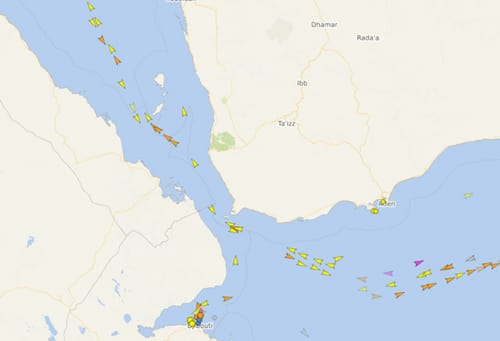
Traffic through the Bab el-Mandeb on October 16 looks thinner than at the same time last week (VesselFinder)

that matters most
Get the latest maritime news delivered to your inbox daily.
The unsettled situation in the southern Red Sea has seen forces that hitherto suppressed the threat of piracy withdrawing from the area. Hitherto, the coastal patrol forces of the National Resistance Forces, operating from Mocha in particular, made regular seizures of material being imported by the Houthis, making circuitous use of routes from Iran and smuggler networks operating from both sides of the southern Red Sea. The same smugglers come from the community, which inclines towards piracy when times are hard, and security forces are not active. Some elements of the National Resistance Force coastal units, which used to patrol these waters, survived and are now being incorporated into the Yemeni Coast Guard based in Aden. They have lost a lot of their radar and surveillance equipment when Mocha was captured by the Houthis, but at least the remnants are now consolidating within the single Yemeni Coast Guard structure rather than being split between two separate chains of command.
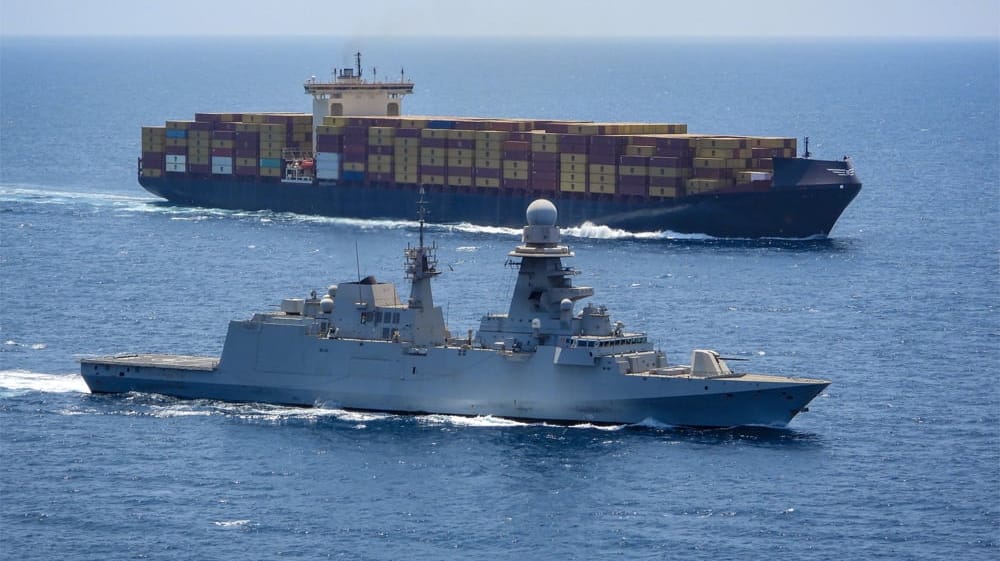
The European Union’s Operations Aspides and Atalanta, the only naval coalitions currently providing support to merchantmen transiting the Bab el-Mandeb, are on alert for an increase in piracy, and recently deterred an attempted pirate seizure of St Vincent & Grenadines-flagged cargo ship MV Glamor (IMO 9177961). The Spanish flagship of the Aspides force is the Santa María Class frigate ESPS Numancia (F83), with the flotilla recently having included three FREMM frigates, the Italian Navy’s ITS Carlo Bergamini (F590) and ITS Luigi Rizzo (F595), and the French Navy’s FS Languedoc (D653). Support was provided by a maritime surveillance aircraft. On October 1, the Languedoc engaged and destroyed a Houthi drone in the Bab el-Mandeb using its OTO Melara 76 mm gun. The drone had been threatening the CMA CGM container ship CMA CGM Champs Elysees (IMO 9839131) and another containership belonging to MSC.
