Dockworkers Worldwide Strike Against Militarization, Wages and More
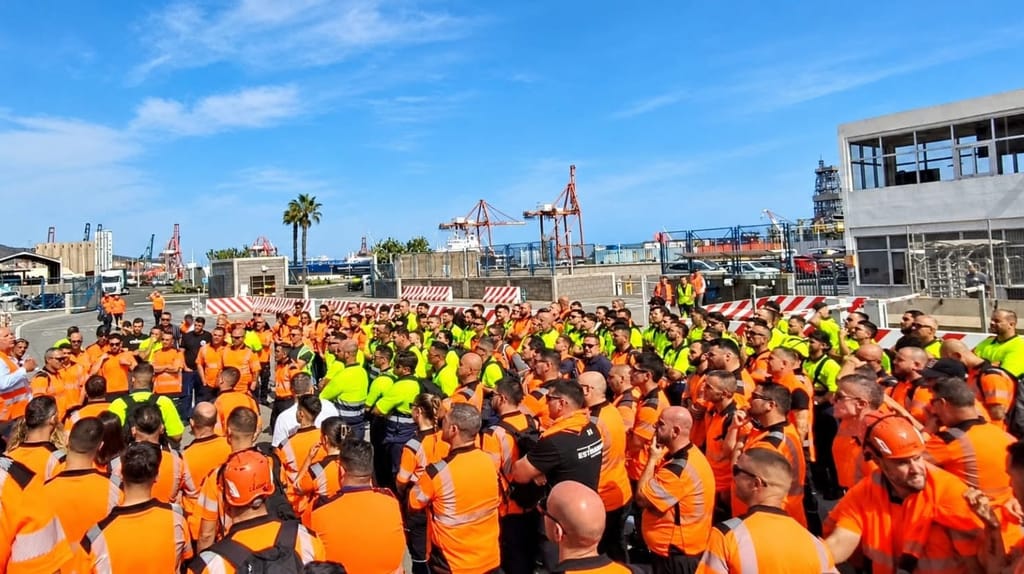
In what is being called the largest action of its kind, dockworkers around the world joined a strike call on Friday that was reportedly impacting as many as 113 ports in 22 countries. What was originally billed by the organizers as an effort against militarization of ports and shipments of war-related cargoes, however, took on a local tone with demonstrations against working conditions, calls for wage increases, and other issues.
Organizers highlighted that for two years dockworkers have stopped cargoes, mostly one ship at a time, to protest military cargoes. They pointed to efforts in Tangier, Piraeus, France, Spain, and elsewhere, using the broad theme “Dockworkers do not work for war.” The individual protests did result in delaying some ships and cargoes while others were diverted. The U.S. Federal Maritime Commission recently announced it is planning penalties against Spain after Maersk Line, Ltd. ships were forced to divert over the suspicion they were carrying military-related cargoes to Israel.
In February 2026, the unions called for their first day of action. The coordinated efforts on February 6 reportedly involved 20 ports in seven countries. Organizers asserted they stopped five suspected ships.
Today’s action also started as a demonstration against militarization and specifically the war in Gaza. However, it quickly expanded to include local issues such as demands in France for increased minimum wages and higher salaries rather than bonuses, which the unions highlighted do not contribute to social security coverage. Other workers demonstrated against their working conditions.
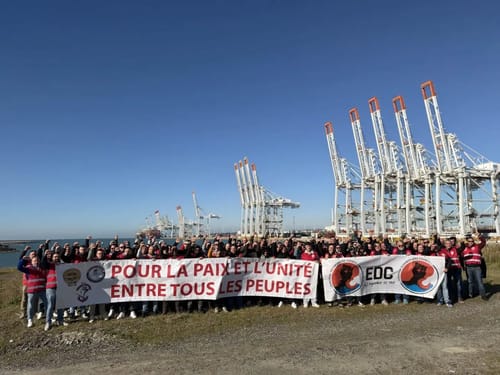
Workers in the Port of Le Havre, France demonstrated and called for increased salaries (European Dockworkers Council)
The European Dockworkers Council led the call for action and reported it would include strikes in France, Italy, Greece, and Turkey, as well as stoppages in Morocco and Cyprus. Later reports said the ILWU in California was joining the effort at the ports of Oakland and San Francisco. The Hamburg chapter of Ver.di was also reported to have joined, while the European Dockworkers Council said it had also expanded to include more countries such as Sweden and Slovenia.
They claimed that the action was impacting ports that collectively handle 13.5 percent of global shipping and 63 percent of container activity. They said the one-day delay would result in costs of $57 million, with $2.8 billion worth of cargo not moving. Organizers claimed in the Mediterranean alone they would disrupt more than 40 percent of cargo.
It was unclear how much impact the action really had, with analysts saying one day would not have a dramatic global impact on supply chains and operations. Several companies, however, had warned of potential delays.

that matters most
Get the latest maritime news delivered to your inbox daily.
There were also some sympathy actions. In Italy, Unione Sindacale di Base called for a 24-hour general strike, but there were reports that the government was ordering workers not to strike and to return to their jobs. In Greece, the seafarers' union also called a strike, and ferries to the islands were disrupted. The French unions said that 24 ports were involved in the action, but it was separate from a nationwide general strike which is now scheduled for November 5.
The organizers predicted that this would not be the last of their coordinated efforts. They asserted that an international dockworkers’ movement is emerging and would continue to strike to stop the militarization of ports and the exports of war-related materials.