


Central Command Settles Into New Battle Rhythm as Reinforcements Arrive
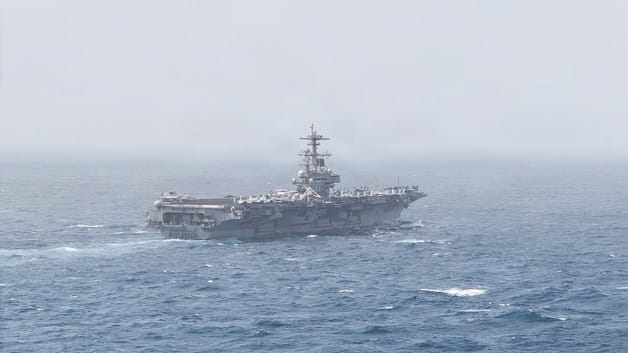
Two weeks ago, when the ceasefire in the Gulf was more or less holding, the Maritime Executive reported that the US Navy was maintaining a forward readiness posture, rotating some assets within theater to give forward deployed units opportunities for rest, resupply and recuperation. The US Air Force was likewise using the relative lull to rotate some forward–deployed units back to continental United States. This force lay-down provided Commander CENTCOM with the immediate means to return fire and to maintain pressure on the IRGC, should the need arise, as well as time for air assets to be brought back from the United States if the conflict was once again flaring up.
Two carrier strike groups remain in theater, flagshipped by USS Abraham Lincoln (CVN-72) - now on a record-breaking deployment - and the USS George H. W. Bush (CVN-77).
USS Boxer (LHD 4), USS Portland (LPD 27) and USS Comstock (LSD 45) with the 11th Marine Expeditionary Unit – incorporating F-35Bs and tactical helicopters, which are of particular utility for defending ships in the strait - are now in theater.
The Tripoli Amphibious Ready Group, consisting of USS Tripoli (LHA 7), USS San Diego (LPD-22) and USS New Orleans (LPD-18) with the 31st Marine Expeditionary Unit embarked, are now being held in reserve. A carrier strike group rotation or reinforcement could be expected to occur sometime soon.
Since the series of incidents over the last 10 days - in which the IRGC fired on shipping in the southern Omani channel in the Strait of Hormuz, as well as ground targets in GCC countries - US forces have concentrated on attacking IRGC targets directly involved in these attacks. At the political level, sanctions and the blockade on Iranian shipping and ports have been re-imposed. In recent days, US attacks have gone a little deeper, to interdict supply routes serving the Hormuz littoral from where the IRGC attacks on shipping are launched. But there has been no expansion of the targeting list into the Tehran area, nor a broadening of the targeting list to include political and military leaders at national level. An attack on a key rail bridge near Aqqala, on Iran’s Transnational North-South Corridor rail route through Turkmenistan, appears to have been a one-off -and possibly a political message to China.
The restraint in the American targeting, probably designed to keep open the possibility of a resumption of the suspended Memorandum of Understanding negotiations, has not been fully mirrored on the IRGC’s side. The IRGC, in addition to attacking US bases in GCC countries and Jordan, has also been attacking infrastructure targets like power and desalination plants in Kuwait. But it is difficult to calibrate going only halfway to war, and the deaths of three American servicemen attacked at Jordan's Muwaffaq Al Salti airbase is the sort of incident which can lead to escalation.
In these circumstances, it is no surprise to see the flow of US Air Force aircraft reversing and now returning to the Central Command theater of operations.
Six F-15E Strike Eagles from RAF Lakenheath’s 48th Fighter Wing were seen on July 18 over France en route to Jordan, supported by two KC-135R operating from Istres. On the same day, seven F-16CM Fighting Falcons from 31st Fighter Wing left Aviano and were refueled by KC-135s out of Naval Air Station Sigonella and (later) out of an air station in Israel. Their destination in the Middle East is unknown.

that matters most
Get the latest maritime news delivered to your inbox daily.
On July 17, nine F-35A Lightnings from RAF Lakenheath, also supported from Istres in France, were noted heading for Saudi Arabia. Earlier in the week, A-10 Warthogs from the 23rd Fighter Wing based at Moody AFB in Georgia were brought back into theater.
These reinforcements do not indicate that the Central Command air campaign is to be widened imminently. The B-52s are not yet back at RAF Fairford, which would be a clearer indication of an intent to widen the campaign. But the reinforcements give CENTCOM commander Admiral Brad Cooper defensive reinforcements and the option to go deeper immediately if the situation deteriorates further.
