


US Coast Guard Plans to Homeport First Two Finnish Icebreakers in Alaska
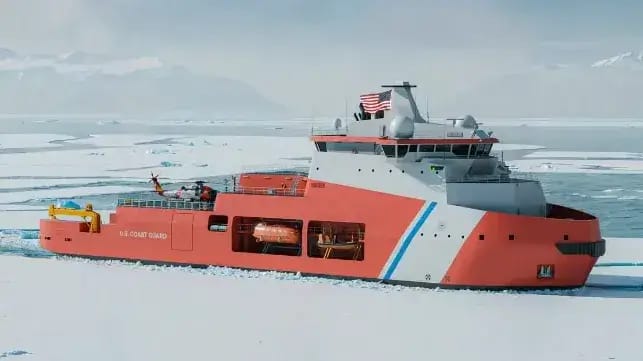
After considerable pressure from Alaska's congressional delegation, the Coast Guard has decided that the first two of its new Finnish-built icebreakers will be homeported in Alaska, where they will be close to sea ice but far from the Lower 48's maintenance infrastructure and housing markets.
The new Arctic Security Cutter is a medium icebreaker program with two designs and two contracting consortia. The first contract award covers up to six hulls and went to Finland's Rauma Marine (two hulls) and Gulf Coast yard Bollinger (four hulls). The second award for up to five hulls went to Canadian shipbuilder Davie and its Finnish subsidiary, Helsinki Shipyard. The first two will be built in Finland, the remaining three at Davie's yards in Port Arthur and Galveston, formerly owned by Gulf Copper. Davie and Helsinki will be working to a different, well-established design. The award will yield two classes of vessel (or variants, per the Coast Guard) in one program of record - not unlike the Littoral Combat Ship (LCS) or the Medium Endurance Cutter (WMEC).
The first two hulls should deliver by the end of 2028; a third vessel could also end up in Alaska, according to the state's congressional delegation. Once commissioned, they will need homeport facilities and housing for crew and support staff, the service emphasized.
“Homeporting these two Arctic Security Cutters in Alaska is a decisive step forward in securing America’s Arctic frontier,” said Secretary of Homeland Security Markwayne Mullin in a statement. “These vessels will deliver the enduring operational presence our nation needs to protect sovereignty, deter foreign adversaries, and safeguard vital resources for the American people.”
Alaska is on the front lines of contact with Russian and Chinese interests in the Arctic, and that competition has been heating up in recent years. Adm. Kevin Lunday, Coast Guard commandant, described the homeporting decision as a strategic choice.
"By strategically positioning these state-of-the-art icebreakers in Alaska, the Coast Guard will maximize our ability to defend our northern border and approaches, while reinforcing America’s maritime dominance in a crucial region," he said.
The Coast Guard is also investing in infrastructure improvements in Juneau, Alaska to accommodate the newly-purchased commercial icebreaker Aiviq, now renamed USCGC Storis. The new base will cost about $300 million - but may not be ready until 2029, Adm. Lunday told a Senate hearing in February.

that matters most
Get the latest maritime news delivered to your inbox daily.
The West Coast's large commercial drydock facilities are concentrated in Seattle, Portland and San Diego, supported by a network of suppliers and well-developed housing and labor markets. Almost all of the large fishing companies, cruise operators and domestic shipping services for the Alaska market are based out of Seattle, the closest metropolis in the Continental U.S. to the northern reaches of the Pacific. Seattle is also the Coast Guard's primary base for icebreakers.
Alaska has a critical housing shortage, a hurdle for opening new operations centers in the state. "In almost every community, housing is an issue, and it’s an issue throughout the whole state," said Sen. Dan Sullivan (R-AK), speaking to the Alaska Beacon. "This is where we need to get the state, the cities, the boroughs also, to come to the table."
