

Trump Says U.S. Will End Naval Blockade of Iran
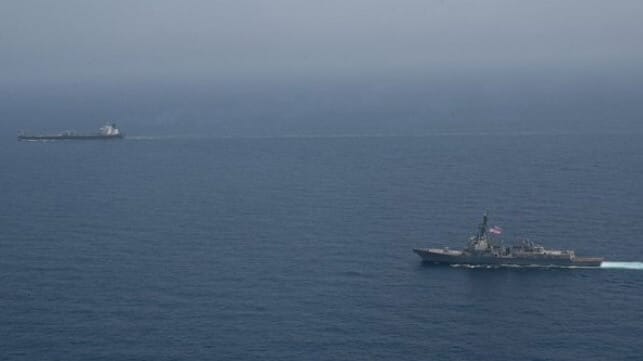
Listing out his conditions for the ceasefire agreement on social media on Friday, Donald Trump said the U.S. would lift its naval blockade. He did not give a timeline, but said ships caught in the region may start the process of “heading home.”
Roughly a quarter of the large oil tankers trapped inside the Persian Gulf at the outbreak of the Iran war have managed to slip out, reports Bloomberg. Based on AIS signals and other data, it believes 29 of the 109 supertankers stuck in the Persian Gulf have either slipped out or gained permission from the Iranians for the transit.
However, traffic through the Strait has continued at a trickle, with even fewer vessels willing to chance a return trip back into the Persian Gulf due to the fears they could become caught. On Friday, the International Energy Agency, International Monetary Fund, World Bank Group, and World Trade Organization issued a statement warning of the lasting impact. In addition to a rapid drawdown of the world’s oil reserves, they warned that the continued disruption was having broad impacts on food and other critical supply chains.
Shortly before Trump’s statement, CENTCOM provided its daily update, reporting that a total of 115 commercial vessels have been redirected to ensure no commerce enters or leaves Iranian ports. While it no longer cites the four vessels that were disabled, it said the enforcement was ongoing. The number of vessels rose by a few each day.
“Ships caught in the Strait due to our amazing and unprecedented naval blockade, which will now be lifted, may start the process of ‘heading home!’ Say HELLO to your wives, husbands, parents, and families…” wrote Trump.
The lifting of the blockade, Trump said, was part of the efforts to fully reopen the Strait of Hormuz. He asserted that Iran had to immediately open the Strait with no tolls, for unrestricted shipping traffic in both directions. He also said the U.S. had already detonated most of the mines, but made another condition that Iran would complete the immediate removal and/or detonation of any mines that are left, while asserting, “which will not be many.”
The key conditions are that Iran will never have a nuclear weapon or bomb, and he asserted the U.S. would “unearth” the enriched uranium, which is buried deep underground in the collapsed structures bombed last year by the United States. He said only the U.S. and China have the mechanical capability to unearth the uranium. He said the International Atomic Energy Agency would also be involved, and the uranium destroyed. He made no mention of Iran’s enrichment capabilities.
No timeline was provided, but he said that he was heading into the Situation Room to meet with advisers. He said he would be making a “final determination.” Trump has not commented, but reports said he left the meeting after two hours and had not reached a decision.
Iran has yet to make a public statement on the terms or if it has agreed to the terms. Hours earlier, a military adviser to Iran’s Supreme Leader Mojtaba Khamenei warned Iran would launch attacks if the U.S. naval blockade “continues beyond a certain timeframe.

that matters most
Get the latest maritime news delivered to your inbox daily.
Experts agree that Iran’s exports of oil have largely been brought to a halt. TankerTrackers.com on Wednesday estimated that “There are close to 60 million barrels of Iranian crude oil trapped by the U.S. Navy blockade. That is nearly $6 billion in oil revenue that currently is not reaching Tehran.”
Iran has repeatedly said that any agreement would have to include a pullback of U.S. forces. The U.S. currently has approximately 20 warships in the region to maintain the line east of the Strait of Hormuz to enforce the blockade that Trump announced in mid-April.