


Victims’ Families Settle on the Eve of the Dali Civil Trial
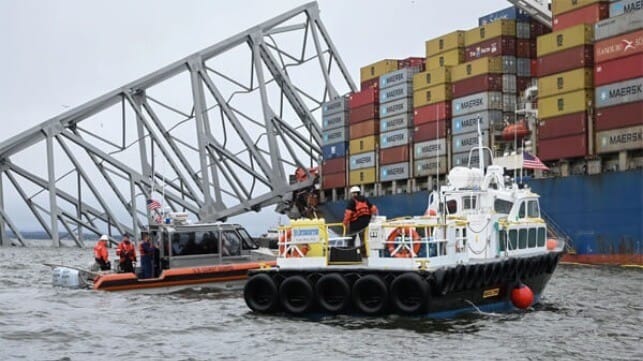
With the civil trial due to start on Monday, June 1, additional settlements were reached with the families of those killed when the containership Dali destroyed the Baltimore roadway bridge, as well as some of the other plaintiffs. Experts have said the trial, which could run three weeks, could be one of the most consequential in U.S. maritime law.
Shortly after the allision in which the containership Dali blacked out and struck the Francis Scott Key Bridge in March 2024, the vessel’s owners, Grace Ocean, and its operators, Synergy Marine, filed with the U.S. District Court to invoke an 1850s law that would let the companies limit their liability to the value of the ship and its cargo. The law has been invoked in historic cases such as the loss of the Atlantic liner Titanic in 1912, and more recently, it was invoked with the Deepwater Horizon. Transocean, the owner of the Deepwater Horizon rig, attempted to invoke the 1851 Limitation of Liability Act to limit its payout to the value of the sunken rig. It attempted to limit the liability to around $27 million, but losing in the courts, it agreed to settle for $1.4 billion in criminal and civil fines to settle its liability.
Grace Ocean and Synergy have asked the court to decide if they can limit the liabilities to just over $40 million. In the first phase of the case, which starts next week in a bench trial, Judge James Bredar will hear the arguments on limitation. The second phase would move on to the individual claims.
Lawyers for five of the six victims of the disaster announced on Thursday, however, that they have reached a settlement and will withdraw from the case. They called it bittersweet, noting that the families still have to deal with the losses, but they could now move on. Six roadworkers died when the bridge collapsed, and a seventh was rescued from the water. One family had previously reached a settlement, and the other five reported they too have come to terms.
In addition to the victims’ families, the Baltimore Banner news outlet reports the road crew’s employer, Brawner Builders, has agreed to a settlement, as has Baltimore Gas and Electric. Earlier, the State of Maryland also reported it had settled for a record $2.25 billion.
Those still pursuing claims in the court include the one survivor. The City of Baltimore and the County also still have claims, as do many local businesses that claimed financial losses from the destruction of the bridge and the closure of the harbor.
The Baltimore Banner reports that five subpoenas were issued to compel individuals to appear in court, but it notes that the crew has invoked its right against self-incrimination. Several crewmembers have been held in Baltimore for more than two years waiting for the trial. Some crewmembers and employees of Synergy Marine also reportedly used their rights during the deposition phase. Synergy Marine has said, based on the criminal charges that were unsealed weeks ago, crewmembers and employees will not come to the United States, fearing they too could be detained or face the potential of additional criminal charges. It said it was unlikely they would testify via video, but it can use the depositions in the trial.
The trial is likely to involve mostly expert witnesses. The court has ruled that the National Transportation Safety Board report is inadmissible, but evidence collected during the investigation can be cited.

that matters most
Get the latest maritime news delivered to your inbox daily.
The case and its outcome will be closely followed for its potential impact on future maritime liability cases. There is the potential that there could be some more settlements before the start of the trial, and still Synergy Marine and one of its technical superintendents have been indicted on criminal charges. In a separate case, the companies are pursuing claims against HD Hyundai Heavy Industries, claiming manufacturing defects in the vessel, which was built in 2015.
