


Traffic Slowly Picking up in the Strait of Hormuz
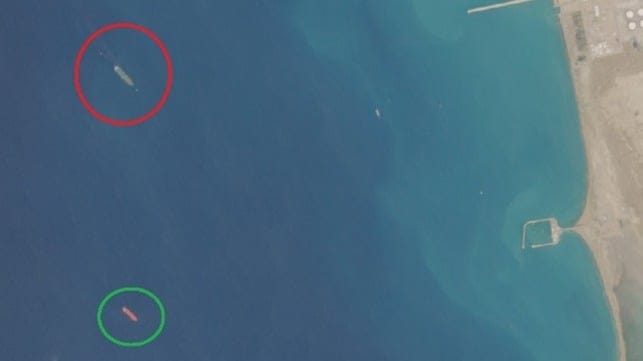
There was evidence on June 16 and 17 that traffic is picking up in the Strait of Hormuz, but it is far from pre-war normals.
The movement on June 16 of three Iranian-owned VLCCs, the NITC tankers Diona (IMO 9569695), Hero2 (IMO 9362073) and the Suezmax Sonia I (IMO 9357365) out of the eastern end of the US naval blockade has already been widely reported.
Inside the Gulf, in a snapshot of the traffic in the area of Larak Island, which shipping must pass if following the Iranian-mandated rules of the so-called Persian Gulf Strait Authority (PGSA), the area is active with groups of fast speed boats - not necessarily indicative of IRGC craft, as civilian trader speedboats often travel in small groups on their way to Khasab in the Musandam Peninsula.
Two 277m Suezmax tankers are both heading out of the Gulf on the PGSA-prescribed route, one rounding Larak Island and the other further to the East still making for the lee of the Iranian Sirik coastline. On June 17, there is still very little traffic moving which is identifiable in AIS tracking data, save for the Maltese-flagged bulk carrier Thalassini (IMO 9286592) moving south in the PGSA’s outward channel. On June 15, the Maltese-flagged LNG carrier Disha (IMO 9250713) made an outward transit en route to India, also with its AIS transponder switched on.
Elsewhere in the Gulf, almost all vessels are static and at anchor.
An unidentified Aframax tanker was loading at the Kooh Mobarak Single Point Mooring (SPM) on the Jask Peninsula on June 15 and 16. This is the first tanker seen loading at the facility since June 1, reflecting its sporadic use during the crisis and suggestive of restrictions in crude flows reaching the terminal from the collection point at Goreh in Bushehr Province. The Guinea-flagged and OFAC-sanctioned Vernon (IMO 9232876) anchored 1.75nm due south of the SPM since May 19, is still not loading.
In the Kharg Island area, there is as yet no evidence of a change to the situation which has prevailed now for several months. Up to June 15 there was no indication in imagery of tankers moving onto loading piers, nor of movement in the large fleet of tankers which are anchored south-west of Kharg Island.
17 JUN 2026@CopernicusEU #Sentinel2 ?????????
— Charlie B (@supbrow) June 17, 2026
Kharg Island ????????
~24 tankers spotted in the anchorage
Around 16 of them are likely laden with ?????????????
They are still loitering here, despite indications that a few other unladen tankers and cargo ships have seemingly crossed the US Blockade… pic.twitter.com/bJKsQ0NotR
Courtesy UANI / Charlie Brown

that matters most
Get the latest maritime news delivered to your inbox daily.
Although traffic generally has not apparently picked up yet, there is ample evidence that both oil and LNG tankers in ballast are pre-positioning towards the Gulf area, in expectation that traffic will resume imminently.
But while there is optimism that shipping movements will restart, the maritime community for the moment is in a wait-and-see mode - until the modalities of future Strait of Hormuz transits become clearer, whether using the 1968 Traffic Separation Scheme, the PGSA system or variations; some clarity may emerge if and when the text of the Memorandum of Understanding (MoU) describing the interim arrangements is released on June 21. The caution has been reinforced by the statement made by President Trump at the G7 conference at Evian that the text of the MoU, scheduled to be released on Friday June 21, is not yet fixed, accompanied by more threats to bomb the Iranians. Moreover, the drafts of the 14-clause MoU which NBC and other US media organizations have published have been disavowed.
