


The Blockade on Iran is Deepening – But Also Widening
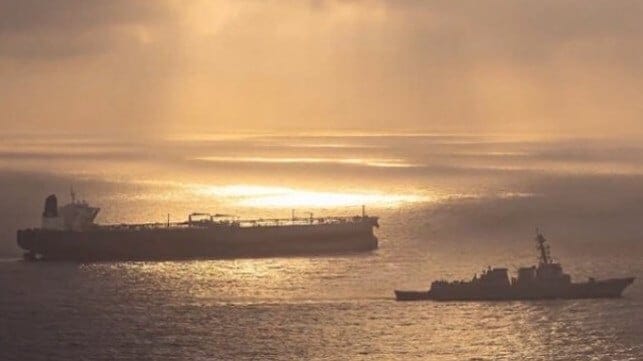
It is generally accepted that the U.S. naval blockade on Iran, targeting both Iranian ships and ports, is nearly 100 percent effective. Iran has not been able to export oil for many weeks, and stocks built up as a contingency reserve before the war are now either exhausted or are nearly run down. The effect is now being felt by the Iranian government, which will be losing approximately 40 percent of the revenues on which its annual budget is based.
U.S. Central Command highlighted on Thursday, October 22, that it was marking 100 days since U.S. forces resumed the naval blockade. As of mid-month, it had said U.S. forces had redirected 138 commercial vessels as part of the effort to ensure strict compliance.
Although not used to transport large volumes of either oil, gas or other goods, sea routes across the Caspian, rail routes through Turkmenistan to China and Russia, and air traffic have all been severely curtailed. The U.S. Treasury’s Operation Economic Fury has also disrupted illicit financial transactions, through which Iran managed to access the international financial system – disrupted, but not entirely halted, because Iranians are adept at avoiding U.S. Treasury restrictions, and probably have several fallback means to transact as back doors are identified and closed down. This has all added to the pressure being imposed by the naval blockade, which is doing most of the heavy lifting and by far the most damage to the Iranian regime’s ability to keep on going. But whatever the disruption, and against this backdrop, it must not be forgotten that the Iranian population is used to hardship and is resilient, even though most Iranians dislike their own government and religious rule.
Iran still has alternative conduits for trading with the outside world – although not so much in oil and gas, where volumes and a lack of infrastructure make it difficult to find alternative routes out of the country, and where the lack of maritime routes is decisive. Iran enjoys land access across its borders to Pakistan, Afghanistan, Turkmenistan, Azerbaijan, Armenia, Turkey, and Iraq. But even here, the interagency approach being adopted by the United States means that use of these land routes is now being curtailed.
To the east, Turkmenistan, Afghanistan, and Pakistan were never the best of friends with Iran, although Pakistan has said that it intends to increase capacity at its border crossing point at Kuhak; plenty of commerce across the border is smuggling, which does not in any case pass through the designated border control points. The border with Pakistan is particularly tense at present, a consequence of a flare-up of counter-regime insurgency in Iran’s southwestern provinces, spearheaded by Sunni Baluch separatists. None of these countries in reality will move quickly to alleviate delays, wary of U.S. oversight. As a warning of potential consequences, the connection into Turkmenistan and thence to China through the Inche-Burun border crossing in Iran’s north-eastern Golestan Province was disrupted by U.S. bombing of the bridge at Aq Tekeh Khan on July 9.
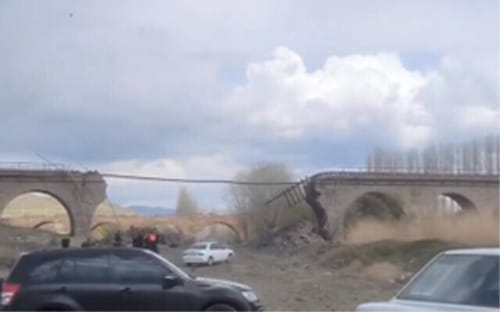
The rail bridge near Aminabad, Isfahan Province, on April 7, 2026
In theory, Azerbaijan could aid Iran by offering increased access through sea, rail and road routes. In theory, Azerbaijan could provide access to Iranian coastal tankers unloading oil products in Baku, at the head of the Cehyan-Tbilisi pipeline. But again, while diplomatic relations are formal and correct, there is no friendship between these two nations to ease open doors. Indeed, Azerbaijan has recently banned the wearing of headscarves in schools, a secularization gesture which will have incensed the Iranians, further soured relationships, and acted as a message to the substantial element of the Azeri minority in Iran’s northern provinces who are at odds with Iran’s religious leadership.
A possible trade route to be opened up might be through Armenia’s Zangezur Corridor, sandwiched between two blocks of Azeri territory. But this is a road route only and of limited capacity, and Armenia will not be seeking to please Iran at the expense of its fledgling relationship with NATO and the United States. What used to be a heavily used rail freight route from Tabriz through Jolfa and thence to Armenia and Russia remains inoperative.
The land routes linking Iran with Turkey have always been important and heavily used. The Turkish official guide to the old Silk Route border crossing at Bazargan, the busiest crossing point, says that over 200,000 trucks use the checkpoint annually. The checkpoint was expanded to 20 truck lanes earlier this year. Although there are now 1,200 daily crossings, up from 200 a day last year, an Iranian official says that waits at the border have doubled in recent months to about five days, and on October 6, over 4000 trucks were waiting to cross the border. Before getting to Bazargan, trucks from Europe have already often had to wait weeks at the Bulgarian-Turkish border before being able to drive on through Turkey to Bazargan. Aside from two other crossing points at Razi and Serow, the border is marked with a guarded 10-foot-high concrete wall. The sole rail route, from Van in Turkey to Tabriz, mostly carrying passenger traffic, was disabled by bridge strikes during the recent war, but by the end of April some services were back in action. From a trade perspective, the controlled nature of the border would make it easy for the Turkish government to close down – if it wished to succumb to U.S. pressure.
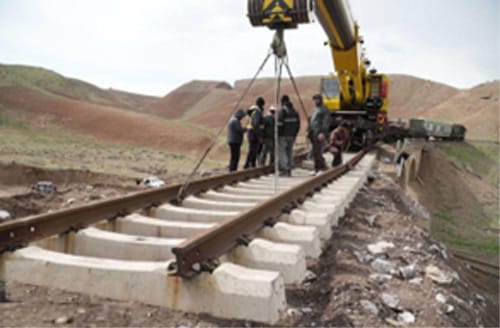
The Iranian railway repair crew swings into action on the mainline from Van to Tabriz
Finally, there are already signs that the Iraqi government is restricting traffic on its border with Iran, in response to U.S. pressure, and in line with the closing down of air routes. The major crossing at Al Sheeb in Maysan has been closed, and Kurdish politicians expect Mandali to be closed soon as well. Even if the Iraqi Border Crossings Authority does close further customs posts, substantial volumes of goods will continue to be smuggled across what is a very porous border, for the benefit generally of ordinary Iranians rather than the government. The Iraqi Prime Minister Ali Faleh Al Zaidi has acknowledged he has been requested by Washington to close the border, but will face opposition and disobedience from pro-Iranian politicians.

that matters most
Get the latest maritime news delivered to your inbox daily.
With the exception of Turkey, where practical difficulties already limit any increased flow of exports and imports, trading through every other Iranian border is either curtailed or restricted. Washington appears to be increasing the pressure on neighboring states to do more. But in any case, only 20% of Iran’s trade has historically traveled across these borders. It is already difficult to switch additional volumes to land routes. Nothing the Iranians can do will be able in any meaningful way to carry more of the 80% of Iranian trade which previously was carried by the merchant marine.
Should open warfare resume, Iran has already been weakened by its inability to import and export since the naval blockade was imposed. Iran, as well as global trade generally, remains entirely dependent on shipping, and the impact of the blockade is growing.
